Category Archives: Alex Sharp

Living-2022

Living-2022

Director Oliver Hermanus

Starring Bill Nighy, Aimee Lou Wood

Scott’s Review #1,380
Reviewed July 20, 2023

Grade: B+

Living (2022) is a British film remake of a Japanese movie named Ikiru, made in 1952. That screenplay was partly inspired by Leo Tolstoy’s 1886 novella The Death of Ivan Ilyich. I have not seen that film, but my best bet is that it is either equal to or superior to Living.

The remake is quiet yet powerful. It teaches a poignant lesson about living life to its fullest and not wasting time on trivial and meaningless things that most people stress over.

Before you know it, life is over.

The brilliance of this message is that it can be applied to anyone’s life at any age and in any given situation. At least that is what I took from the film, and therefore, the film is inspiring to me personally.

In this particular case, the focus is on an older man who has just been diagnosed with terminal cancer and given a maximum of six months to live.

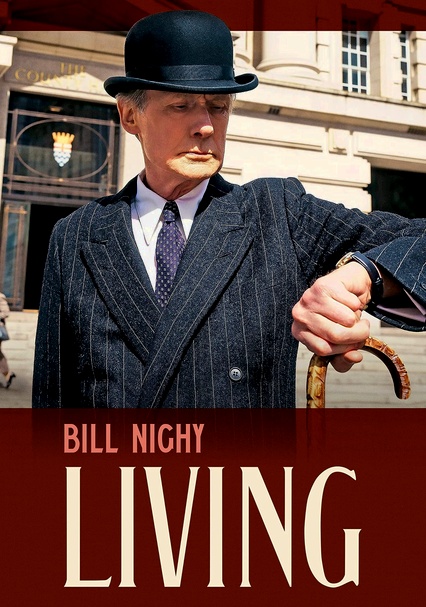
With high reliability, Living tells the story of an ordinary man named Rodney Miller (Bill Nighy) who has so far lived years of dull office work and a careful routine. In other words, he has led a bland existence and rarely does anything exciting.

To be clear, he is not a loser but is quite polished, prim, and proper. Well-dressed, has a good job, and is highly responsible. He resides with his son and daughter-in-law.

Once his doctor gives Mr. Miller his diagnosis, he becomes determined to turn his dull life into something extraordinary with the help of a young office worker, Miss Margaret Harris, played by Aimee Lou Wood.

While the supporting actors are fine, they are not given much to do or explored deeply, except perhaps Wood. She is compelling as a girl-next-door type who bonds with her much older boss. We root for her to find happiness, and she does.

Living works best as a character study, and Nighy quietly takes charge with a ferociously understated performance that justifiably landed him with an Academy Award nomination.

The actor has a gorgeous voice, so very poised, deep, and oozing with polish and sophistication. I fell in love with the character right away, even before his diagnosis with deadly cancer.

He’s not an evil man, just a boring one, and Nighy is successful at showing his appeal. This is evident in his personal life, where he is unable to communicate with his son, despite his desperate desire to do so.

His life has so far avoided any ruffling of feathers that he cannot even adequately express himself.

The film avoids exploring much of Mr. Williams’s personal life, and he has no designs on Miss Harris other than his envy of her joy and passion for life. He does not seem to be gay, but nothing is said about a wife or ex-wife.

The film’s overall pace is slow, which may not appeal to some viewers. Since the running time was merely one hour and forty-two minutes, I wasn’t bored, though I wasn’t energized either, until the ending, which I found moving.

The experience is not a downer despite the subject matter, and no scenes of Mr. Williams dying a painful death or any hospital scenes are featured.

Instead, it portrays life.

The filmmaking is clean and polished, much like Mr. Williams, and there is a rich London texture. Rainy days, a sophisticated swagger, and crisp, structured sets and art design are what I mainly notice.

The title “Living” (2022) is apt for the lesson being presented to the audience. Spend an enormous amount on that savory dinner, eat a giant ice cream sundae, or help someone before looking the other way.

Because one day it will be too late.

Oscar Nominations: Best Actor-Bill Nighy, Best Adapted Screenplay
The Trial of the Chicago 7-2020

The Trial of the Chicago 7-2020

Director Aaron Sorkin

Starring Sacha Baron Cohen, Eddie Redmayne, Joseph Gordon-Levitt

Scott’s Review #1,136

Reviewed April 26, 2021

Grade: B+

The Trial of the Chicago 7 (2020) is a Hollywood film with an important message. It’s conventional and explores a historic episode of great importance, and the story is told well with many liberties taken for effect.

Director Aaron Sorkin sticks to a familiar formula, peppering humor with the standard heavy drama, and creates a film that will appeal to mainstream audiences. He was rewarded with several Oscar nominations for the film.

It’s a crowdpleaser first and foremost.

I would have been bothered more by the traditional approach had the subject matter not been so weighty or not presented in a left-leaning way, which it was.

Solidly anti-war, this made the film more powerful and meaningful, though some of the comedic elements seemed silly and trite, and added to lighten the mood.

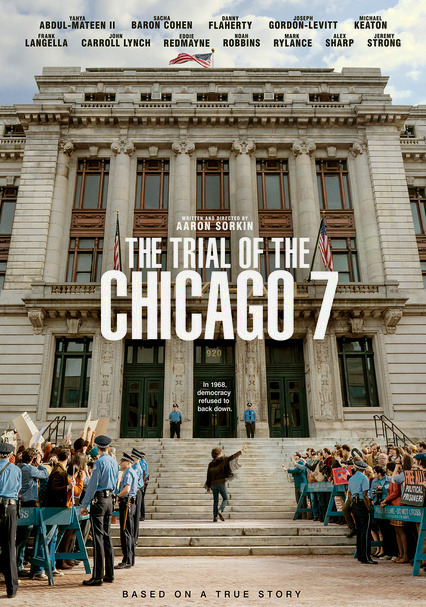
The period is 1969, though the main subject at hand occurs in 1968, so there is much back and forth. After antiwar activists clash with police and National Guardsmen at the important 1968 Democratic National Convention in Chicago, violence erupts.

Charged with conspiracy and inciting to riot, seven of the protestors are put on trial. The charges are controversial because a new president, Richard Nixon, has just been elected, and a revenge-seeking Attorney General lusts for an example to be made of them.

The casting is tremendous.

John Doman is fabulous in the quick role of the evil Attorney General John Mitchell (historians know that he was later a convicted criminal), and Frank Langella makes Judge Julius Hoffman into the asshole he was.

I’ve never been as impressed with Sacha Baron Cohen (or rather, this is the first time I’ve been impressed) as he steamrolls into the role of Abbie Hoffman, a social and political activist.

Eddie Redmayne, John Carroll Lynch, Mark Rylance, and Joseph Gordon-Levitt also deserve praise as either a member of the seven or lawyers for either side.

Whether or not specific accuracy is achieved is not top of mind for me. The Trial of the Chicago 7 provides a historical account of the events that unfolded the night of the riots and the subsequent courtroom proceedings the following year. I’m okay with a few exaggerations for cinema’s sake.

The product is a safe and glossy affair and incredibly slick to the eyes.

The editing is fantastic. Snippets of the real Chicago riots of 1968 are interspersed with the created scenes, creating a sound effect through the back and forth. But before this, real-life comments from Martin Luther King Jr. and Robert Kennedy kick off the action. Both assassinated, their existence is essential to witness before the point at which the film is ever made.

Justice is not always served. Sorkin’s point in including the sequences seems to hit home that there are good politicians out there fighting for truth and fairness.

My favorite scene is the final one. At the end of the trial, Hayden (Redmayne) is given a chance to make a case for a lenient sentence. However, over Judge Hoffman’s objections, Hayden uses his closing remarks to name the 4,752 soldiers who were killed in the Vietnam War since the trial began.

This act prompts many in the court to stand and cheer. Viewers will as well.

The main problem that gnawed at me is the same concern I had when I realized that Sorkin was at the director’s helm. He is a dazzling screenwriter, making the dialogue crisp and rich with intelligence.

But, known for television successes such as The West Wing (1999-2006) and Sports Night (1998-2000), this causes The Trial of the Chicago 7 to look like a made-for-television production versus a raw film experience.

I realize that Sorkin will likely never be a film auteur. Sorkin is the reason that The Trial of the Chicago 7 is a B+ film and not an A film.

The late 1960s were a prominent and sometimes tragic time in United States history. The Trial of the Chicago 7 delves into a pivotal event where several were railroaded and punished for something they did not do.

The film makes sure that the railroaders get their just desserts, and that’s fun to see.

Oscar Nominations: Best Picture, Best Supporting Actor-Sacha Baron Cohen, Best Original Screenplay, Best Cinematography, Best Film Editing, Best Original Song-“Hear My Voice”