Tag Archives: Bert Remsen

California Split-1974

California Split-1974

Director Robert Altman

Starring Elliott Gould, George Segal

Scott’s Review #1,493

Reviewed August 25, 2025

Grade: A-

California Split (1974) is heavily recommended for hardcore Robert Altman enthusiasts as a way of comparing his other, more well-known works with this effort.

It’s a minor film in his vast catalog, but a dissection of the very best of what the director offered the world of cinema and why cinephiles forever love him.

For novice Altman viewers, I’d start with The Long Goodbye (1973), Nashville (1975), or Gosford Park (2001).

Rich with fascinating, mostly minor or even background characters, combined with overlapping, largely improvised dialogue, this is Altman’s sweet spot. The dialogue crackles with brilliance and everyday conversation, especially around the casino tables.

California Split dives headfirst into a sad and sometimes depressing world of casinos, filled with prostitutes, derelicts, robust cashouts, and shattered dreams.

Footloose and fancy free, Charlie Waters (Elliott Gould) rooms with two high-class prostitutes, Barbara Miller (Ann Prentiss) and Susan Peters (Gwen Welles), and lives to gamble.

Along with his more reasonable friend Bill Denny (George Segal), Charlie sets out on a gambling streak in search of the big payday, regardless of the ramifications or hijinks they encounter along the way.

After troubles in Los Angeles, they quickly flock to Reno, Nevada, to see if their luck changes.

While Charlie and Bill have some lucky moments, they also have to contend with serious setbacks like owed debts and stolen money that threaten to derail their lofty ambitions.

California Split is a minor treasure.

Good chemistry exists between Gould and Segal, and they make compelling buddies. Charlie is the yin to Bill’s yang, but Bill is the character I care about most.

Explained to be married but separated, assumed because of his gambling addiction, Segal’s character is conflicted. Unable to help himself, he is nonetheless marginally sensible and aware of his problems.

After winning an enormous payout, instead of celebrating like Charlie does, Bill is instead morose.

He shares a tender moment with Susan, but after a feeble attempt at intimacy, he suddenly bails, leaving her shattered.

While the ladies don’t get as much screen time as the men, Prentiss and Welles also have a strong connection. With lesser acting talents or lesser writing, their characters could have been dismissed as floosies without any merit, but there’s a deeper understanding.

I yearned for more backstory, especially for Susan. Wounded and starved for love, she is my favorite female character.

Characters who appear in just one scene can leave a lasting impression.

The sassy receptionist, the angry, well-dressed woman in a bar who insults Bill with homophobic slurs, the female bartender (Barbara Ruick) in Reno observing Charlie and Bill’s conversations, and the fat lady at the casino table, each is fraught with endless possibilities.

How did each reach their lot in life?

Despite the unique characters and strong chemistry amongst the leads, California Split suffers from some aimlessness.

Occasional scenes are useless and meander incessantly. When the gents engage in a game of basketball with some strangers, there’s really no point to the scene.

The final sequence is compelling but also a letdown, as there is little satisfying climax or explanation of what happens to the characters in the future.

California Split (1974) is triumphant because it proudly celebrates Altman’s unique brand of filmmaking, showing his abilities as an iconoclast in the world of cinema.

It thrives on character over plot and the nuances of human behavior over dramatic story arcs. It displays his improvisational style and his ability to draw the viewer into a seedy world quite willingly.

Though not his most outstanding work, the mere essence of Altman is prevalent, making it a measured success.
Nashville-1975

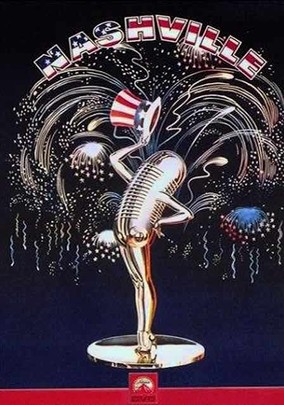
Nashville-1975

Director Robert Altman

Starring Lily Tomlin, Keith Carradine, Karen Black

Top 250 Films #3

Scott’s Review #47

60001541

Reviewed June 19, 2014

Grade: A

Nashville (1975)  is a brilliant film.

I have found that with each subsequent viewing, it creeps higher and higher on my list of favorite movies of all time.

The style is unique (largely improvised) and epitomizes the film’s creative freedom in the 1970s.

Director Robert Altman lets his actors express themselves, even allowing them to write their own songs; the overlapping dialogue creates a natural feel as the viewer watches the cast of twenty-four principals intersect over five days at a political rally/country music festival.

It is pure Robert Altman at his finest.

Nashville is a satire of the political arena of the early 1970s, particularly the Vietnam conflict and its politicians.

The film certainly questions and challenges the government with an ironic patriotic setting (Nashville).

The country music industry was in uproar upon the film’s initial release. It is a layered film that can be discussed and appreciated, with every character cared for.

I cannot adequately describe the multitude of nuances in each scene that are noticed over time.

Each character, even those with limited screen time, is vital to the story, as are the political elements —the questions of war, policies, and so on.

The chaotic bits and individual storylines come together at the end, and many background events are exciting to watch and note throughout each viewing.

With each experience, the audience will notice more and more. I certainly do.

Lily Tomlin, for example, plays Linnea, a haggard mother of deaf children with a supportive husband, a woman who, on the surface, is heroic, yet a complex character. She is bored with her life and falls in love with a young musician despite the guilt and repercussions.

The musician in question is Tom Frank, played by Keith Carradine. Handsome and self-absorbed, he arrives in Nashville to dump his bandmates in hopes of a solo career and beds many willing females.

He also lashes out at a soldier at the airport, saying, “Kill anyone lately?”

Despite his unlikable character, Carradine delivers one of the film’s most beautiful performances when he sings “I’m Easy”.

Several of the female characters assume he is singing the song for them, but who is he truly singing it for — if anyone?

Another character to analyze is Barbara Jean, played by Ronee Blakley. A frail yet very successful country singer, she is in and out of hospitals as she frets that her replacement singer will steal her thunder.

Her insecurities rise to the surface.

Insecurity is a common theme among the characters. Many of them are unsure, afraid, or lack confidence in their musical talent, relationships, or themselves.

These are only three examples of the twenty-four richly layered characters- some ambitious, some falling apart, others meandering through life.

Many songs throughout were written and performed by the actors themselves.

Nashville (1975) is storytelling and filmmaking at its best. A creation by Altman that is deservedly admired, revered, and heralded as a significant influence.

It is studied in film schools as it should be.

Oscar Nominations: 1 win-Best Picture, Best Director-Robert Altman, Best Supporting Actress-Ronee Blakley, Lily Tomlin, Best Original Song-“I’m Easy” (won)

The Player-1992

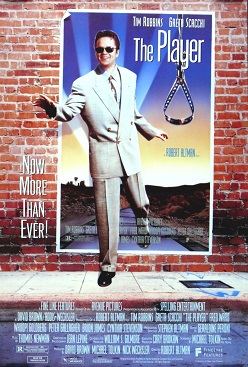
The Player-1992

Director Robert Altman

Starring Tim Robbins, Peter Gallagher

Top 250 Films #181

Scott’s Review #601

Reviewed January 11, 2017

Grade: A

The Player (1992) ranks up there with other Robert Altman classics such as Gosford Park (2001), Nashville (1975), and Short Cuts (1993).

The film is an excellent piece of Hollywood satire and centers around a jaded movie executive, played by Tim Robbins, who does an incredible job with his role.

Robbins plays Griffin Mill, a man with no scruples. Feeling usurped by a younger executive, played by Peter Gallagher, as well as receiving death threats, he goes on the hunt for the person he feels responsible for, which leads to murder.

The audience is unsure whether to love or hate Mill, thanks to Robbin’s performance. He is snarky, but also vulnerable and a tad sympathetic.

The film contains a slew of real Hollywood celebrities (Cher, Malcolm McDowell, Bruce Willis) playing themselves and is largely improvised (as many of Altman’s films are).

Whoopi Goldberg and Lyle Lovett star as odd police detectives.

The plot is nothing that hasn’t been done before, but it’s the realness and the direction that make this movie a must-see, especially for Robert Altman fans.

The Player (1992) is a hidden gem.

Oscar Nominations: Best Director-Robert Altman, Best Screenplay Based on Material Previously Produced or Published, Best Film Editing

Independent Spirit Award Nominations: 1 win-Best Feature (won)

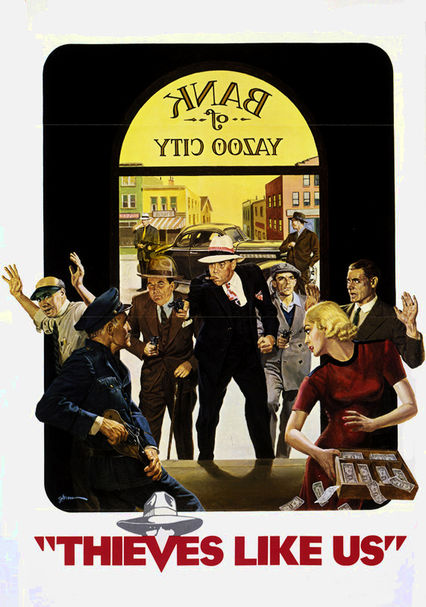
Thieves Like Us-1974

Thieves Like Us-1974

Director Robert Altman

Starring Keith Carradine, Shelley Duvall

Top 250 Films #190

Scott’s Review #1,071

Reviewed October 16, 2020

Grade: A

The first time I saw Thieves Like Us (1974), I was not blown away. I have forgotten what my original gripe was, but my lackluster star rating on Netflix years ago is confirmation of such.

All is now forgiven, and like a fine wine, this film gets better and better with each viewing.

It’s a gangster film, but a heart-wrenching story containing one of the sweetest romances in cinema history.

Based on the novel of the same name by Edward Anderson, director Robert Altman, famous for allowing his actors to ad-lib their lines to their heart’s content and peppering his films with overlapping, “real-life” dialogue, limits this technique this time around.

His stars, Keith Carradine and Shelley Duvall, regular fixtures in his films, are the main attraction, but supporting players like Louise Fletcher, Bert Remsen, and John Schuck give tremendous performances.

Set in the 1930s in the Deep South of Mississippi, the time period and location are key elements of the film’s success.

Having never set foot in this geographical area, I nonetheless found myself escaping there and ruminating on what it would have been like to live there during the Great Depression.

The many outdoor sequences with trees, forests, country roads, and home-cooked meals provide a luminous atmosphere and texture.

Small-town living has never felt so good and cozy.

Wisely, Altman steers clear of any racial overtones or dialogue within the film. The film is not about that.

There appear to be many black characters, mostly in the background, townspeople scenes, or as prisoners, which adds flavor. But they are represented as living among other folks without any aggression or stereotypes.

They are, and it feels like the South.

Altman crafts an experience of understated, good storytelling, proving a quality film can be quiet and proud, not needing explosive bells and whistles to prove showy. The dialogue crackles on its own and is smart.

The plot is compelling. Bowie (Carradine) is an escaped convict who embarks on a crime spree with fellow former prisoners Chicamaw (John Schuck) and T-Dub (Bert Remsen). While in hiding between bank robberies, Bowie meets a young woman named Keechie (Duvall), and the two quickly fall in love.

A life of crime doesn’t sit well with Keechie, however, so she and Bowie try to settle down, but the law is determined to bring him to justice.

The fun is in watching romance blossom between Bowie and Keechie. Despite Bowie being a criminal, his character contains sweetness and purity that match like a glove with the whimsical truth and simplicity of Keechie.

Throughout the film, I compared the characters to the legendary icons Bonnie and Clyde from the self-titled cinema masterpiece.

They are similar but different. The pair sits quietly on the front porch, talking about life and the future, optimistically planning their lives together, unaware of what fate has in store for them. Their innocence and their goofy humor made me fall in love with them.

The relationship between the three men is apt. They have each other’s backs and are loyal to a fault. The men are convicts and cause death and injury, but there is a humanity that Altman gives to each character.

We do not think of them as derelicts.

When Bowie poses as a sheriff to break Chickamaw out of prison, we root for the escape rather than for the warden. Bowie kills the warden, shocking Chickamaw. Even with disputes, there is care between the men.

It does take patience to get into this film; I probably did not give the film its due on my first watch. Once the film ended, I was left with a feeling of having experienced something of value and a visionary, cinematic story.

The homespun characters, eating a feast of meat and southern biscuits and discussing the day’s events, are richly and atmospherically rendered.

Carradine and Duvall would reunite a year later in another Altman masterpiece, Nashville (1975), playing vastly different, both unlikable, characters. Hence, a recommendation is to watch both films back-to-back to appreciate the dizzying, morphed characterization.

Thieves Like Us (1974) is no mere opening act for Nashville but of a different ilk.

The film is a treasure.

A Wedding-1978

A Wedding-1978

Director Robert Altman

Starring Carol Burnett, Mia Farrow, Paul Dooley

Scott’s Review #539

Reviewed December 17, 2016

Grade: A

A Wedding (1978) is an obscure, brilliant gem penned and directed by Robert Altman- a film genius and one of my most adored directors.

I love most of his movies and A Wedding is no exception. The creative way that Altman weaves intersecting storylines and dialogue, thereby creating a real-life tone, gives immense realism to his films.

In A Wedding, he takes a basic life event and turns it into a well-nuanced, fascinating, comical, yet dramatic story.

He is known for having enormous casts (in A Wedding it is forty-eight principles), but every character serves a purpose.

The viewer will feel that they are a fly on the wall of a real wedding.

Altman’s actors primarily improvise the dialogue, speaking at the same time, bringing a realistic edge. I adore this quality.

The film is a satire- people either love or loathe attending weddings and Altman’s film caters to the latter. He creates a setting, from the ceremony to the reception, riddled with awkward moments, and social guffaws.

In pure satirical, soap opera fashion, two wealthy families gather at a lavish estate for the ceremony to commence. Hilarity ensues when the corpse of the matriarch of one family lies in her bed, nobody realizing she is dead.

Other hi-jinks, such as the revelation of a nude, life-size portrait of the bride, the caterer falling ill, and a tornado wreaking havoc.

Slowly, secrets are revealed by the families, as the alcohol flows and the characters become involved in the perilous situations.

Altman does it again as he creates a masterpiece based on real-life situations that most can relate to.