Category Archives: George Segal

California Split-1974

California Split-1974

Director Robert Altman

Starring Elliott Gould, George Segal

Scott’s Review #1,493

Reviewed August 25, 2025

Grade: A-

California Split (1974) is heavily recommended for hardcore Robert Altman enthusiasts as a way of comparing his other, more well-known works with this effort.

It’s a minor film in his vast catalog, but a dissection of the very best of what the director offered the world of cinema and why cinephiles forever love him.

For novice Altman viewers, I’d start with The Long Goodbye (1973), Nashville (1975), or Gosford Park (2001).

Rich with fascinating, mostly minor or even background characters, combined with overlapping, largely improvised dialogue, this is Altman’s sweet spot. The dialogue crackles with brilliance and everyday conversation, especially around the casino tables.

California Split dives headfirst into a sad and sometimes depressing world of casinos, filled with prostitutes, derelicts, robust cashouts, and shattered dreams.

Footloose and fancy free, Charlie Waters (Elliott Gould) rooms with two high-class prostitutes, Barbara Miller (Ann Prentiss) and Susan Peters (Gwen Welles), and lives to gamble.

Along with his more reasonable friend Bill Denny (George Segal), Charlie sets out on a gambling streak in search of the big payday, regardless of the ramifications or hijinks they encounter along the way.

After troubles in Los Angeles, they quickly flock to Reno, Nevada, to see if their luck changes.

While Charlie and Bill have some lucky moments, they also have to contend with serious setbacks like owed debts and stolen money that threaten to derail their lofty ambitions.

California Split is a minor treasure.

Good chemistry exists between Gould and Segal, and they make compelling buddies. Charlie is the yin to Bill’s yang, but Bill is the character I care about most.

Explained to be married but separated, assumed because of his gambling addiction, Segal’s character is conflicted. Unable to help himself, he is nonetheless marginally sensible and aware of his problems.

After winning an enormous payout, instead of celebrating like Charlie does, Bill is instead morose.

He shares a tender moment with Susan, but after a feeble attempt at intimacy, he suddenly bails, leaving her shattered.

While the ladies don’t get as much screen time as the men, Prentiss and Welles also have a strong connection. With lesser acting talents or lesser writing, their characters could have been dismissed as floosies without any merit, but there’s a deeper understanding.

I yearned for more backstory, especially for Susan. Wounded and starved for love, she is my favorite female character.

Characters who appear in just one scene can leave a lasting impression.

The sassy receptionist, the angry, well-dressed woman in a bar who insults Bill with homophobic slurs, the female bartender (Barbara Ruick) in Reno observing Charlie and Bill’s conversations, and the fat lady at the casino table, each is fraught with endless possibilities.

How did each reach their lot in life?

Despite the unique characters and strong chemistry amongst the leads, California Split suffers from some aimlessness.

Occasional scenes are useless and meander incessantly. When the gents engage in a game of basketball with some strangers, there’s really no point to the scene.

The final sequence is compelling but also a letdown, as there is little satisfying climax or explanation of what happens to the characters in the future.

California Split (1974) is triumphant because it proudly celebrates Altman’s unique brand of filmmaking, showing his abilities as an iconoclast in the world of cinema.

It thrives on character over plot and the nuances of human behavior over dramatic story arcs. It displays his improvisational style and his ability to draw the viewer into a seedy world quite willingly.

Though not his most outstanding work, the mere essence of Altman is prevalent, making it a measured success.
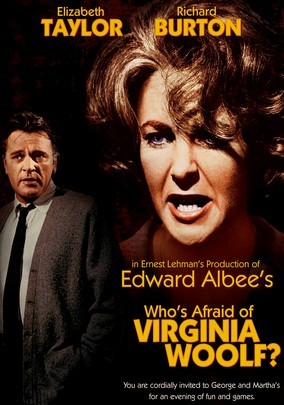
Who’s Afraid of Virginia Woolf?-1966

Who’s Afraid of Virginia Woolf? -1966

Director Mike Nichols

Starring Elizabeth Taylor, Richard Burton

Top 250 Films #51

Scott’s Review #200

1120753

Reviewed December 3, 2014

Grade: A

Who’s Afraid of Virginia Woolf? This dark film, directed by Mike Nichols (The Graduate), is based on a play from the early 1960s.

Thankfully, the Production Code had been lifted by 1966, allowing edgier, darker films to be made—think The Wild Bunch or Bonnie and Clyde from the same period.

Who’s Afraid of Virginia Woolf? is dreary, bleak, and with damn good acting by all four principals.

George and Martha (Richard Burton and Elizabeth Taylor) are associate history professors and the college president’s daughter, respectively. They live in a small town in New England.

They have a complex, often bitter love-hate relationship.

One night, they invite young newlyweds Nick (George Segal) and Honey (Sandy Dennis), a new professor and his wife, over for drinks at 2:00 a.m.

From this point, a destructive night of verbal assaults and psychological games ensues with damaging and sad results for all parties involved, as their personal lives are exposed and dissected.

At the forefront are George and Martha, whose relationship is characterized by insults, neediness, secrets, and alcohol. After an evening out, they return home and have a vicious fight.

When their young friends arrive, the tension is thick.

Eventually, the young couple becomes sucked into the older couple’s web of dysfunction, aided by endless drinks throughout the night.

The film is shot in black and white, like a play, which I found highly effective. Most scenes occur in George and Martha’s house.

While all four actors are great (and were all Oscar-nominated), my standouts are Taylor and Dennis.

In my opinion, this role is Taylor’s finest acting performance. She is overweight, bitter, angry, frustrated, drunk, and, at times, vicious to her husband. This performance differs from many of her other film roles and is truly dynamite.

As her anger flares up, the heat and intensity oozing from the screen can be felt. She goes from vulnerable and soft one moment to a grizzled, bitter woman the next.

Conversely, Dennis is pure, innocent, kind, vulnerable, impressionable, and somewhat naive. Having had too much brandy and spent more than one occasion in the bathroom, Dennis successfully plays giddiness and innocence to the hilt.

Both Martha and Honey harbor dark secrets, which eventually are revealed.

The ambiance is just amazing. The black-and-white cinematography gives the film a hot, suffocating feel. It feels like a quiet little college hamlet, and the setting of the eerily quiet wee hours of the morning is conveyed successfully.

Each story, told mainly by George and Martha, is captivating in its viciousness (both usually belittling the other), and the film becomes mesmerizing in its shock value at the insults hurled.

What will they say or do next?

I loved the scene where Honey awkwardly dances at the late-night bar that the four of them go to. Also, the shotgun scene, where George obtains the gun from the garage during one of Martha’s insulting tales, is disturbing – what will he do with the gun?

The stories involving George and Martha’s son are sad and mysterious- the viewer wonders what is happening.

The final reveal still gives me chills.

Who’s Afraid of Virginia Woolf? (1966) is one of the most significant film adaptations of a play I have ever seen.

Oscar Nominations: 5 wins-Best Picture, Best Director-Mike Nichols, Best Actor-Richard Burton, Best Actress-Elizabeth Taylor (won), Best Supporting Actor-George Segal, Best Supporting Actress-Sandy Dennis (won), Best Screenplay Based on Material from Another Medium, Best Original Music Score, Best Sound, Best Art Direction, Black-and-White (won), Best Cinematography, Black-and-White (won), Best Costume Design, Black-and-White (won), Best Film Editing

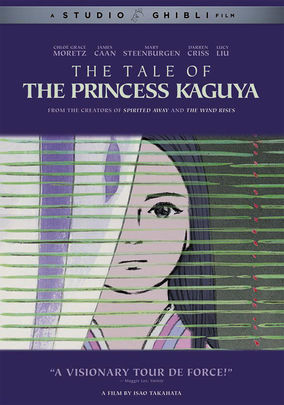
The Tale Of The Princess Kaguya-2014

The Tale Of The Princess Kaguya-2014

Director Isao Takahata

Starring (Voices) Chloë Grace Moretz, Darren Criss

Scott’s Review #430

80013552

Reviewed June 23, 2016

Grade: B+

The Tale Of The Princess Kaguya is a Japanese animated film released in 2014.

It is a unique film- mixing elements of fantasy and drama- stunning to experience and appreciate from a creative perspective. Unusual still is the lengthy running time of two hours and seventeen minutes- animated films are typically on the short side.

This is not to say that it drags, although I found it helpful to view it in segments.

Originally made in Japanese, the film has been dubbed in English and features recognizable voices such as Mary Steenburgen, Lucy Lui, and James Caan.

A bamboo cutter, Miyatsuko, discovers a baby girl inside a bamboo tree one day. He and his wife consider her a divine presence and keep her as their own, naming her Princess Kaguya.

Mysteriously, she begins to grow and develop at an alarming rate and is the wonder of the village. Kaguya develops a playful crush on Sutemaru, a handsome peasant.  Kaguya, led by her parents, is taken into a life of nobility and wealth as her destiny.

Her governess attempts to mold her into a regal Princess, but Kaguya is a wandering, free spirit, and rejects the formalities of this life. Her myriad of wealthy suitors counters her feelings for Sutemaru.

From a story perspective, the film shines, as the conflict over wealth versus poverty is explored. Kaguya’s parents are not greedy, but they want her to receive just desserts and a life free of hardship- as they are used to.

They want something better for her.

One can relate to the parent’s views, but Kaguya feels differently. She wants freedom, love, and happiness, not a life of rules, procedures, smoke and mirrors.

The filmmakers present the viewpoint of someone “other-worldly”  observing and analyzing planet Earth, warts and all, so the film has a message. It is not cliched or overbearing in its approach though-merely honest and sincere.

Every frame in the film appears to be a gorgeous drawing- not conventional, fast-paced animation, but classic, muted, pastel-type colors are used, giving it a softer touch, which astounded me.

If one is not into the story (tough to imagine), one could easily sit back and marvel at the spectacle.

The growing trend in animated films seems to be a return to traditional drawings- think Rudolph the Red-Nosed Reindeer from the 1960s- as evidenced by The Tale Of The Princess Kaguya and Anomalisa (2015), two recent animated features receiving critical acclaim.

This is music to my ears as these are far superior to the redundant, CGI-laden films.

Oscar Nominations: Best Animated Feature Film