Category Archives: Allan F. Nicholls

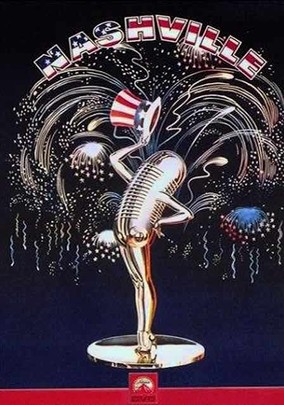
Nashville-1975

Nashville-1975

Director Robert Altman

Starring Lily Tomlin, Keith Carradine, Karen Black

Top 250 Films #3

Scott’s Review #47
60001541

Reviewed June 19, 2014

Grade: A

Nashville (1975)  is a brilliant film.

I have found that with each subsequent viewing, it creeps higher and higher on my list of favorite movies of all time.

The style is unique (largely improvised) and epitomizes the film’s creative freedom in the 1970s.

Director Robert Altman lets his actors express themselves, even allowing them to write their own songs; the overlapping dialogue creates a natural feel as the viewer watches the cast of twenty-four principals intersect over five days at a political rally/country music festival.

It is pure Robert Altman at his finest.

Nashville is a satire of the political arena of the early 1970s, particularly the Vietnam conflict and its politicians.

The film certainly questions and challenges the government with an ironic patriotic setting (Nashville).

The country music industry was in uproar upon the film’s initial release. It is a layered film that can be discussed and appreciated, with every character cared for.

I cannot adequately describe the multitude of nuances in each scene that are noticed over time.

Each character, even those with limited screen time, is vital to the story, as are the political elements —the questions of war, policies, and so on.

The chaotic bits and individual storylines come together at the end, and many background events are exciting to watch and note throughout each viewing.

With each experience, the audience will notice more and more. I certainly do.

Lily Tomlin, for example, plays Linnea, a haggard mother of deaf children with a supportive husband, a woman who, on the surface, is heroic, yet a complex character. She is bored with her life and falls in love with a young musician despite the guilt and repercussions.

The musician in question is Tom Frank, played by Keith Carradine. Handsome and self-absorbed, he arrives in Nashville to dump his bandmates in hopes of a solo career and beds many willing females.

He also lashes out at a soldier at the airport, saying, “Kill anyone lately?”

Despite his unlikable character, Carradine delivers one of the film’s most beautiful performances when he sings “I’m Easy”.

Several of the female characters assume he is singing the song for them, but who is he truly singing it for — if anyone?

Another character to analyze is Barbara Jean, played by Ronee Blakley. A frail yet very successful country singer, she is in and out of hospitals as she frets that her replacement singer will steal her thunder.

Her insecurities rise to the surface.

Insecurity is a common theme among the characters. Many of them are unsure, afraid, or lack confidence in their musical talent, relationships, or themselves.

These are only three examples of the twenty-four richly layered characters- some ambitious, some falling apart, others meandering through life.

Many songs throughout were written and performed by the actors themselves.

Nashville (1975) is storytelling and filmmaking at its best. A creation by Altman that is deservedly admired, revered, and heralded as a significant influence.

It is studied in film schools as it should be.

Oscar Nominations: 1 win-Best Picture, Best Director-Robert Altman, Best Supporting Actress-Ronee Blakley, Lily Tomlin, Best Original Song-“I’m Easy” (won)

Popeye-1980

Popeye-1980

Director Robert Altman

Starring Robin Williams, Shelley Duvall

Scott’s Review #1,474

Reviewed March 31, 2025

Grade: C+

As a loyal fan of the legendary director Robert Altman, I had never seen his 1980 effort, Popeye, which starred his muse, Shelley Duvall, and then rising movie star Robin Williams.

My favorite Altman films, Nashville (1975), Short Cuts (1993), and Gosford Park (2001), are masterpieces sprinkling overlapping dialogue with enormous casts.

Qualities that I adore.

I hoped Popeye would follow the same formula, but strangely and disappointingly, it doesn’t. The end product feels nothing like an Altman film and is a wacky, jagged attempted comedic affair that results in disappointment.

Desperately, it regains some semblance of control during the mid-section when sentimental and touching musical numbers surface, but this cannot save the film from mediocrity.

The entire affair seems rather pointless and overly messy.

When a muscled sailor named Popeye (Williams) journeys to the port town of Sweethaven, looking for the father (Ray Walston) who deserted him as a baby, he befriends an array of bumbling eccentrics.

He falls madly in love with dorky, sweet-natured Olive Oyl (Duvall).

Conflict erupts when it’s revealed that she already has a suitor, the jealous Bluto (Paul L. Smith). Popeye discovers an abandoned baby, Swee’Pea, whom he raises with Olive Oyl’s help, cementing their courtship. But when the spurned Bluto kidnaps Olive and the child, Popeye takes action with the help of his magic spinach.

Williams and Duvall are wonderfully cast and easily the best part of the otherwise ineffectual film.

The chemistry propels an investment in the couple despite the overreaching, zany dialogue. Williams dazzles with a cartoonish performance that befits who the funnyman would play best during his career despite turns towards more dramatic fare.

There is an infectious likeability factor that oozes from the screen. He’s also surprisingly cute.

Duvall nearly upstages Williams and everyone else with a maddingly frenetic and manic, excellent acting job. The actor was born to play Olive, even suffering from the nickname as a child.

Her constant and irritatingly grating ‘oohs’ are irresistible, and I mimicked her well before the credits rolled, much to my husband’s and my amusement.

The best moments occur midway through, with a combination of hits, such as ‘He Needs Me’ and ‘It’s Not Easy Being Me, which are performances by Duvall and Williams, respectively.

Both songs made me fall in love with the characters and made me thirst for more sentimentality over silliness.

You’d think I would have loved the film if for Williams and Duvall alone.

From the opening sequence, though, I found myself unamused and unenamored with the rest of the film.

Meant to be funny, the Taxman (Donald Moffat), Wimpy (Paul Dooley), and Bluto (Paul L. Smith) feel over-the-top and silly. They each lack any warmth or endearment and seem like caricatures of the cartoon.

The finale is meant to be edge-of-your-seat peril, with an octopus added to eat Olive Oyl and Swee’Pea, presumably. This is mixed with an uninspired performance by Ray Walston as Poopdeck Pappy (Popeye’s father).

Waiting for the spinach representation, but this comes too late in the game. Recognizing Popeye’s dislike for spinach, Bluto force-feeds it to him before throwing him into the water. The spinach revitalizes Popeye and boosts his strength, helping him defeat Bluto and Salty Sam.

Popeye celebrates his victory and his newfound appreciation of spinach.

If I made a list of Robert Altman films, I would rank Popeye (1980) toward the bottom. Reviled by critics at the time of release, the film has grown some appreciation over the years, but I’m not sure why.

A Wedding-1978

A Wedding-1978

Director Robert Altman

Starring Carol Burnett, Mia Farrow, Paul Dooley

Scott’s Review #539

Reviewed December 17, 2016

Grade: A

A Wedding (1978) is an obscure, brilliant gem penned and directed by Robert Altman- a film genius and one of my most adored directors.

I love most of his movies and A Wedding is no exception. The creative way that Altman weaves intersecting storylines and dialogue, thereby creating a real-life tone, gives immense realism to his films.

In A Wedding, he takes a basic life event and turns it into a well-nuanced, fascinating, comical, yet dramatic story.

He is known for having enormous casts (in A Wedding it is forty-eight principles), but every character serves a purpose.

The viewer will feel that they are a fly on the wall of a real wedding.

Altman’s actors primarily improvise the dialogue, speaking at the same time, bringing a realistic edge. I adore this quality.

The film is a satire- people either love or loathe attending weddings and Altman’s film caters to the latter. He creates a setting, from the ceremony to the reception, riddled with awkward moments, and social guffaws.

In pure satirical, soap opera fashion, two wealthy families gather at a lavish estate for the ceremony to commence. Hilarity ensues when the corpse of the matriarch of one family lies in her bed, nobody realizing she is dead.

Other hi-jinks, such as the revelation of a nude, life-size portrait of the bride, the caterer falling ill, and a tornado wreaking havoc.

Slowly, secrets are revealed by the families, as the alcohol flows and the characters become involved in the perilous situations.

Altman does it again as he creates a masterpiece based on real-life situations that most can relate to.