Category Archives: Denholm Elliott

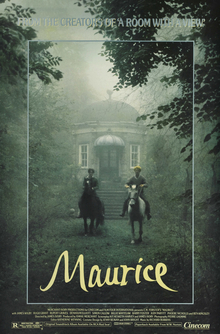
Maurice-1987

Maurice-1987

Director James Ivory

Starring James Wilby, Hugh Grant

Top 250 Films #111

Scott’s Review #14

60010639

Reviewed June 17, 2014

Grade: A

A brilliant film adaptation of the E.M. Forster novel set at Cambridge University during the turn of the twentieth century, it tells the story of oppression and social norms that took place at the time.

It is a gorgeously shot film, with beautiful landscapes, photography, and costumes.

Reminiscent of the British films “A Room with a View”, and “Howard’s End”, it is a male love story during a time when it was forbidden and lives were ruined because of sexuality like this.

The film’s characters make choices: some repressed, others celebrate, with differing results. In the middle of it, all is a beautiful love story.

Maurice (1987) is a timeless, brave treasure.

Oscar Nominations: Best Costume Design

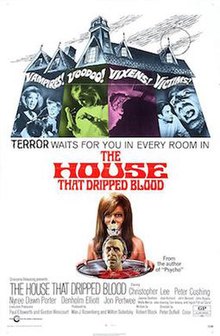
The House That Dripped Blood-1971

The House That Dripped Blood-1971

Director Peter Duffell

Starring Christopher Lee, Peter Cushing

Scott’s Review #1,408

Reviewed October 31, 2023

Grade: B+

Any horror project featuring Christopher Lee and Peter Cushing is worth a watch, and The House That Dripped Blood (1971) includes both actors, though, sadly, not in any scenes together.

The British horror anthology is spooky and perfect for the Halloween season. The action surrounds a hulking house where bad events occur regardless of who inhabits it.

The film is divided into four short stories explaining the circumstances surrounding the individual inhabitants.

The production is low budget, which is perfect for a film like this, but the title makes it seem bloodier and gorier than it is.

All of the stories were initially written and later adapted into scripts by Robert Bloch.

Below is a summary, review, and rating of each vignette.

Framework: B+

Shortly after renting an old country house, a well-known film star, Paul Henderson, mysteriously disappears, and a local Sergeant calls Inspector Holloway (John Bennett) from Scotland Yard to investigate.

When he inquires at the local police station, he is told some of the house’s history.

He soon learns how four tenants met macabre fates.

The ‘Framework’ sequence sits between the vignettes and provides good context, but it’s largely just the interplay between Inspector and Sergeant.

This serves as an introduction to each chapter and ties the events together.

Method for Murder: A-

Charles Hillyer (Denholm Elliott) is a struggling writer who specializes in horror stories. He and his wife Alice (Joanna Dunham), move into the house thinking it will serve as inspiration. Charles creates a devious character named ‘Dominic’ after he ‘imagines’ seeing him outside a window.

Charles soon starts to see Dominic, who begins stalking and tormenting him.

My second favorite of the four chapters, I all but guessed the ‘twist’ from the get-go, but I was surprised by the ‘twist on top of a twist,’ which pleased me.

It’s great when a villain thinks they’ve gotten away with murder, only to be murdered themselves.

Waxworks: B+

Retired stockbroker Philip Grayson (Cushing) moves into the house with plans to read, garden, and relax. Though initially he occupies himself with his hobbies, he quickly becomes lonely. One day, while wandering around town, he happens upon a wax museum.

Grayson explores the museum and finds a sculpture of a dead woman he had loved. The museum’s proprietor explains that he based the likeness of the sculpture on his late wife, who had been executed after murdering his best friend.

Despite featuring Cushing, it’s a moderately good story but lacks the compelling nature of a couple of the other vignettes.

It’s less about the house itself and more about the wax museum and obsession as the subject matter.

While decent, Waxworks didn’t blow me away either.

Sweets to the Sweet: A

Widower John Reid (Lee) moves into the house next door along with his odd young daughter Jane (Chloe Franks). John hires former teacher Ann Norton (Nyree Dawn Porter) to tutor Jane. Ann bonds with Jane and helps her overcome a fear of fire.

Ann suspects John of abusing Jane, but is there more to the story? Why doesn’t he let Jane play with other children or with toys, and why does he do his best to keep her isolated?

Is there something wrong with Jane?

This is the best installment and has a resemblance to The Innocents (1961), featuring a governess and a spooky child. Viewers will find themselves switching allegiances to the characters as the story moves quickly.

The Cloak: B+

Finally, horror film actor Paul Henderson (Jon Pertwee) moves into the house while starring in a vampire film being shot nearby.

Irritated by the cast and crew’s lack of maturity or talent, he decides to buy a realistic cloak for his character (who happens to be a vampire). The shop he makes his purchase from is run by the enigmatic Theo von Hartmann (Geoffrey Bayldon), who eerily offers him a black cloak.

This one plays like a Hammer Horror Dracula installment and is good but not great. Less happens within the confines of the house than I’d like, and Paul is an unlikable character.

The action on the movie set and in the shop are the best parts.

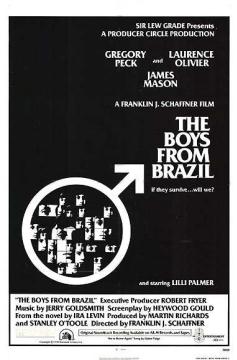
The Boys from Brazil-1978

The Boys from Brazil-1978

Director Franklin J. Schaffner

Starring Laurence Olivier, Gregory Peck, James Mason

Scott’s Review #1,391

Reviewed August 20, 2023

Grade: B+

The Boys from Brazil (1978) is a taut political thriller with a neo-Nazi focus and a weird cloning subject matter. It’s a bit of a tough follow but quite compelling all the way though and doesn’t lag at all.

Sometimes political thrillers get overly complicated or drag but this one doesn’t. The story is slightly hokey and impractical even bordering on ludicrous but since it’s so intriguing and action-packed these adjectives can be overlooked.

Surprisingly, I wasn’t blown away by either the performance of Laurence Olivier or Gregory Peck despite being a fan of both quality actors. Both actors overact and create stereotypes but especially Peck’s character is a bit too cartoonish.

It took me half the film to even recognize either man since both are heavily made up making them hard to recognize. It also took until the dramatic conclusion for either character to truly grow on me.

A brilliant one-scene cameo performance by Uta Hagen, a German American actress, as a former Nazi guard now imprisoned nearly steals the show and should have deserved an Oscar nomination.

The story surrounds Doctor Josef Mengele played by Peck who clones Adolf Hitler ninety-five times and raises the boys in Brazil, giving them childhoods identical to Hitler’s in various parts of the world.

His goal is to create a band of Nazi leaders that can continue where Hitler left off, forming the Fourth Reich. Their fathers will be murdered and the boys will be mothered as Hitler was.

Ezra Lieberman (Laurence Olivier), a Nazi hunter, learns of the plan from a young journalist (Steve Guttenberg) and is determined to thwart it.

The plot is a tough pill to swallow and takes some time to absorb exactly what is going on but it’s fresh and unique. I’m not sure if in 1978 people had had enough of Nazi and World War II films but both subjects are always worth dissecting again.

I’m not sure why it was so tough to get used to Peck as the evil doctor but it was. It’s probably because Peck usually plays characters with a strong moral compass and he was playing way against type.

His character looks weird and Peck seems to be overacting sometimes almost like he was playing a James Bond villain. It’s not exactly a role that measures up to Atticus Finch in To Kill a Mockingbird (1962).

Olivier is better and the main protagonist of The Boys from Brazil but I’m not sure he entirely wins me over. It’s not easy immersing in the prim and proper British aristocratic actor playing a Jewish man who kvetches so often.

Still, by the finale when Mengele meets Lieberman in a deadly showdown involving vicious Dobermans, a gun, and a Hitler clone I was cheering for Olivier all the way.

Supporting characters played by Guttenberg, Anne Meara (Jerry Stiller’s wife) as Mrs. Curry, one of the Hitler clone’s mothers, and the aforementioned Hagen is excellent. I wish that each character was explored better and given more screen time.

The same can be said for Rosemary Harris in a one-scene performance. While quality, I wanted more from her character of Frau Doring, the wife of one of the murdered fathers of the Hitler clones.

Finally, James Mason has little to do as Colonel Seibert other than serve as second fiddle to Peck.

But, The Boys from Brazil is the Olivier and Peck show.

The locales are a big win since they add an international vibe and relevance. Geographies such as Germany, Paraguay, Austria, and rural Pennsylvania, United States are featured which lofts the film up tremendously.

The taught nature of the film provides suspense, an ode to history, and an eerie measure of Trumpism in comparison to Nazi-ism. The Boys from Brazil (1978) isn’t prime steak but it’s not a bad watch either.

Oscar Nominations: Best Actor-Laurence Olivier, Best Film Editing, Best Original Music Score

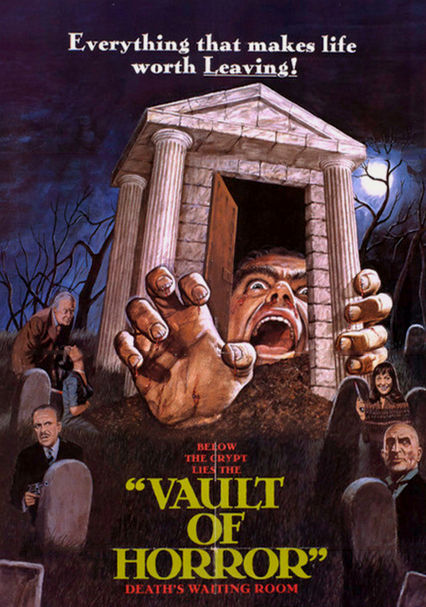
Vault of Horror-1973

Vault of Horror-1973

Director Roy Ward Baker

Starring Curd Jurgens, Daniel Massey

Scott’s Review #1,038

Reviewed June 26, 2020

Grade: A-

Horror anthologies are usually a vast treat and a reminiscent memory of childhood afternoons watching Twilight Zone re-runs on television.

This is hardly much of a stretch since Vault of Horror (1973) is a British anthology based on Tales from the Crypt (1972), which in turn was based on stories EC Comics series.

Each chapter is superior storytelling providing bloodthirsty horror viewers with suspense, adventure, and surprise endings.

Below is a summary, review, and rating of each vignette.

Framing Story- A

Events get off to an intriguing start as one-by-one five businessmen enter an elevator in a corporate office in downtown London. They are taken to the basement level though none of them has pressed that floor and emerge to find a gentlemen’s club.

With no way to get back onto the elevator, they begin to drink, each discussing a reoccurring nightmare.

This segment immediately grasps the viewer as we ponder questions. Is someone holding the men there for a reason, who is behind it, and why? Are the men’s nightmares only nightmares or are they revealing deeper secrets?

Midnight Mess- A

Harold Rodgers (Daniel Massey) is a suave, well-dressed man who tracks down his missing sister Donna (real-life sister, Anna Massey!) in a peculiar village. He fiendishly kills her to acquire her share of their father’s inheritance.

Working up an appetite he dines at a local restaurant that serves blood soup and blood clots as the main course. The village is inhabited by sophisticated vampires and his sister is one of them!

This vignette is my favorite as the restaurant decor is warm and toasty, the village provides a stylish ambiance, and clever writing exists throughout. The bloody feast the eatery serves is a devilish delight in macabre humor.

And the fangs are great.

The Neat Job- A

Arthur Critchit (Terry-Thomas) is an elegant man suffering from obsessive-compulsive disorder. He is married to Eleanor (Glynis Johns), a trophy wife, who despite wanting to please her husband, is a lousy housekeeper.

Constantly criticized for being incompetent, Eleanor loses it and kills Arthur with a hammer. She proudly cuts him to bits and stores his remains in glass jars, all neatly labeled.

This story is simply delicious, offering elegant British furniture to salivate over and macabre, witty comedy as the viewer eagerly anticipates what Eleanor will do when she finally snaps, and we just know she will snap.

Bravo!

The Trick’ll Kill You- A-

Sebastian (Curd Jurgens) is a magician on holiday in India, where he and his wife Inez (Dawn Addams) are searching for new tricks for their act.

Frustrated, they encounter a girl charming a rope out of a basket with a flute. The couple persuades her to come to their hotel room where they murder her and steal the enchanted rope. They gleefully plot how to incorporate the rope into their act assuring them of riches.

Inez experiments with climbing the rope only to disappear with a scream. An ominous patch of blood appears on the ceiling, and the rope coils around Sebastian’s neck and hangs him. Their smirking victim reappears alive in the bazaar.

This vignette provides a good glimpse of the Far East and is culturally outstanding. The story is compelling though a letdown from the earlier entries.

Bargain in Death- B+

Maitland (Michael Craig) is buried alive as part of an insurance scam concocted with his friend Alex (Edward Judd). They each plan to double-cross and kill the other to get the money.

Two trainee doctors bribe a gravedigger to dig up a corpse to help with their studies. When Maitland’s coffin is opened, he jumps up gasping for air, and the gravedigger kills him. At the same time, Alex’s car crashes into a tree and he dies.

In humorous comedy, when trying to close the sale of the corpse the gravedigger apologizes to the doctors for the damage to the head.

This segment is more comical than the others and a nice aside is that the trainee doctors are named Tom and Jerry. The plot is a bit convoluted and doesn’t succeed as much as the other stories.

Drawn and Quartered- A

Moore (Tom Baker) is a struggling painter living in Haiti. When he learns that his paintings have been sold for high prices by art dealers after being praised by a critic, he goes to a voodoo priest for help exacting revenge.

He is instructed that whatever he paints or draws can be harmed by damaging its image.

Returning to London, Moore paints portraits of the three men who cheated him and mutilates the paintings to exact his revenge. After the displays, his portrait, each one, including Moore, suffers an agonizing experience.

This story is top-notch, and the loss of the eyes and the hands are the highlights of fun.

As the film wraps, we learn the mysterious puzzle involving the five men in a satisfying form.

Vault of Horror (1973) is a horror anthology that hardly disappoints. I am eager to watch this one again which is a major achievement for a cinematic offering to have on a viewer.

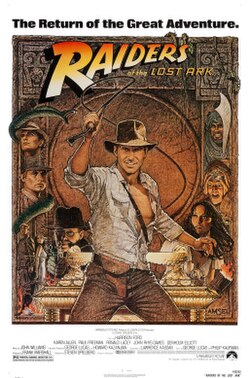
Raiders of the Lost Ark-1981

Raiders of the Lost Ark-1981

Director Steven Spielberg

Starring Harrison Ford, Karen Allen

Scott’s Review #757

Reviewed May 15, 2018

Grade: A

A film that kicked off the tremendously successful and ever-so-fun 1980s trilogy, Raiders of the Lost Ark (1981) is a treasure in the adventure genre time capsule.

Director Steven Spielberg embarks on the journey of one of the most highly visible film heroes in of Indiana “Indie” Jones, a swashbuckling, aww shucks kind of guy.

Harrison Ford is perfectly cast in a role that perfectly fits him and, besides Han Solo, defined him during the decade- the best role of his career if you ask me.

Wonderful to watch in sequence with the even more superb Indiana Jones and the Temple of Doom (1984), these two films are a pure pleasure as our hero faces dangerous obstacles at every turn while either chased by or pursuing sinister robbers or other undesirables.

All the while Indie keeps his familiar sly grin and numerous jokes to entertain audiences.

Raiders of the Lost Ark has it all with superior writing, editing, cinematography, art direction, sound, and visual effects.

They reaped many Oscar nominations, quite uncommon for an adventure tale, but the merits were warranted. Atypical compared to other films of this type, the film is not overly saturated with phony machismo or unnecessary “guy” stuff, but rather appealing and genuine.

The time is 1936 and archaeologist Indiana Jones works as a professor at a University. Known for retrieving ancient artifacts he is contacted by Army intelligence officers who ask him to help stop the Nazis from acquiring the Ark of the Covenant which they believe will make their armies invincible, allowing them to conquer the world in a sinister fashion.

Events lead Indie to Marion (Karen Allen), who harbors resentment towards him for a failed past romance.

The rest of the film follows the pair throughout Nepal and Cairo in an attempt to recover the Ark before the Nazis do.

Raiders of the Lost Ark contains all of the elements of a successful “hit” movie and has blockbuster written all over it. This is not a slight against the film, but rather a testament to all involved.

Led by the successful Spielberg who knows how to connect all the dots, first and foremost Ford infuses charisma into his character so that the audience enjoys his sensibilities and desire for the truth.

Indie is intent on protecting humankind so Spielberg carves a “good versus bad” approach- making the villainous Nazis the antithesis of Jones which creates a clear rooting value.

My favorite scene in the film is nicknamed the “face-melting scene” and contains state-of-the-art special effects that compelled and mesmerized me and also led to light nightmares for any kid under the age of twelve.

The way that the bad guys see swirling, benevolent ghosts- first beautiful and peaceful, but soon turning deadly- cause their faces to melt off or shrivel-the scene is both inventive and dramatic.

Not to be dismissed as trite or fluff are the exciting and memorable scenes dubbed “the snake scene” and “the rolling boulder scene”.  In the former Indie wryly admits his fear and trepidation of snakes as he must traverse a huge pit filled with thousands of them and he comes face to face with a deadly King Cobra.

In the latter scene, Indie must outrun a speeding boulder as he takes an ancient artifact from a sacred spot inside a cave, causing boulders to collapse around him.

Both scenes are enormous fun and the immeasurable edge-of-your-seat sequences.

I never sensed much chemistry between actors Ford and Allen, but writing the characters of Indie and Marion as former lovers adds a good bit of tension and sparring between the characters- this provides some good fodder and humorous situations.

Thankfully the romance between the two is neither the focal point of the film nor all too important, but rather, in the safety that the 1980’s cinema was- merely a necessity.

Raiders of the Lost Ark (1981) is a superb adventure film holding up better than it should decades beyond release. The film is rich with good old-fashioned action, a charismatic hero, thrills, intrigue, and a good history lesson for those interested in the build-up to World War II.

The accounts are fictional of course, but Spielberg offers a fine 1980s cinematic experience that’s got it all.

Oscar Nominations: 4 wins-Best Picture, Best Director-Steven Spielberg, Best Original Score, Best Sound (won), Best Art Direction (won), Best Cinematography, Best Film Editing (won), Best Visual Effects (won)

A Room with a View-1986

A Room with a View-1986

Director James Ivory

Starring Helena Bonham Carter, Julian Sands

Scott’s Review #695

Reviewed November 3, 2017

Grade: B+

A Room with a View (1986) is one of four major films to be based on famed British author E.M. Forster’s novels- Howards End (1992) and A Passage to India (1986), and Maurice (1987) being the other three.

The foursome contains common elements such as the vast English countryside and class distinctions, leading to heartaches and passion.

In the case of A Room with a View, the film traverses from artistic Florence, Italy to a cozy village in England.

The film is a period drama mixed with lots of authentic, unforced, good humor and at its core is a solid romantic drama, though if compared with the aforementioned other films, is not quite on par, though is still an entertaining watch- given the dismal year of cinema circa 1986.

The film was considered one of the best releases that particular year and was awarded a handful of Oscar nominations- winning Costume Design, Adapted Screenplay, and Art Direction.

Cultured and oftentimes brooding, Lucy Honeychurch (Helena Bonham Carter), goes on holiday to Florence with her rigid and conventional older cousin Charlotte (Maggie Smith), who also serves as her chaperone.

While enjoying the artistry of the European city, Lucy meets and falls madly in love with free-spirited George Emerson (Julian Sands), who is also visiting Florence with his easy-going father, Mr. Emerson (Denholm Elliott).

The men seem oblivious to Lucy’s (and Charlotte’s) Victorian-era upbringing, which attracts Lucy and appalls Charlotte.

Months later, the would-be lovers reunite in England and spend time averting obstacles thwarting their love, while admitting to themselves that their love is blossoming.

As Lucy has become engaged to snobbish Cecil Vyse (Daniel Day-Lewis), a sophisticate deemed suitable by her family to marry Lucy, the pair lacks the romantic connection that she shares with George.

Day-Lewis, on the cusp of becoming a breakout star and brilliant talent, gives Cecil a somewhat comical, yet endearing persona, that makes him the main foil, but also breathes sympathy into the character. This is especially evident during the Lucy/Cecil break-up scene.

The standout performance in A Room with a View is the comic brilliance of Smith as the manipulative and witty, Charlotte Bartlett, and this is evident throughout.

Smith injects vigor and comic wit into her character, as Charlotte seemingly makes one blunder after the other in the self-deprecating way she manages to use to her advantage to humorously manipulate other characters into doing things her way.

A risqué and quite hysterical all-male frontal nudity scene occurs mid-way through the film and, while not advancing the plot in any way, steals the entire film in its homoerotic and free-spirited way.

As the Reverend, young George, and Lucy’s energetic brother, Freddy, walk along a beautiful path, they decide to skinny dip in a pond where they horseplay and wrestle with each other completely in the buff.

As they chase each other around the pond, grab each other, and lightly smack bottoms, one cannot help but wonder if this scene set the tone for 1987’s gay-themed period piece based on another E.M. Forster novel, called Maurice.

A coincidence? I think not. As the trio of rascals come upon the properly dressed girls on the path, hilarity takes over the scene.

The art direction and costumes are of major excellence to A Room with a View as the film “looks” like a 1910 period rather than seeming like it is 1986 with the actors donning early twentieth-century styles.

Every scene is a treat from this perspective as we wonder who will wear what attire in the next scene.

As with the other aforementioned E.M. Forster films, class distinctions, and expectations are a major element in A Room with a View and make Lucy and George all the more likable as a couple.

Still, from an overall standpoint, there is something slightly amiss in the story department.

I did not find Helena Bonham Carter, an actor I like, overall very compelling as Lucy, and I think this leads to the story being slightly less than it might have with another in the role.

We may root for Lucy and George, but if the pair do not wind up together it is more of a pity rather than a travesty.

To summarize A Room with a View, the story is good, not great, and other key components to the film are much better than the central love story of Lucy and George but are therefore secondary to the main action.

Given a Charlotte romance, the film’s best character, that would have catapulted this film to the exceptional grade. Imagine the possibilities.

Or more of the two Miss Alan’s and their gossipy nature, or even a story to the rugged nude horseplay among men.

Many of the aspects that could have made A Room with a View (1986) great, were too often on the sidelines.

Oscar Nominations: 3 wins-Best Picture, Best Director-James Ivory, Best Supporting Actor-Denholm Elliott, Best Supporting Actress-Maggie Smith, Best Screenplay Based on Material from Another Medium (won), Best Art Direction (won), Best Cinematography, Best Costume Design (won)