Category Archives: Geoffrey Bayldon

Scrooge-1970

Scrooge-1970

Director Ronald Neame

Starring Albert Finney, Alec Guinness

Top 250 Films #186

Scott’s Review #561
Reviewed December 25, 2016

Grade: A

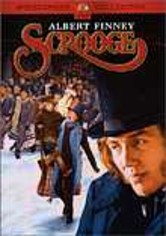
A classic perfect for watching around the holidays, perhaps accompanied by a roaring fire and a bit of brandy, Scrooge (1970) is a magical, musical experience; the entire family should adore it.

The film is a retelling of Charles Dickens’ 1843 story, A Christmas Carol.

Set in London with spectacular London-style art direction, it is perfect in its depiction of life around the holidays in the historic city, circa the nineteenth century.

To be clear, this is the musical version of the popular tale, not to be confused with the 1935 or the 1951 versions of the story.

The film is not as dark or scary as those films are. Instead, the 1970 Scrooge would be a fantastic companion piece to the 1968 classic Oliver!, both based on Dickens stories and both mixing fantastic musical scores with dramatic elements.

Albert Finney takes center stage in flawless form as the old, cantankerous, miser Ebenezer Scrooge. He plays the character as both an older man and, through flashbacks, a young man (Finney was merely 34 years old at the time of filming).

Guinness, indeed a high-caliber actor, is effective as the ghost of Jacob Marley- Scrooge’s former business partner. Scrooge is a moneylender, mainly to the working class, and is unforgiving in his collection of debts.

Filled with hatred for all things good, especially the Christmas holiday, Scrooge refuses to attend a family Christmas dinner hosted by his nephew, Fred, or to give to any charities. He begrudgingly gives his minion and bookkeeper, Bob Cratchit, Christmas Day off.

Finally left alone on Christmas Eve night, Scrooge is visited by the spirit of Jacob Marley, who tells Scrooge that three ghosts will visit him during the night.

In a chilling scene, Marley takes Scrooge on a journey through the sky, where he is greeted by spirits doomed to traverse the Earth, as Jacob is, with shackles acquired from their life as living beings.

Since they are greedy and wicked, they are doomed in the afterlife, just as Scrooge will be if he does not change his ways.

In an excellent subplot, we get to know the Cratchits, led by their father, Bob, a poor but earnest man. The family has little, but makes the most of what they do have, and appreciates the glorious holiday. They prepare a meager Christmas bird and savor being together as a family.

Their youngest, Tiny Tim, is lame, and he lusts over a lavish train set in the local toy shop. Cratchit epitomizes goodness and richness of character, contrasting with Ebenezer Scrooge.

As Scrooge is visited by the ghosts of Christmas past, present, and Christmas yet to come, he slowly realizes he needs to change his ways before it is too late. The audience is treated to stories of Scrooge’s youth, as we understand what has made him the miserly older man that he is today.

The clear highlight of this film is its musical numbers that will leave even the most tone-deaf humming along in glee. Throughout each sequence, we are treated to various numbers.

My favorite is “Thank You Very Much”, as it first appears during the Ghost of Christmas Yet To Come sequence.

By this time, feeling more sympathetic and appreciative, Scrooge merrily dances and sings along with the townspeople, unaware of the fact that they are celebrating his death and are dancing on his coffin to celebrate the fact that their debts are now free and clear.

This catchy tune is a reprise at the end of the film.

Other cheery numbers are “Father Christmas” and “I Like Life”, which perfectly categorize the film as a merry, holiday one, despite its occasional dark tone. This is necessary to avoid making Scrooge too bleak.

I also adore the vivid set designs as the gorgeous city of London is perfectly recreated to show the festive Christmas holiday. The film is not high-budget, but it makes the most of it by using small yet lavish sets.

Scrooge is a perfect holiday film, with fantastic tunes and a meaningful story that comes across on screen as a celebration of life, never edging toward contrived or oversaturated.

A wonderful holiday feast.

Oscar Nominations: Best Original Song Score, Best Original Song for the Picture-“Thank You Very Much”, Best Costume Design, Best Art Direction
The House That Dripped Blood-1971

The House That Dripped Blood-1971

Director Peter Duffell

Starring Christopher Lee, Peter Cushing

Scott’s Review #1,408

Reviewed October 31, 2023

Grade: B+

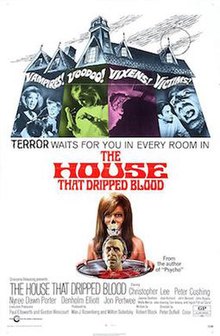
Any horror project featuring Christopher Lee and Peter Cushing is worth a watch, and The House That Dripped Blood (1971) includes both actors, though, sadly, not in any scenes together.

The British horror anthology is spooky and perfect for the Halloween season. The action surrounds a hulking house where bad events occur regardless of who inhabits it.

The film is divided into four short stories explaining the circumstances surrounding the individual inhabitants.

The production is low budget, which is perfect for a film like this, but the title makes it seem bloodier and gorier than it is.

All of the stories were initially written and later adapted into scripts by Robert Bloch.

Below is a summary, review, and rating of each vignette.

Framework: B+

Shortly after renting an old country house, a well-known film star, Paul Henderson, mysteriously disappears, and a local Sergeant calls Inspector Holloway (John Bennett) from Scotland Yard to investigate.

When he inquires at the local police station, he is told some of the house’s history.

He soon learns how four tenants met macabre fates.

The ‘Framework’ sequence sits between the vignettes and provides good context, but it’s largely just the interplay between Inspector and Sergeant.

This serves as an introduction to each chapter and ties the events together.

Method for Murder: A-

Charles Hillyer (Denholm Elliott) is a struggling writer who specializes in horror stories. He and his wife Alice (Joanna Dunham), move into the house thinking it will serve as inspiration. Charles creates a devious character named ‘Dominic’ after he ‘imagines’ seeing him outside a window.

Charles soon starts to see Dominic, who begins stalking and tormenting him.

My second favorite of the four chapters, I all but guessed the ‘twist’ from the get-go, but I was surprised by the ‘twist on top of a twist,’ which pleased me.

It’s great when a villain thinks they’ve gotten away with murder, only to be murdered themselves.

Waxworks: B+

Retired stockbroker Philip Grayson (Cushing) moves into the house with plans to read, garden, and relax. Though initially he occupies himself with his hobbies, he quickly becomes lonely. One day, while wandering around town, he happens upon a wax museum.

Grayson explores the museum and finds a sculpture of a dead woman he had loved. The museum’s proprietor explains that he based the likeness of the sculpture on his late wife, who had been executed after murdering his best friend.

Despite featuring Cushing, it’s a moderately good story but lacks the compelling nature of a couple of the other vignettes.

It’s less about the house itself and more about the wax museum and obsession as the subject matter.

While decent, Waxworks didn’t blow me away either.

Sweets to the Sweet: A

Widower John Reid (Lee) moves into the house next door along with his odd young daughter Jane (Chloe Franks). John hires former teacher Ann Norton (Nyree Dawn Porter) to tutor Jane. Ann bonds with Jane and helps her overcome a fear of fire.

Ann suspects John of abusing Jane, but is there more to the story? Why doesn’t he let Jane play with other children or with toys, and why does he do his best to keep her isolated?

Is there something wrong with Jane?

This is the best installment and has a resemblance to The Innocents (1961), featuring a governess and a spooky child. Viewers will find themselves switching allegiances to the characters as the story moves quickly.

The Cloak: B+

Finally, horror film actor Paul Henderson (Jon Pertwee) moves into the house while starring in a vampire film being shot nearby.

Irritated by the cast and crew’s lack of maturity or talent, he decides to buy a realistic cloak for his character (who happens to be a vampire). The shop he makes his purchase from is run by the enigmatic Theo von Hartmann (Geoffrey Bayldon), who eerily offers him a black cloak.

This one plays like a Hammer Horror Dracula installment and is good but not great. Less happens within the confines of the house than I’d like, and Paul is an unlikable character.

The action on the movie set and in the shop are the best parts.

Tales from the Crypt-1972

Tales from the Crypt-1972

Director Freddie Francis

Starring Joan Collins, Ian Hendry, Robin Phillips

Scott’s Review #1,200

Reviewed November 25, 2021

Grade: A-

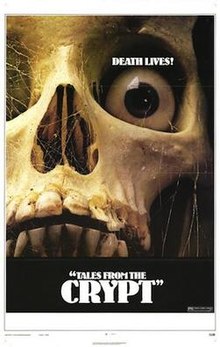
Tales from the Crypt (1972) is a delicious British anthology based on stories from the EC Comics series. Each of the five chapters is eerie storytelling that offers horror fans glimpses into the minds of depraved, devilish characters with sinister motives.

The sheer joy is witnessing their comeuppance.

This film is the predecessor to Vault of Horror (1973) and can be watched as a companion piece.

Below is a summary, review, and rating of each vignette.

Intro

Five strangers are suddenly compelled to join a tourist group to visit the old catacombs.

Separated from the main group, the strangers find themselves in a room with the mysterious Crypt Keeper (Ralph Richardson), who details how each of them may die.

…And All Through The House- A

Joanne Clayton (Joan Collins) brutally kills her husband Richard (Martin Boddey) on Christmas Eve to get her hands on their insurance money.

She prepares to hide his body but hears a radio announcement of a homicidal maniac (Oliver MacGreevy) on the loose.

She sees the killer (who is dressed in a Santa Claus costume) outside her house, but cannot call the police without exposing her crime.

Her daughter is upstairs in her bedroom, unaware.

This is my favorite chapter, and it’s nonstop action. Collins is terrific as the greedy Englishwoman put in peril. The audience will cheer for her to get her just desserts, especially after she callously disregards a lovely Christmas gift her husband bought for her.

Reflection of Death- B+

Carl Maitland (Ian Hendry) abandons his family to be with his secretary, Susan Blake (Angela Grant). After they drive off together, they are involved in a car accident. He wakes up, having been thrown clear of the burned car. He tries to hitchhike home, but everyone he meets screams with horror when they see him.

This vignette is slightly confusing in terms of the events’ timeline, but compelling as we wait to see what Carl’s face looks like and what has happened to Susan and his wife.

Poetic Justice- A

James Elliott (Robin Phillips) lives with his father Edward (David Markham) across from the home of elderly dustman Arthur Edward Grimsdyke (Peter Cushing), who owns several dogs and entertains children in his house.

James hates Arthur’s ramshackle lawn and embarks on a scheme to rid the neighborhood of the older man.

I love seeing Cushing play against type as a kindly grandfatherly character, and this chapter is the ultimate revenge fantasy, and quite satisfying to see what happens to James.

It’s also a perfect watch for Valentine’s Day, since the holiday is in play.

Wish You Were Here- A-

Businessman Ralph Jason (Richard Greene) is on the verge of financial collapse. His wife Enid (Barbara Murray) notices the inscription on a Chinese statue the couple owns.

They are granted three wishes. Enid decides to wish for a fortune and, surprisingly, the wish comes true, but with dire results.

This one wonderfully cascades a chain of events that leaves the characters in peril. The theme is once again about greed, specifically surrounding insurance money. The fast-paced nature is appealing, and the ancient Chinese wishes leave one character in eternal suffering.

Blind Alleys- A-

Major William Rogers (Nigel Patrick) becomes the new director of a home for blind people and exploits his position to live in luxury with his dog, Shane. At the same time, his drastic cuts to food and heating worsen the residents’ living conditions.

Led by George Carter (Patrick Magee), the residents revolt after a fellow resident dies of hypothermia. Rogers and Shane are locked in the basement, where Rogers must navigate through a maze of razor blades and a now ravenous wild dog who will hungrily eat his owner.

Though far-fetched, Blind Alleys is delicious fun and contains my most hated character. This is all the more satisfying as he ‘gets it’ in the end!

Finale

After completing the final tale, the Crypt Keeper reveals that he was not warning them of what would happen, but telling them what has already happened: they have all “died without repentance.

The conclusion does nothing more than put a satisfying cap on the viewer as each character once again pays for their shenanigans.