Tag Archives: Rupert Graves

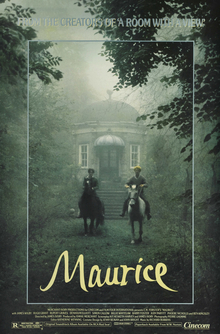
Maurice-1987

Maurice-1987

Director James Ivory

Starring James Wilby, Hugh Grant

Top 250 Films #111

Scott’s Review #14

60010639

Reviewed June 17, 2014

Grade: A

A brilliant film adaptation of the E.M. Forster novel set at Cambridge University during the turn of the twentieth century, it tells the story of oppression and social norms that took place at the time.

It is a gorgeously shot film, with beautiful landscapes, photography, and costumes.

Reminiscent of the British films “A Room with a View”, and “Howard’s End”, it is a male love story during a time when it was forbidden and lives were ruined because of sexuality like this.

The film’s characters make choices: some repressed, others celebrate, with differing results. In the middle of it, all is a beautiful love story.

Maurice (1987) is a timeless, brave treasure.

Oscar Nominations: Best Costume Design

Emma-2020

Emma-2020

Director Autumn de Wilde

Starring Anya Taylor-Joy, Johnny Flynn

Scott’s Review #1,128

Reviewed March 31, 2021

Grade: B

I haven’t read the classic Jane Austen novel written in 1815, nor have I seen the 1996 film version starring Gwyneth Paltrow. Neither of these is a prerequisite to enjoying the 2020 version of Emma starring Anya Taylor-Joy in the lead role of Emma Woodhouse.

The film, while set in the early nineteenth century, feels incredibly contemporary and seemingly makes little attempt at a classic style save for the hair, makeup, and costumes.

These items are splendid, and the highlight makes the film stylish and bright.

Beautiful, bright, and rich, Emma (Taylor-Joy) enjoys her matchmaking skills that sometimes lead to awkward or failed matches and romantic missteps. She claims not to be interested in her romance or potential suitors, though that changes with time.

She struggles with the challenges of growing up, despite being pampered and often interfering in others’ affairs. Emma is also mischievous and not always kind, though deep down she is a good person and has regret when she hurts someone’s feelings with her antics.

In a good, coming-of-age way, she finally realizes that love for her and a proper match of her own has been there all along and staring her in the face.

The film begins with Emma’s governess, Miss Taylor (Gemma Whelan), marrying and becoming Mrs. Weston.

She and Emma are best friends, and Emma is saddened, so she settles on Harriet Smith (Mia Goth), a younger girl whom Emma supposes is the unclaimed child of a gentleman; Harriet’s parents are unknown, but her education has been provided for.

They become bonded, and Emma’s influence is immeasurable.

Taylor-Joy does an excellent job in the title role and carefully makes Emma naughty and sometimes unlikable before carefully reeling her in with an act of kindness. She has no malice in mind but is often bored and looking for excitement.

I found myself rooting for her to find romance with Mr. Knightley (Johnny Flynn), which she does, but not without a hurdle or two on the way.

Other characters come and go with flirtations and romantic possibilities explored.

Speaking of Flynn, the actor is rumored to play rock icon David Bowie in a future theatrical feature. A real musician, Flynn, should be the perfect casting for that critical part.

He is the only character to show some flesh, his bare bum, in Emma, and one wonders if female director Autumn de Wilde did this purposefully. After all, traditionally in cinema, it’s been the female who is more commonly nude. Turnabout is fair play.

While Taylor-Joy is good, she is nearly upstaged by the delightful Goth, who is fabulous as the insecure and impressionable Harriet. With humor and innocence, she makes her character quite likable. I’d like to see more from this young actress.

Bill Nighy is perfectly cast as the comical father of Emma, while Miranda Hart as Miss Bates steamrolls over every scene she is in.

Some inconsistencies exist, especially where Miss Bates is concerned. A quick mention that Miss Bates and her family had once been rich and are now struggling is not explored, where it reportedly was in the novel.

Dividing the film into seasonal sections (Autumn, Winter, Spring, and Summer) is a good decision and makes it more like a novel. The winter snow and Christmas festivities, along with a summer picnic, do wonders to add fresh atmospheric tidbits.

The many scenes of delicious spreads of food and drink laid out for hungry eyes to see offer a robust and colorful glimpse of the culture.

The vibrancy, the food, and the clothing, as mentioned above, all brimming with richness based on the seasons, are the main draw. The castles and large houses featured surely small-town English style, brimming with vastness and atmosphere.

Emma (2020) is a fun film, but its story isn’t the strongest aspect. Predictably, all characters wind up with whom they should wind up with, and there is a happily ever after sensibility.

Adolescents can easily sit in comfort with their parents and enjoy the lightweight affair. Nobody will be offended, and all will be satisfied. It’s a solid romantic period piece.

Oscar Nominations: Best Costume Design, Best Makeup & Hairstyling

A Room with a View-1986

A Room with a View-1986

Director James Ivory

Starring Helena Bonham Carter, Julian Sands

Scott’s Review #695

Reviewed November 3, 2017

Grade: B+

A Room with a View (1986) is one of four major films to be based on famed British author E.M. Forster’s novels- Howards End (1992) and A Passage to India (1986), and Maurice (1987) being the other three.

The foursome contains common elements such as the vast English countryside and class distinctions, leading to heartaches and passion.

In the case of A Room with a View, the film traverses from artistic Florence, Italy to a cozy village in England.

The film is a period drama mixed with lots of authentic, unforced, good humor and at its core is a solid romantic drama, though if compared with the aforementioned other films, is not quite on par, though is still an entertaining watch- given the dismal year of cinema circa 1986.

The film was considered one of the best releases that particular year and was awarded a handful of Oscar nominations- winning Costume Design, Adapted Screenplay, and Art Direction.

Cultured and oftentimes brooding, Lucy Honeychurch (Helena Bonham Carter), goes on holiday to Florence with her rigid and conventional older cousin Charlotte (Maggie Smith), who also serves as her chaperone.

While enjoying the artistry of the European city, Lucy meets and falls madly in love with free-spirited George Emerson (Julian Sands), who is also visiting Florence with his easy-going father, Mr. Emerson (Denholm Elliott).

The men seem oblivious to Lucy’s (and Charlotte’s) Victorian-era upbringing, which attracts Lucy and appalls Charlotte.

Months later, the would-be lovers reunite in England and spend time averting obstacles thwarting their love, while admitting to themselves that their love is blossoming.

As Lucy has become engaged to snobbish Cecil Vyse (Daniel Day-Lewis), a sophisticate deemed suitable by her family to marry Lucy, the pair lacks the romantic connection that she shares with George.

Day-Lewis, on the cusp of becoming a breakout star and brilliant talent, gives Cecil a somewhat comical, yet endearing persona, that makes him the main foil, but also breathes sympathy into the character. This is especially evident during the Lucy/Cecil break-up scene.

The standout performance in A Room with a View is the comic brilliance of Smith as the manipulative and witty, Charlotte Bartlett, and this is evident throughout.

Smith injects vigor and comic wit into her character, as Charlotte seemingly makes one blunder after the other in the self-deprecating way she manages to use to her advantage to humorously manipulate other characters into doing things her way.

A risqué and quite hysterical all-male frontal nudity scene occurs mid-way through the film and, while not advancing the plot in any way, steals the entire film in its homoerotic and free-spirited way.

As the Reverend, young George, and Lucy’s energetic brother, Freddy, walk along a beautiful path, they decide to skinny dip in a pond where they horseplay and wrestle with each other completely in the buff.

As they chase each other around the pond, grab each other, and lightly smack bottoms, one cannot help but wonder if this scene set the tone for 1987’s gay-themed period piece based on another E.M. Forster novel, called Maurice.

A coincidence? I think not. As the trio of rascals come upon the properly dressed girls on the path, hilarity takes over the scene.

The art direction and costumes are of major excellence to A Room with a View as the film “looks” like a 1910 period rather than seeming like it is 1986 with the actors donning early twentieth-century styles.

Every scene is a treat from this perspective as we wonder who will wear what attire in the next scene.

As with the other aforementioned E.M. Forster films, class distinctions, and expectations are a major element in A Room with a View and make Lucy and George all the more likable as a couple.

Still, from an overall standpoint, there is something slightly amiss in the story department.

I did not find Helena Bonham Carter, an actor I like, overall very compelling as Lucy, and I think this leads to the story being slightly less than it might have with another in the role.

We may root for Lucy and George, but if the pair do not wind up together it is more of a pity rather than a travesty.

To summarize A Room with a View, the story is good, not great, and other key components to the film are much better than the central love story of Lucy and George but are therefore secondary to the main action.

Given a Charlotte romance, the film’s best character, that would have catapulted this film to the exceptional grade. Imagine the possibilities.

Or more of the two Miss Alan’s and their gossipy nature, or even a story to the rugged nude horseplay among men.

Many of the aspects that could have made A Room with a View (1986) great, were too often on the sidelines.

Oscar Nominations: 3 wins-Best Picture, Best Director-James Ivory, Best Supporting Actor-Denholm Elliott, Best Supporting Actress-Maggie Smith, Best Screenplay Based on Material from Another Medium (won), Best Art Direction (won), Best Cinematography, Best Costume Design (won)