Category Archives: Billie Whitelaw

Frenzy-1972

Frenzy-1972

Director Alfred Hitchcock

Starring Jon Finch, Barry Foster, Anna Massey

Top 250 Films #28

Top 40 Horror Films #7  

Scott’s Review #244

Frenzy_movieposter

Reviewed May 17, 2015

Grade: A

Frenzy (1972) is a later-day Alfred Hitchcock film that returns the masterful director to his roots in London, England, his country of origin, and the place where his early films were made.

As with numerous other Hitchcock stories, the protagonist is falsely accused of murder and struggles mightily to prove his innocence before time runs out and he meets his doom.

The film is distinctly British, featuring an entirely British cast, and includes a humorous side story about the primary investigator’s wife. This terrible cook prepares exotic yet unappetizing meals for her husband.

This comic relief perfectly balances the heavy drama encompassing the main murder story, as Frenzy is one of Hitchcock’s most violent and graphic films.

Made in 1972, he was able to include much more explicit content. A neck-tie murderer, who also rapes his female victims, is on the loose in London.

In the opening sequence, we see a dead woman floating in the Thames River during broad daylight, nude, except for a neck-tie that she has been strangled with. A crowd of spectators races to see what all the fuss is about.

We then meet the central character of the film, down-on-his-luck bartender Richard Blaney, who is fired from his job as a bartender by his hateful boss.

Blaney has a loyal girlfriend in Babs, a barmaid at the same local watering hole. Babs is sexy, yet plain. He also has a successful ex-wife, Brenda, who runs a dating company. Blaney regularly sponges off Brenda for money and dinners. Also in the picture is successful fruit-market trader Bob Rusk, who is a friend of Blaney’s.

All four of these central characters play a significant role in the main plot.

As events begin to unfold, the film is not a whodunit as traditionally it could have been. Instead, the audience quickly learns who the murderer is and their motivations, which is an interesting twist in itself.

Despite this knowledge, the film is quite compelling as a classic Hitchcock horror-thriller.

It is interesting for Hitchcock fans to compare this film with many of his earlier works. Released in 1972, at a time in film history when such sensors were more lax, it is the first Hitchcock film to feature nudity.

It is also the film of Hitchcock’s that features the most brutal rape/murder scene of all, surpassing the shower scene from Psycho, in my opinion.

The victim’s ordeal is prolonged, as she begins praying, thinking she will only be raped, at first unaware that her attacker is also the neck-tie murderer, and her life is running short. This leads to a sad, gruesome outcome for her.

One of the most interesting murder scenes takes place off-camera and is an ingenious idea by Hitchcock. The neck-tie murderer lures a victim to his apartment complex under the guise of being a friend of hers.

They walk upstairs to his unit and go inside, all the while the camera remains outside the apartment, so the viewer only imagines the horrors unfolding inside.

The camera then slowly goes back down the stairs and out onto the street, and looks up at the murderer’s window. The fact that the victim is one of the main characters makes one’s imagination run wild about what is transpiring inside the apartment, and the viewer is filled with grief.

This is a brilliant choice by Hitchcock and so effective to the story.

Another great scene is the potato truck sequence.

As the neck-tie murderer has dumped his victim, like garbage, into a potato sack, he is panicked to realize that she has taken his pin from his jacket and presumably clenched it in her fist as a clue, despite her demise.

What will he do now?

The extended scene features the murderer inside the potato truck attempting to unclench his pin from her hand and escape the moving truck without being caught.

It is my favorite scene in Frenzy.

Frenzy (1972) is a return to triumph for Hitchcock, after the complex Topaz (1969) and Torn Curtain (1966), both underappreciated political thrillers made a few years earlier.

He returns to the horror genre like gangbusters, throwing in some good, sophisticated British humor for good measure.

What a treat this film is.
The Omen-1976

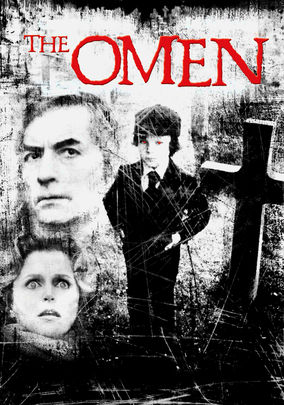
The Omen-1976

Director Richard Donner

Starring Gregory Peck, Lee Remick

Top 250 Films #110

Top 40 Horror Films #21

Scott’s Review #331

60002150

Reviewed January 8, 2016

Grade: A

On the heels of similarly themed supernatural horror films, and all three classics in my view, The Omen (1976) follows suit with the religious-minded terrifying piece that resembles both The Exorcist (1973) and Rosemary’s Baby (1968).

All three films are cherished gems and favorite horror films of mine.

The Omen (the last to be released) is quite possibly the weaker entry having taken much from the other two films, and at the forefront is a child encompassed by devilish forces.

But to say “weaker” implies it is not good, which is not the case- The Omen is a masterpiece.

Set mostly in London, the film begins in Rome. Gregory Peck plays a powerful diplomat, Robert Thorn. Robert’s wife, Katherine (Lee Remick), has just given birth to a baby, who dies.

Unbeknownst to her, Robert and a priest have taken a newborn whose mother has just died, thereby fooling Katherine into thinking she has delivered a healthy baby boy. They name their child Damien.

Soon, Robert is named U.S. Ambassador of the United Kingdom- an astounding honor, but his and Katherine’s lives spin out of control when strange events begin to occur surrounding Damien, and they realize the child is not “right”.

I adore the many aspects of The Omen. The locale of sophisticated and royal London is perfect. The Thorns live in a grand, palatial estate just oozing with possible horror elements.

During a vast party for little Damien’s fifth birthday, the attendees are gathered on the perfectly manicured grounds of the Thorn home. It is a bright and cheery afternoon.

Suddenly, from the top floor bedroom window, Damien’s fresh-faced nanny publicly hangs herself from the window proudly shouting, “This is all for you, Damien”!

This scene is one of the most horrific and surprising scenes in the film.

When Damien’s new nanny shows up, she is off-putting and sinister. The inclusion of a pack of black dogs hovering around the estate is fiendish, and an innocent trip to the zoo results in the scared animals fleeing from Damien as if he is the antichrist, which of course, he is revealed to be.

Fantastic is the religious element of The Omen, a sure measure to frighten and freak out audiences brave enough to watch this film.

Who will not be on edge as a sweet-looking little kid is assumed to be the devil?  Religious elements in horror have been prevalent throughout the film ages.

Perhaps it is the Italian and British accents and settings that add layers of fear to the film.

What I love most about the film is its cynicism. The Omen is not a happy film by any means, nor does it result in a happy ending- Satan wins in the end.

Two memorable scenes are the pole through the heart of the priest scene and the gruesome decapitation of a photographer by a sheet of glass. In both scenes, Satan causes the deaths.

The finale of the film is incredibly compelling and downright shocking- the face-off of Robert and Damien in a church and the prevailing conclusion sets the stage for a sequel, which of course there was more than one.

The sinister smile at the end of the film is immeasurable in its evil nature.

The Omen (1976) is a film that I love to watch and revel in fright when the chills start to creep up my back.

What a fantastic film.

Oscar Nominations: 1 win-Best Original Score (won), Best Original Song-“Ave Satani”

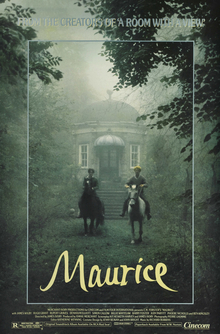
Maurice-1987

Maurice-1987

Director James Ivory

Starring James Wilby, Hugh Grant

Top 250 Films #111

Scott’s Review #14

60010639

Reviewed June 17, 2014

Grade: A

A brilliant film adaptation of the E.M. Forster novel set at Cambridge University during the turn of the twentieth century, it tells the story of oppression and social norms that took place at the time.

It is a gorgeously shot film, with beautiful landscapes, photography, and costumes.

Reminiscent of the British films “A Room with a View”, and “Howard’s End”, it is a male love story during a time when it was forbidden and lives were ruined because of sexuality like this.

The film’s characters make choices: some repressed, others celebrate, with differing results. In the middle of it, all is a beautiful love story.

Maurice (1987) is a timeless, brave treasure.

Oscar Nominations: Best Costume Design