Category Archives: Thriller

10 Rillington Place-1971

10 Rillington Place-1971

Director Richard Fleischer

Starring Richard Attenborough, Judy Geeson, John Hurt

Scott’s Review #1,424
Reviewed March 22, 2024

Grade: A

Richard Fleischer has directed films such as Dr. Doolittle (1967) and Soylent Green (1973) that are remembered better than 10 Rillington Place (1971).

That’s a shame, because the film is one I hadn’t seen or heard of, yet it’s chilling, macabre, and masterful in its bleakness and atmosphere.

It’s also wonderfully acted.

One can’t help but notice the stark similarities to Frenzy, an equally disturbing and great 1972 film by Alfred Hitchcock.  Did this film influence the master of suspense to create that one? Only he knows the answer to that question.

Primarily set in one dreary apartment building in London named 10 Rillington Place, it tells the true story of the British serial killer John Christie (Richard Attenborough), who committed many of his crimes in the tall terraced house, and the miscarriage of justice involving his neighbor, the simple-minded Timothy Evans (John Hurt).

John used Timothy as a scapegoat for the murders.

John is a seemingly model citizen but a killer, as the audience witnesses in the first scene. He poses as a kindly doctor who convinces naive women that he can cure whatever ails them, whether it’s aches and pains or a pesky pregnancy.

He usually strangles them to death and buries them in a makeshift graveyard in the pretty garden in front of his residence.

The main story in 10 Rillington Place follows John as he cons a pregnant bride (Judy Geeson) who is struggling financially to use his help and medical methods. John’s dutiful, clueless wife, Ethel (Pat Heywood), slowly discovers her husband’s shenanigans, but will she fall victim as his next target?

Of course, Richard Attenborough steals the show as the demented killer with a calm, cool, and collected exterior. As an average-looking Joe type, he can use his trusting appearance to his advantage.

I’d trust him.

Attenborough became an Academy Award-winning director for 1982’s Gandhi, so he knows his craft well. He also directed Cry Freedom in 1987 and Chaplin in 1992.

In actor mode, he is phenomenal as a crazed killer. His most excellent skill is his demeanor. Thoughtful and pondering, he never plays the psycho or the nut. He is careful, but that’s part of his creepiness. With every noise, he peers out the window, drawing the living room curtain ever so slightly, revealing his face.

Hurt and Geeson are terrific as the young couple with the cards stacked against them. They are simply looking for tranquility and the means to raise their child.

Simplicity is a winning formula, and most of the film is subdued thanks to Fleischer’s laid-back direction techniques.

The look of 10 Rillington Place is perfection. The colors are muted and faded, giving a dank and depressing look. Even a bright red velvet sofa appears dark and dreary.

As Timothy and Beryl agree to lease the top-floor flat, it will not bode well for them, and we can sense it.

Towards the end of the film, it is almost too much to bear with the knowledge that John strangles a toddler to death and unceremoniously stuffs the child, wrapped in a blanket, in a washroom.

Brilliantly, the murders rarely happen on screen and involve none of the principal characters. That’s what’s so haunting about the film and reminds me of Hitchcock’s Frenzy.

Remember the scene where the necktie killer lures a female victim upstairs to her death? There is silence and a shot of the staircase for seemingly an eternity until the killer descends the stairs.

We know what’s happened.

What we don’t see is sometimes much more frightening than what we do see.

The ghastly reveal at the end of 10 Rillington Place that the story is based on real-life events packed a punch since I didn’t have this knowledge going into the film.

Thankfully, 10 Rillington Place (1971) has received its just desserts in recent years, with praise and recognition. This proves that great films are like cream and rise to the top…..eventually.
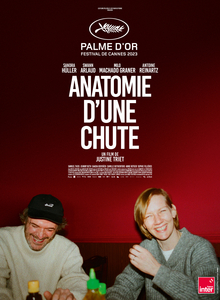
Anatomy of a Fall-2023

Anatomy of a Fall 2023

Director Justine Triet

Starring Sandra Hüller, Milo Machado-Graner

Scott’s Review #1,422

Reviewed March 4, 2024

Grade: B+

The taut legal thriller, Anatomy of a Fall (2023) is rich with mystery and almost immediately offers the viewer a character’s surprising death. The rest of the film is spent trying to figure out how the death occurred as a trial surfaces.

The mountainous puzzle made me as the viewer anticipate a shocking conclusion or at least a cemented ending leaving nothing to the imagination.

In plain terms, I wanted to know why the character died, at whose hand, and how the act was done.

As good as the film is the ending underwhelmed me. I was left wanting more than I was offered. This is undoubtedly a result of the enormous buildup.

However, the effort is spectacular, and some of the year’s best acting is showcased by Sandra Hüller and Milo Machado-Graner, who give rich and dramatic performances. They stay believable and nuanced in challenging, teary scenes. 

Sandra (Sandra Hüller), her husband Samuel (Samuel Theis), and their eleven-year-old son Daniel ( Milo Machado-Graner) live a secluded life in a remote town in the French Alps.

Tension develops when Sandra, who is a writer, is interviewed by a reporter at home as they sip and enjoy wine. Samuel ruins the moment by blasting an obnoxious song loop causing the interview to be aborted.

Suddenly, Samuel is found dead in the snow by Daniel! The police question whether he was murdered or possibly committed suicide. Samuel’s suspicious death is ultimately presumed murder, and Sandra becomes the prime suspect.

As the trial begins, the events of Samuel’s death are uncovered while the complexities increase. A disturbing journey into Sandra and Samuel’s troubled relationship is explored with Daniel being at the center of the drama.

Anatomy of a Fall is a slow-moving vehicle but that’s a large part of its appeal for me. After Samuel’s death, the film features quiet scene after quiet scene of Sandra and Daniel being interviewed by either their lawyers or others involved in the case.

While not action scenes, the dialogue reveals an incredible amount of backstory. An incident that occurred years earlier is key and the remnants of that unfortunate activity are vital to the entire reveal.

With tremendous acting the film is also significant in scoring Justine Triet an Oscar nomination for Best Director when shamefully few female directors have ever been given this distinct honor.

Unfortunately, Triet’s nomination comes at the expense of Greta Gerwig NOT being nominated for the ginormous blockbuster hit Barbie. I’d give the nomination to Gerwig but why couldn’t they both be nominated?

Triet also wrote the screenplay and wisely crafted an unpredictable vehicle. Since Sandra is on trial the writing could have felt forced or generic but it doesn’t. There are also no silly television drama moments of unnecessary legal jargon or canned shocking tense moments.

What Triet serves up is genuine and humanistic.

The cold and snowy atmosphere reminds me of a Swedish film from 2014 called Force Majeure with a similar story of uncovered secrets and backstory. They are both set in the French Alps ironically enough.

I expected more from the ending but Anatomy of a Fall (2023) mesmerizes and keeps one guessing never feeling boring like some legal dramas can.

While Triet’s Oscar nomination may be questionable, Hüller’s is not and I’d even argue she deserves to win.

Oscar Nominations: 1 win-Best Picture, Best Director-Justine Triet, Best Actress-Sandra Hüller, Best Original Screenplay (won), Best Editing

Independent Spirit Award Nominations: 1 win-Best International Film (won)

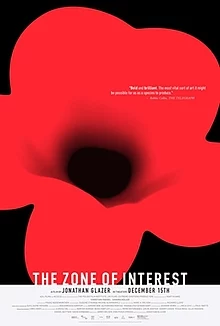
The Zone of Interest-2023

The Zone of Interest-2023

Director Jonathan Glazer

Starring Christian Friedel, Sandra Hüller

Scott’s Review #1,419

Reviewed February 2, 2024

Grade: A

The Zone of Interest (2023) offers a unique experience for its audience. It’s one of a distant observer to unthinkable horrors and events that took place during the 1940s occupied Poland.

A lovely estate rife with flourishing flowers and plush gardens surrounds the haunting setting of the Auschwitz concentration camp.

Exterminations and unspeakable acts of human suffering occur daily whilst a German family enjoys their dream home hardly unnerved by what’s going on steps away.

The father is the mastermind behind the suffering.

The macabre film is extraordinary, and powerful, and will haunt you long after it ends.

The subject matter of the Holocaust in cinema is usually told with a visual examination of the victims. In The Zone of Interest, though, what you don’t see is worse than what you do.

The commandant of Auschwitz, Rudolf Höss (Christian Friedel), and his wife Hedwig (Sandra Hüller) live a seemingly idyllic life with their five children. They fish, swim, and frolic among the confines of their house and garden next to the camp.

Höss is a high-ranking and respected member of the Third Reich. Servants handle chores around the house, while the prisoners’ belongings are given to the family.

As a viewer, I first thought to myself what a happy family they seem to be. I was quickly sickened when I realized what was going on over the top of their high walls and their role in it.

Director, Jonathan Glazer, brought us disturbing films such as Birth (2004) and Under the Skin (2015) and revolts even more with The Zone of Interest. I’m not sure I’ve ever seen a film quite like it.

Usually, what happens in a film happens on screen. Seeing the Jews gassed or shot or tortured is horrific enough. Spielberg’s Schindler’s List (1993) was a masterpiece by visually featuring the nature of the Holocaust in an inventive black-and-white way.

We see the victims.

In The Zone of Interest, it’s the sound that is effective. Beyond the garden wall, gunshots, shouting, and sounds of trains and furnaces are constantly heard.

The nights are even worse.

A quick glimpse of flames and smoke roaring to the sky are the visuals key to the events taking place next door.

We only very quickly see a parade of prisoners march through the grass……once.

Höss approves the design of a new crematorium, which soon becomes operational. With horror, it is confirmed that thousands of Jews are gassed and burned.

Glazer keeps the viewer at a distance with more than just experiencing the unseen. The cameras are set far back from events so the audience observes the family instead of being alongside.

There are no closeups.

The lighting is superior. Muted tones portray the starkness of the period. Effective is how everything appears grey except the flowers in the garden.

Some peculiarities exist that are hard to figure out. In two sequences, a Polish girl who lives nearby sneaks out every night, hiding food at the prisoners’ work sites for them to find and eat.

The film is a clay animation style similar to what Glazer used in parts of Under the Skin. It’s weird, stylistic, and fascinating.

Late in the film, Höss descends a staircase and retches. He does so again. I’m not sure why he does. Is he subconsciously sickened by the death he causes? He has been tasked with a new initiative to transport hundreds of thousands of Hungarian Jews to Auschwitz to be killed.

The mission has been named after him.

Is it too much for him to deal with?

The film ends with a modern scene of a group of janitors cleaning the Auschwitz-Birkenau State Museum before it opens.

I was dying to know what happened to Höss and Hedwig.

It’s a searing film, unforgettable and uncomfortable. It plods and sickens but is pure art. It’s troublesome and a unique entry for Holocaust films. Glazer finds a new way to examine material told in cinema for decades.

The Zone of Interest (2023) is a painful masterpiece and a thinking man’s film.

Oscar Nominations: 2 wins-Best Picture, Best Director-Jonathan Glazer, Best Adapted Screenplay, Best International Feature Film (won), Best Sound (won)

Independent Spirit Award Nominations: Best International Film

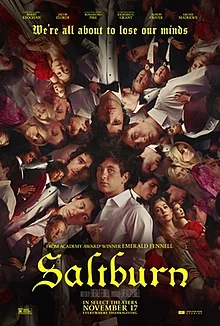
Saltburn-2023

Saltburn-2023

Director Emerald Fennell

Starring Barry Keoghan, Jacob Elordi, Rosamund Pike

Scott’s Review #1,417

Reviewed January 19, 2024

Grade: A

Emerald Fennell, as a director (she also acts) is someone to keep a close eye on.  With only her second film, Saltburn (2023), she has quickly drawn comparisons to Darren Aronofsky and Yorgos Lanthimos by creating wickedly daring comedies rife with sharp dialogue and peculiar tastes.

Okay, I’m drawing those comparisons on my own.

The point is that she creates films that are not necessarily for mainstream audiences but will satisfy the peculiar cravings of those seeking left-of-center and hard-to-predict films.

She also wrote the screenplay.

Those wary of hard-to-digest scenes involving blood, sex, nudity, and other depravities, be forewarned.

Her first film was the revenge-themed and Academy Award-winning Promising Young Woman (2020) starring Carey Mulligan who makes a return appearance in Saltburn.

This time out Fennell offers us a beautifully daring story centering around privilege, jealousy, and desire. The film offers unlikable characters with enough twists and turns to keep the audience off guard and confused as to who to root for or against.

Will the characters we hate stay hated? If this sounds vague it’s because the film is filled with mystery.

Oliver Quick (Barry Keoghan) is an awkward young man struggling to find his place at Oxford University the recipient of a scholarship for those with financial hardships. His mother is a recovering drug addict and his father is dead.

Unpopular, he finds himself drawn to the charming and handsome Felix Catton (Jacob Elordi), who also happens to be filthy rich. Felix is the envy of almost everyone as they strive to be his friend or bedfellow.

After Oliver does Felix a favor, they become buddies, and Felix unexpectedly invites him to Saltburn, his eccentric family’s sprawling estate, for a summer vacation.

The lavish Oxford University is grandiose and scholarly with lots of preppy and wealthy intellectuals. As the snobs partake in parties and wild games Oliver is looked down on by everyone but Felix. The spoiled students are not meant for the audience to like.

I love how Fennell incorporates legions of insecurities suffered by the have-nots struggling to fit in which is a common theme of hers. The only kid willing to give Oliver the time of day is a creepy Jeffrey Dahmer type.

Anyone familiar with cliques on college campuses will be firmly in Oliver’s corner. He’s a good kid after all, who has been dealt a struggling hand at life, what with his parent’s issues and all.

The shit hits the fan when Oliver arrives at Saltburn which makes Oxford seem minimal in comparison. Manicured and sprawling lawns complete with a center maze are overwhelming to Oliver to say nothing of the group of oddballs that make up the family and staff.

Suddenly though, everything becomes weird, and the tone of the film shifts.

The final forty-five minutes are riveting with unexpected events transpiring after a wild party to celebrate Oliver’s birthday. Felix, his sister, and their parents are involved in shenanigans that make the viewers question everything they’ve seen thus far.

Mulligan doesn’t have much to do in Saltburn. Her role amounts to little more than a cameo which would be more irritating if the other characters weren’t so richly written.

Rosamund Pike and Richard E. Grant sizzle as aristocratic types oblivious to everyone else and their wealthy surroundings. It’s almost as if they assume everyone lives this well.

The sexual scenes of desire are breathtaking and startlingly explicit. In one scene, two characters make out with bloody mouths and in another, one character masturbates in a bathtub while another character spies on him and lustfully licks the faucet a few minutes later.

The best acting performance belongs to Keoghan who delivers a complex and spirited character who we’re not sure what will do next or sometimes why. He possesses an innocent yet creepy veneer which is tough to figure out.

His naked dance sequence is one of the wildest in cinema history.

Fennell hits another grand slam with the eerie yet fascinating Saltburn (2023), a delicious examination of the class system. The mixture of the groveling poor with the callous rich makes for a brilliant story.

I can’t wait to see what she does next.

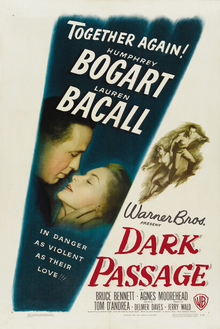
Dark Passage-1947

Dark Passage-1947

Director Delmer Daves

Starring Humphrey Bogart, Lauren Bacall

Scott’s Review #1,393

Reviewed August 25, 2023

Grade: B

In 1947, Humphrey Bogart and Lauren Bacall were big Hollywood stars. Dark Passage is the third of four films a real-life couple made together in the 1940s. It must have catapulted audiences to theaters to see the power couple perform.

To Have and Have Not (1944), The Big Sleep (1946), and Key Largo (1948).

Dark Passage is based on the 1946 novel of the same title by David Goodis.

Vincent Parry (Bogart) has just escaped from San Quentin prison near San Francisco, California, after being locked up for murdering his wife, a crime he did not commit.

He finds a plastic surgeon to give him new features. After getting a ride out of town from a stranger, Vincent meets a young woman, Irene Jansen (Bacall). She lets him stay in her apartment while he heals and continues to try to clear his name.

The duo falls madly in love and attempts to figure out the puzzle and find the real killer.

Delmer Daves is a director with whom I am unfamiliar. The film’s first portion uses superior camera angles and a point-of-view (POV) filming from Vincent’s perspective.

The audience sees what Vincent sees, which was used to justify Vincent’s plastic surgery and the knowledge that viewers wouldn’t buy a different actor from Bogart. This makes sense and adds a creative technological perspective to the film.

Something about black-and-white filmmaking always conjures up 1940s cinema for me. That Dark Passage is a thriller with film noir elements, making it all the more effective.

A personal treat for me was to see the exterior sequences of San Francisco. The Golden Gate Bridge and Union Square are easy to spot, and having spent time in both locales, I was fascinated by what both looked and felt like in the 1940s.

Notwithstanding the ‘look,’ the main draw is Bogart and Bacall. Although I have not seen their other films, their chemistry is apparent in Vincent and Irene.

The tenderness between the pair, considering the characters have only just met, is strong, especially during a quiet scene when they sip after-dinner coffee next to a window with driving California rain.

They get to know each other, and so does the audience.

Bacall, who is terrific and smolders with sensuality and confidence, easily outshines Bogart, who doesn’t deliver his best work. This could be partly because he doesn’t speak until the midway point of the film, but there is an aura that Bacall has that Bogart doesn’t.

My favorite film of his is Casablanca (1942).

The story starts tremendously with mystery and intrigue. Who killed Vincent’s wife quickly becomes who killed Vincent’s friend after he is also found murdered.

A tremendous scene between Vincent, a man he hitches a ride from and a taxi cab driver who helps Vincent increases the thrill ride with quick and engaging dialogue meant to maintain suspense.

The climax fizzles with an overly complicated and overwrought build-up to the final reveal that drags. When the villains are unmasked, their motivations are suspect and underwhelming.

One character plummeting from a high-rise window to their death is pretty cool, especially for 1947. The shrieking neighbor and the dead body displayed along the sidewalk is a highlight.

Also, a portion of the film takes place in beautiful Peru, similar to the nightclub in Casablanca.

Dark Passage (1947) is a pretty good film but will be appreciated mainly by fans of Bogart and Bacall. The plot is up and down, but the behemoth Hollywood stars are the main attraction.

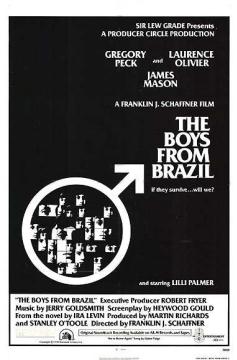
The Boys from Brazil-1978

The Boys from Brazil-1978

Director Franklin J. Schaffner

Starring Gregory Peck, Laurence Olivier

Scott’s Review #1,391

Reviewed August 20, 2023

Grade: B+

The Boys from Brazil (1978) is a taut political thriller with a neo-Nazi focus and a weird cloning subject matter.

It’s a bit of a tough follow, but it stays compelling all the way through and doesn’t lag.

Sometimes political thrillers get overly complicated or drag, but this one doesn’t.

The story is slightly hokey and impractical, even bordering on ludicrous, but since it’s so intriguing and action-packed, you can overlook those flaws.

Surprisingly, I wasn’t blown away by either Laurence Olivier’s or Gregory Peck’s performance, despite being a fan of both actors. Both actors overact and create stereotypes, but especially Peck’s character is a bit too cartoonish.

It took me half the film to recognize either man, since both are heavily made up and hard to tell apart. It also took until the dramatic conclusion for either character to truly grow on me.

A brilliant one-scene cameo performance by Uta Hagen, a German-American actress, as a former Nazi guard now imprisoned, nearly steals the show and should have earned an Oscar nomination.

The story surrounds Doctor Josef Mengele, played by Peck, who clones Adolf Hitler ninety-five times and raises the boys in Brazil, giving them childhoods identical to Hitler’s in various parts of the world.

His goal is to create a band of Nazi leaders that can continue where Hitler left off, forming the Fourth Reich. Their fathers will be murdered, and the boys will be mothered as Hitler was.

Ezra Lieberman (Laurence Olivier), a Nazi hunter, learns of the plan from a young journalist (Steve Guttenberg) and is determined to thwart it.

The plot is a tough pill to swallow and takes some time to absorb fully, but it’s fresh and unique. I’m not sure if, in 1978, people had had enough of Nazi and World War II films, but both subjects are always worth dissecting again.

I’m not sure why it was so tough to get used to Peck as the evil doctor, but it was. It’s probably because Peck usually plays characters with a strong moral compass, and he was playing way against type.

His character looks weird, and Peck seems to overact sometimes, almost like he’s playing a James Bond villain. It’s not exactly a role that measures up to Atticus Finch in To Kill a Mockingbird (1962).

Olivier is better and the main protagonist of The Boys from Brazil, but I’m not sure he entirely wins me over.

It’s not easy to immerse yourself in the prim-and-proper British aristocratic actor playing a Jewish man who kvetch so often.

Still, by the finale, when Mengele meets Lieberman in a deadly showdown involving vicious Dobermans, a gun, and a Hitler clone, I was cheering for Olivier all the way.

Supporting characters played by Guttenberg, Anne Meara (Jerry Stiller’s wife) as Mrs. Curry, one of the Hitler clones’ mothers, and the aforementioned Hagen are excellent.

I wish the film had explored each character better and given them more screen time.

The same can be said for Rosemary Harris in a one-scene performance. While the quality was good, I wanted more from her character of Frau Doring, the wife of one of the murdered fathers of the Hitler clones.

Finally, James Mason has little to do as Colonel Seibert other than serve as second fiddle to Peck.

But The Boys from Brazil is the Olivier and Peck show.

The locales are a big win, adding an international vibe and relevance. Geographies such as Germany, Paraguay, Austria, and rural Pennsylvania, United States, are featured, which greatly elevate the film.

The film’s taut nature provides suspense, an ode to history, and an eerie measure of Trumpism compared to Nazi-ism. The Boys from Brazil (1978) isn’t prime steak, but it’s not a bad watch either.

Oscar Nominations: Best Actor-Laurence Olivier, Best Film Editing, Best Original Music Score

Golden Globe Nominations: Best Actor-Drama-Gregory Peck

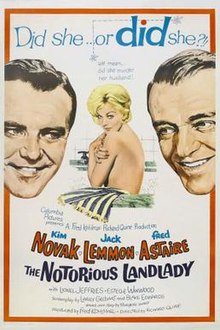
The Notorious Landlady-1962

The Notorious Landlady-1962

Director Richard Quine

Starring Kim Novak, Jack Lemmon, Fred Astaire

Scott’s Review #1,390

Reviewed August 16, 2023

Grade: B+

If viewers can overlook The Notorious Landlady (1962) ‘s messy nature and intermittent schizophrenic pacing, the film is enjoyable.

It’s not platinum status, but it’s a decent enough flick, especially for Kim Novak and Jack Lemmon fans, who were big stars. This is the third and final film that the duo starred in.

Like the film, their chemistry fluctuates, but it is appealing to see Novak in a comic role, whereas the genre is familiar territory for the funny Lemmon.

After her husband mysteriously disappears, Carly Hardwicke (Novak) finds renting a room in her lovely London apartment impossible because everyone assumes she’s responsible.

American diplomat William Gridley (Jack Lemmon) is new to the city and desires to live with Carly. It doesn’t hurt that Carly is easy on the eyes. William becomes smitten with her, unaware of her troubles.

When his boss, Franklyn Ambruster (Fred Astaire), learns what Gridley has stumbled into, the two men try to clear her name. A series of lies and misunderstandings catapult events into a compelling mystery.

Even though neither William nor Carly is British, the foggy locale works well and provides a foreign mystery. They reside in a courtyard-type home, from which neighbors can see in or out to other apartments. This comes into greater play towards the end of the film.

This is just one example of Alfred Hitchcock’s influence on 1954’s Rear Window, which director Richard Quine heftily borrows. He’s wise to do so since he secured Novak, fresh from her role in Vertigo (1958) two years earlier.

Shit, even the title ‘The Notorious Landlady’ borrows the title of the 1946 Hitchcock masterpiece, ‘Notorious.’

There’s also a secret locked door that Carly references and forbids anyone from entering, adding suspense and foreboding.

Despite the tepid chemistry between the stars, I ultimately enjoyed their romance. It’s a hard sell that the gorgeous Carly would fall head over heels for the everyman William, but she does.

They win me over during a dramatic scene where an attempted romantic dinner of steaks goes awry, and instead, a massive fire erupts. The burgeoning lovers cling together in a sweet embrace that cements their appeal.

The tension is supposed to be about whether Carly murdered her husband and has designs on William. Red herrings like kitchen poisons and the like make an appearance, but I was more interested in the impending mystery of said husband than really believing she’d want to kill William.

The last act introduces a threatening character, an unexpected villain, and a race to save another character in dangerous peril.

A courtroom scene also adds to the tension.

The central storyline is satisfying, edge of your seat, and suspenseful. I assume Quine was going for it.

The Notorious Landlady shifts genres a whopping three times in the story! The tone is all over the place: first, romantic comedy, then suspense and drama, and finally, slapstick.

During the finale, when Carly and William race to a retirement community and scramble to stop an out-of-control wheelchair, I half expected Laurel & Hardy or The Little Rascals to make a cameo.

Poor Fred Astaire has little to do and struggles to be relevant compared to Novak and Lemmon’s characters. At times, I even forgot he was still in the film.

The Notorious Landlady (1962) is an entertaining vehicle and a must-see for fans of Novak or Lemmon eager to see a largely forgotten film that offers something fun.

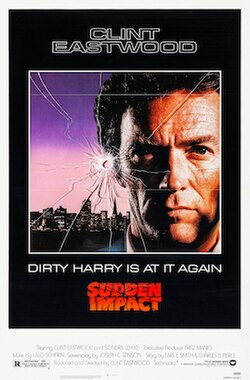
Sudden Impact-1983

Sudden Impact-1983

Director Clint Eastwood

Starring Clint Eastwood, Sondra Locke

Scott’s Review #1,388

Reviewed August 12, 2023

Grade: B+

The groundbreaking and highly influential Dirty Harry, released in 1971, spawned four sequels. Sudden Impact (1983) is the third.

It is directed by, produced by, and stars Clint Eastwood (making it the only Dirty Harry film to be directed by Eastwood himself) and co-stars Sondra Locke, the star’s longtime girlfriend.

On the surface, the film is standard fare and relatively conventional, featuring slick cinematography, a predictable story, shoot ’em-ups, and cartoon villains.

It’s also quite bloody and violent, with a theme of justice being served.

Exactly what you’d expect from any action/thriller to come out in the two decades following the original.

By 1983, the clichés and story setups had been seen in so many crime-thriller films that they felt tired and stale and could be predicted in advance.

The expected Dirty Harry catchphrase in Sudden Impact is, “Go ahead, make my day,” which is probably what the film is best remembered for, though some assume the famous line appears in Dirty Harry.

This isn’t a glowing testament for Sudden Impact.

United States President Ronald Reagan embarrassingly used the “make my day” line in a March 1985 speech, threatening to veto legislation raising taxes.

The secret weapon of Sudden Impact, though, is the inclusion of Locke, who is a tour de force as an actor and elevates the film quite a bit. Her romance with Eastwood (on and off the silver screen) simmers with chemistry, making Sudden Impact feel like a much better film than it is.

Jennifer Spencer (Sondra Locke) is a thirty-something blonde bombshell who, along with her much younger sister, was gang raped, but the crime went unpunished. She now hunts down those responsible one by one and gruesomely shoots them in the testicles before killing them.

She’s not a gal to be messed with.

The murders attract the attention of Harry Callahan (Eastwood), who is on a forced vacation due to his violent approach to police work.

The case gets complicated when Harry develops a relationship with Jennifer, and it’s up to Harry to make the right decision when Jennifer’s life is threatened for a second time.

Locke and Eastwood always do well with marginal material- think Bronco Billy (1980) or Every Which Way But Loose (1978). Both of those films are more comical, so it’s riveting to see them co-star in a violence-based thriller.

Not to dwell on Locke (okay, I must), but she’s the best part of Sudden Impact. The first scene involves one of her vigilante murders, and her cold, calm steadiness is magnificent. Through icy eyes, she is filled with rage, though she is wise and calculating.

When she is not blowing balls to bits, Jennifer leads a successful life as an author and escapes to a whimsical carnival town outside San Francisco to focus on her work. She also finds time to finish killing the remaining members of the gang of rapists.

Locke mesmerizes in every scene she appears in.

Eastwood is good too, but his character is the same grizzled, sick-of-crime guy with a gun he’s had since the beginning. Harry’s arguments with the suits in the top office are tired, and the actors cast are handily stock types.

The win is Eastwood’s scenes with Locke. As they share dinner, a romantic tenderness perfectly offsets the rest of the story. We ask, will he send her to prison or let her go when he inevitably finds out she’s the killer?

Is she justified?

The rapists are cartoon-like and poorly cast, and there is no character development. The main villain, Mick (Paul Drake), shrieks, wails, and delivers his dialogue in an over-the-top fashion. He’s a poor man’s ‘Scorpio’ who he tries to emulate.

A female villain, an assumed lesbian named Ray Parkins, in a purely politically incorrect fashion, has every lesbian stereotype imaginable.

I liken Sudden Impact (1983) to a McDonald’s meal. A greasy Big Mac, fries, and a shake. It’s not fine dining, but it’s satisfying, and one knows exactly what to expect. Only in this case is Locke the special sauce.

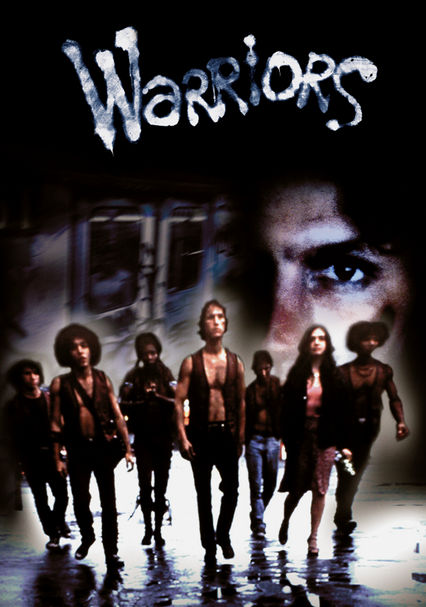
The Warriors-1979

The Warriors-1979

Director Walter Hill

Starring Michael Beck, James Remar, Deborah Van Valkenburgh

Scott’s Review #1,383

Reviewed July 31, 2023

Grade: B+

The Warriors (1979) is an entertaining gang-themed action-thriller that is a perfect watch for a late Saturday night.

Reportedly, it caused friction and outbreaks of fights in movie theaters when it was released, but decades later, it doesn’t feel as dangerous as it might have then.

The film does terrific work with its art direction, which melds live action with colorful character drawings. This infuses an artistic experience and elevates the results far above dumb action flicks like Rambo (1982), Death Wish (1974), and countless others.

In a perhaps peculiar comparison, The Warriors reminds me a bit of John Carpenter’s Escape from New York, which came two years later. The isolated Manhattan streets and other areas with a post-apocalyptic feel merge the two films, in my mind anyway.

The film suffers a bit from a dated, obscure categorization and is not remembered as well as it perhaps should be. The acting isn’t terrific either, but strangely, this makes the experience a bit more raw and enjoyable.

After being wrongly accused of killing a charismatic gang leader named Cyrus, a Coney Island street gang known as the Warriors must hoof their way home, which is miles from where the death occurred.

They are pursued by both police and enemy gangs, one of which framed them for Cyrus’s execution.

The ambiance and atmosphere are the best aspects of the film. So many Big Apple treats can be found, especially in the infamous Central Park, which takes center stage. The lavish and picturesque park wasn’t as safe and pristine in the late 1970s as it was in 2023, and the film uses this to its advantage.

Characters never know who or what might be lurking behind a bench or a tree. A particularly fun scene features a young Mercedes Ruehl being groped by a gang member, only to be revealed to be a sexy policewoman who quickly puts the perp in handcuffs.

The other featured locales include Van Cortlandt Park, Union Square, 96th Street and Broadway, and Riverside Park. The beauty of this is that the action doesn’t include only Manhattan but also other boroughs like the Bronx and Brooklyn, showing the vastness of NYC.

The main romance is between Swan (Michael Beck) and Mercy (Deborah Van Valkenburgh). The pair have a sliver of chemistry, but I wasn’t watching the film for doleful young people.

One scene was exceptionally well done when the couple laid eyes on some well-dressed, upstanding teenagers on the subway who could easily be their doppelgängers.

Maybe them in another life? The forlorn look on the faces of Swan and Mercy reveals much as the couple’s all eyes each other, perhaps thinking the same thing.

Walter Hill directs the film and is well-versed in the action genre, creating the popular film 48 Hours (1982). He paces and choreographs the action sequences so well that it’s as if the viewer is watching a dance routine occur.

The opening sequence gets the tone of the film out in the open as the storied Wonder Wheel on dusty Coney Island is on full display. Even the bright and windy shore feels gloomy and ominous as leather-clad gang members make it their turf.

The finale salutes the Warriors with a song, ‘In the City by Joe Walsh, which I particularly enjoyed because it’s a great song.

Though unrealistic for the time, it’s nice to see gang members of different ethnicities team up, showcasing diverse representation.

The film is a perfect watch for cinema fans thirsty for old New York City locales and greasy, dirty subway stations because the real Manhattan wasn’t too different from what The Warriors (1979) showcases.

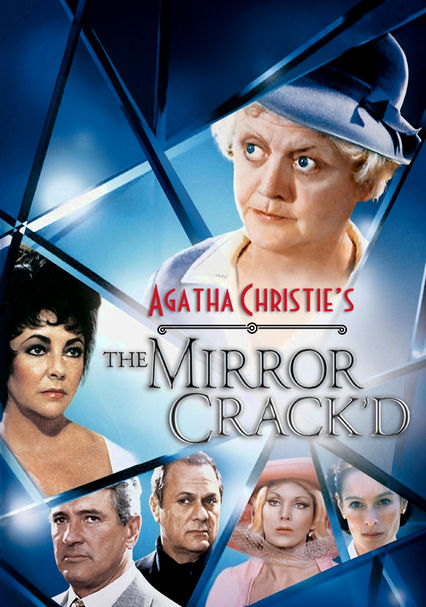
The Mirror Crack’d-1980

The Mirror Crack’d-1980

Director Guy Hamilton

Starring Angela Lansbury, Elizabeth Taylor, Rock Hudson

Scott’s Review #1,371

Reviewed June 22, 2023

Grade: B+

I’m a sucker for any sort of whodunit, especially based on an Agatha Christie novel.

Some of her treasures, like Murder on the Orient Express (1974) and Death on the Nile (1978), have made for quality crime-thriller filmmaking.

With The Mirror Crack’d (1980), director Guy Hamilton (he directed four James Bond films) gathers some of Hollywood’s finest stars and crafts an adaptation with British authenticity and a knock-it-out-of-the-park finale twist I didn’t see coming.

Fans of the long-running CBS sleuth series Murder, She Wrote from the 1980s are treated to gleeful clues that the film influenced the show. Both star the iconic Angela Lansbury.

The main character and murder solver in The Mirror Crack’d is a kindly older woman named Miss Marple, played by Lansbury. The actress is aged via makeup to look much older than she was at the time. Lansbury does a good job with the speech and mannerisms of her character’s age.

Jane Marple (Lansbury) is tickled pink when two glamorous Hollywood actresses, Marina Rudd (Elizabeth Taylor) and Lola Brewster (Kim Novak), arrive in her quaint English village to shoot a movie.

Drama is sprinkled in when it’s revealed that the two actresses despise each other.

At a film-related welcome reception, Marina engages in conversation with a longtime fan, Heather Babcock, and is momentarily distracted. Soon afterward, the fan collapses and dies, poisoned by a drink intended for Marina.

Pleasure is had by the incorporation of so many stars, some way past their prime.

My favorite is the dynamic duo of Taylor and Hudson as a married couple. Fans will recall that Hudson’s sad death due to A.I.D.S. in 1985 led to Taylor championing a crusade for research with which the government then refused to be associated.

Her efforts and star power led to tremendous progress to be made as the disease ravaged the world’s LGBTQ+ community.

So, any scene centered on Taylor and Hudson is heartfelt and a pure treat.

Otherwise, the cast of characters is arranged in a familiar pattern, revealing that almost everyone would have a reason to kill the glamorous star. Could it be her sexy blonde rival? Or the cranky producer of the film played by Tony Curtis? Or even her hubby, Jason?

Geraldine Chapman appears as Ella Zielensky, who is secretly in love with Jason and has a good reason to want Marina out of the way. Especially suspicious are her trips to a phone booth to call an unknown person, accusing them of murder.

The setting adds value as the small English village is cute and picturesque. Marple’s cottage is perfectly dressed with colors and patterns well suited to her character.

The Mirror Crack’d has a couple of misfires and sometimes a television-movie feel. The comparisons to Murder, She Wrote, while nice, are also detractors since they make the film seem like a small-screen effort.

The time is supposed to be 1953, and the characters are dressed appropriately, but it doesn’t feel authentic. The real year 1980 feels more believable despite the costumes.

While it doesn’t drag a bit, it also isn’t quite as good as the aforementioned Murder on the Orient Express (1974) or Death on the Nile (1978).

For a good old-fashioned detective story based on a storied author, one could do worse than watching The Mirror Crack’d (1980).

Sure, there are other, better-produced efforts, but the film is a solid, entertaining watch with glamorous stars incorporated.

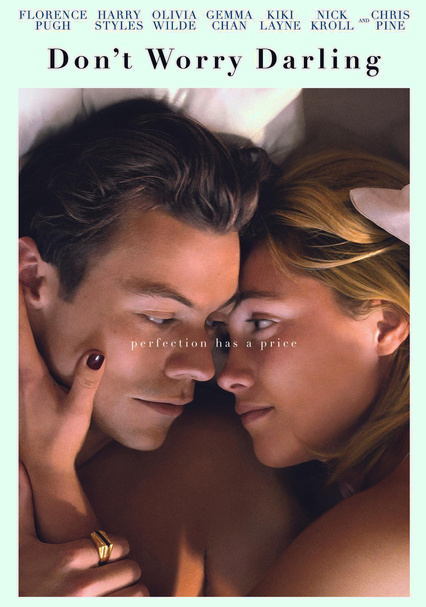
Don’t Worry Darling-2022

Don’t Worry Darling-2022

Director Olivia Wilde

Starring Florence Pugh, Harry Styles, Chris Pine

Scott’s Review #1,368

Reviewed June 9, 2023

Grade: B+

Don’t Worry Darling (2022) plays like a modern version of The Stepford Wives (1975) meets Pleasantville (1998) but with a supernatural spin and lots of much-needed modern diversity.

Not set in present times, the characters all feel very 2022 but are transplanted to a different period that only enhances an already unsettling feeling.

The sophisticated 1950s set design and art direction are a significant score, as well as the mysterious happenings that continue to shroud the central character and her surroundings.

The film never lags and, in fact, fascinates throughout. There is a continuous feeling of uncertainty, dread, and controlled chaos that assuredly will explode in the finale.

I’m not sure I quite got the conclusion right away until I read through the summary, and something about an alternate universe and different lives outside of the primary setting was revealed. Regardless, it felt unsatisfying, especially compared to the rest of the events.

But, small potatoes, I still enjoyed Don’t Worry Darling immensely.

The premise is thrilling from the start. A 1950s housewife named Alice, played by emerging star Florence Pugh, is living with her husband in a utopian experimental community. They mingle with neighbors, host lavish parties with delicious food and drink, and enjoy each gorgeous sunny day.

Daily, the men dutifully drive off to work in the distinguished Victory Headquarters while the wives cheerfully clean and scrub the windows and prepare a savory dinner, counting the minutes until their husbands return for a romp in the hay.

It all sounds too good to be true.

When a close friend Margaret (KiKi Layne) experiences a psychotic episode witnessed by Alice, she begins to worry that her husband’s glamorous company may be hiding disturbing secrets and that everything may not be as perfect as it seems.

I am becoming a big fan of Florence Pugh, who effortlessly carries the film. Impressive in both Midsommar and as Amy in Little Women, both in 2019, she possesses a specific ‘it’ factor showcased well in Don’t Worry Darling.

Pugh has many scenes with no dialogue. Ranging from a soak in the bathtub, a bizarre episode where she wraps her head in Saran Wrap, and witnessing her friend’s death, she does so much without speaking.

Successfully, the audience is taken along for the ride. We know as much as Alice does, which is nothing. It’s not that Alice hates her life; hell, she’s got it pretty good. A scrumptious roast and carrots alongside hot sex on her dining room table, the girl could do much worse.

But she knows something is off and is determined to find out what it is. Why are the women forbidden from seeing the Victory Headquarters? Why does a plane crash that only Alice sees? Why does Frank, the alpha male leader of Victory, wonderfully played by Chris Pine, keep eyeing Alice?

Impressive is the direction by Olivia Wilde, who also appears as Alice’s friend, Bunny. Along with the screenwriter, Katie Silberman, the duo crafts a piece of work with a feminist perspective turned topsy-turvy, and it’s a good angle.

Not to harp on the ending again, but the message of female empowerment, which I think is the intention of Wilde and Silberman, is unclear. A bolder message and a more finite ending would have helped cement the deal.

Still, in Wilde’s only second film, the first being the vastly different Booksmart (2019), she should only be proud of herself and the product she created.

If one is seeking an emboldened psychological thriller with twists and turns to savor, Don’t Worry Darling (2022) is a fine pick. It creeps along with appropriate plot points and a stylized visual canvas.

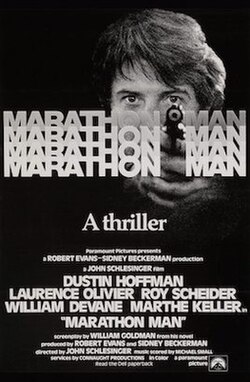
Marathon Man-1976

Marathon Man-1976

Director John Schlesinger

Starring Dustin Hoffman

Scott’s Review #1,359

Reviewed April 29, 2023

Grade: A-

Writer William Goldman was involved in two politically charged, taut thrillers released in 1976 that you can easily watch back-to-back.

Fast-paced, rapidly edited, action-packed offerings are on the menu.

The Academy Award-winning All the President’s Men (1976) and Marathon Man (1976) are highly recommended, as they are in the same vein.

They are part of why I love 1970s cinema so much. Freedom and rich character development, combined with a singular vision, are admirable traits.

John Schlesinger, famous for Midnight Cowboy (1969) and other films, directs.

Goldman wrote both films, and each stars Dustin Hoffman, so the similarities are endless. And yet, each has its own identity.

In Marathon Man, Thomas “Babe” Levy (Hoffman) is a Columbia graduate student and long-distance runner, residing in New York City. His older brother, Doc (Roy Scheider), is a government agent chasing down a Nazi war criminal named Szell (Laurence Olivier).

Babe doesn’t learn about Doc’s career until a tragic event draws him into a plot involving stolen gems and sadistic madmen. Even his girlfriend, Elsa (Marthe Keller), becomes a suspect as everything Babe believes is suddenly turned upside down.

At over two hours, there is not a slow moment in the film.

We meet Babe as he runs through New York City, so the audience learns that his obsession with running may be linked to his need to escape something.

This proves to be true when we learn the brothers’ father committed suicide after being investigated during the Joseph McCarthy era, when civilians were suspected and accused of being communists.

So, the backstory made me sympathize with Babe and Doc and fleshed them out as characters. Hoffman and Scheider are superb and show the nuances in the brothers’ personalities. Doc is sophisticated, and Babe is common, though highly intelligent.

The musical score, by Michael Small, deserves mention. Oftentimes in film, the score serves as more or less ‘background music’ and can go unnoticed.

This is not the case in Marathon Man, and I noticed the music-enhancing sequences several times, especially when peril was involved.

I was pleased to learn that the iconic Laurence Olivier plays the villain, Szell. He is believable as a vicious German Nazi who specializes in a unique brand of dental work.

First blonde, then bald, the role’s physical demands are on full display. He also calmly performs torturous tactics using dental tools.

Marathon Man is made up of a series of scenes that will either enthrall, make the audience squirm, or, in some cases, both.

Speaking of dental work, any viewer with a phobia or dislike of going to the dentist may want to fast-forward past the sequence in which Babe is forced to endure stylized poking and prodding.

Szell and his henchmen are convinced that Babe knows more than he is letting on and are determined to make him reveal all.

Early on, a terrifying road-rage scene in Manhattan is as good as it gets and reveals the plot’s gist. Nazis, anti-semitism, and a fiery gasoline truck encompass a speedy and argumentative car chase scene.

The sequence is heart-racing, nail-biting, and revealing.

Others flesh out the film like a quiet lunch at a lovely French restaurant. Doc takes Babe and Elsa out where they dine on lavish courses of creamy, sophisticated cuisine and wine.

The richness of the food and culture enhances the earlier scenes set in Paris.

The final thirty minutes of Marathon Man are the best part. A series of shootouts in the suburban rural farmland and foot chases in downtown Manhattan culminate in a showdown between Babe and Szell near a water tank in Central Park.

A strong appeal for viewers is the scene-by-scene New York City action, as many exteriors were shot there.

The plot of Marathon Man (1976) is sometimes too complicated, and not all events add up satisfactorily. The who’s who and realism are a tough sell, but it hardly matters.

The film entertains and is a high-energy thrill ride, and that is more than enough for me.

Oscar Nominations: Best Supporting Actor-Laurence Olivier

Golden Globe Nominations: 1 win-Best Actor-Drama-Dustin Hoffman, Best Director-John Schlesinger,  Best Supporting Actor-Laurence Olivier (won), Best Supporting Actress-Marthe Keller, Best Screenplay

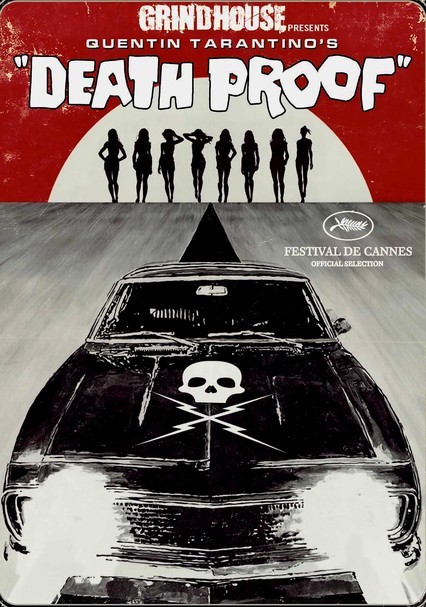
Grindhouse: Death Proof-2007

Grindhouse: Death Proof-2007

Director Quentin Tarantino

Starring Kurt Russell

Scott’s Review #1,344

Reviewed February 13, 2023

Grade: A

It’s tough to go wrong with a Quentin Tarantino film, recognizing that one needs to be a Tarantino fan. His films are for specific tastes that indulge in stylized violence, dark humor, and cartoonish characters.

Grindhouse: Death Proof (2007) is an easy victory for the director, incorporating his trademark qualities through beautiful female race car drivers and a sadistic stuntman.

As usual, revenge is the name of the game and results in a satisfying ending. The thrill is in the chase that occurs mainly midway through, and plenty of B-movie references and old songs are on display.

The experience is a pure pleasure for any cinema lover who appreciates aspects of the film, like editing, that too often fall beneath the surface.

The scratchy film texture and retro title sequence all help to encompass another Tarantino opus.

The film is part of a double feature with Robert Rodriguez’s Planet Terror and includes a series of mock-exploitative trailers.

Both, specifically Tarantino’s, harken back to when exploitative films were shown in dusty movie houses with grainy video and a stale popcorn stench.

The mood was immediately set for me while watching the film, which greatly enhanced my enjoyment.

Psychotic stuntman Mike (Kurt Russell) is a professional body double who likes to meet unsuspecting women at bars and take them for deadly drives for fun. He has a specially made car that he calls ‘Death Proof,’ but only for the driver, not the passenger.

The first half of the film involves a group of girls out for a good time in a dive bar. Abbie (Rosario Dawson), Pam (Rose McGowan), and others ultimately fall victim to his shenanigans during a particularly well-filmed head-on collision.

Later, he meets a tough group of female race car drivers led by real-life stuntwoman Zoe Bell, who vows to make him pay for causing them trouble.

Their hell-bent vengeance just may be what the doctor ordered to cause Mike’s downfall.

Tarantino fans often overlook Death Proof, and it might be because it’s paired with another film. But it’s not half a movie either, and at one hour and fifty-four minutes, it’s got legs.

The film flies under the radar for me, too, but it’s a high-octane mile-minute experience.

One great part of Death Proof is the throwback to cult films of the 1960s and 1970s, especially Faster Pussycat! Kill! Kill!, a 1965 exploitative masterpiece by Russ Meyer.

These girls are no shrinking violets or damsels in distress who need a man to save the day. Quite the contrary. They kick ass and take names, especially in the flawless second half. Out for blood, the girls assuredly put Mike firmly in his place.

Juxtaposed with the first half, which has a dire ending for the girls, the second half is more upbeat and satisfying.

The lighting is also different in the two halves. The first takes place well beyond midnight, while the second is in the bright afternoon.

Tarantino produces a brilliant piece of feminist progressivism with nasty muscle and female characters not to be messed with. Death Proof (2007) features badass characters, hints of humor, and discussions about men.

The girlie action flick blends perfectly with the 1970s race cars and the sexploitation theme Tarantino is recreating while still making the film feel modern and relevant.

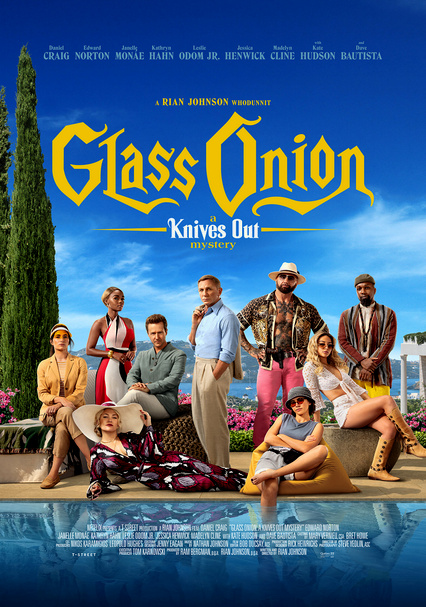
Glass Onion: A Knives Out Mystery-2022

Glass Onion: A Knives Out Mystery-2022

Director Rian Johnson

Starring Daniel Craig, Edward Norton, Janelle Monáe

Scott’s Review #1,331

Reviewed January 5, 2023

Grade: B

I teetered over grading Glass Onion: A Knives Out Mystery (2022), referred to as Glass Onion, a B+ or a B, but the hardline critic in me won out on this day.

If I hadn’t compared it so much to the deliciously witty and inventive Knives Out from 2019, I might have given it a generous B+ rating. Still, it’s also impossible not to compare the two, since the setups and similarities are too apparent.

Rian Johnson, who returns to the fold as director, writer, and co-producer, pays tribute to the fabulous Agatha Christie murder mystery whodunits and the Hercule Poirot detective inclusion with the delightful Daniel Craig as the lead, reprising his role as master detective Benoit Blanc, as he takes on an exciting new case.

A Greek island owned by ultra-billionaire Miles Bron (Edward Norton) serves as the setting for the Southern detective’s latest adventure, which unfolds as a group of the tech giant’s friends gather for a murder mystery party that quickly turns deadly.

I couldn’t watch Miles without thinking of Elon Musk, the current controversial social media Twitter chief executive officer, in all his juvenile buffoonery.

Appearances by top stars Janelle Monáe, Kate Hudson, Kathryn Hahn, and Leslie Odom Jr., and a surprise cameo by Hugh Grant round out the cast. Along with Craig and Norton, this brings enough star power to create buzz.

It’s also appealing that Benoit, a clear ode to Poirot, is the only character who is the same from the first Knives Out story. His character is immediately developed when we see him soaking in a bathtub in his Manhattan apartment, conversing with a male voice offscreen.

He refuses to leave the tub during the very topical COVID pandemic, making the entire film feel incredibly timely and relevant.

Let’s see what happens when the film ages ten years.

We later learn that his husband, Phillip (Hugh Grant), lives with him, and Blanc is gay. How wonderful to incorporate an LGBTQ+ presence into a main character, and icing on the cake is that the studly James Bond actor is all in.

With Blanc’s vague sexuality revealed, the exciting mystery commences with many twists and turns among the characters, led by a fantastic dual performance by Monáe. She plays sophisticated New Yorker Andi and her southern sister Helen Brand.

The other characters are a mixed bag with Hudson and Hahn playing ridiculous, over-the-top roles as a washed-up fashion designer and an aspiring governor, respectively.

But the cartoon character award goes to former WWE professional wrestler David Bautista as the weird, buff guy, Duke Cody, who barely keeps his clothes on.

Still, the characters are a hoot, and the anticipation of how they all connect, who has screwed over whom, and why, is slowly revealed in fun form.

Not to be outdone, there are even revelations of who is screwing whom in the bedroom.

The story isn’t as interesting as the one in Knives Out. The ingenious script is lost, and by the end, it’s a case of who cares? All we want to know is who’s dead and who’s alive, and what does the Mona Lisa have to do with anything?

The cast undoubtedly had a ball making Glass Onion, and the sunny Greek Island locale is a great choice. As the players bask in the sun and saunter around in bikinis, sipping a cocktail or three amid peril, it is great fun for the cast and viewers alike.

It’s unclear if Johnson will create another installment of the Knives Out collection, but I’m on board if he does. I’ve been fascinated by the whodunit genre for as long as I can remember.

Glass Onion: A Knives Out Mystery (2022) isn’t quite as riveting or satisfying as Knives Out (2019), but the film is still enjoyable, thanks to its superior, glossy production values and a great cast.

Oscar Nominations: Best Adapted Screenplay

The Enforcer-1976

The Enforcer-1976

Director James Fargo

Starring Clint Eastwood, Tyne Daly, John Mitchum

Scott’s Review #1,330

Reviewed January 2, 2023

Grade: B+

The Dirty Harry film series is pure, gooey 1970s machismo entertainment.

Featuring a vigilante-type police detective who rids the world of the bad guys is pleasure personified, if not all that realistic. In these films, there is only good versus evil, and social issues, if explored, are not the most relevant part of the film, but rather provide more context for why the events occur.

Nonetheless, the films are top-notch in action, with quality gunfights and violence, creating a powerful crime thriller franchise that still holds up well.

They are much better than the similar yet uninspired and poorly acted Death Wish films featuring Charles Bronson.

The Enforcer (1976) is a third of five films from 1971 until 1988, following the 1971 masterpiece Dirty Harry and the nearly as good Magnum Force in 1973.

This one offers a slightly progressive, feminist approach that continues into 1983’s Sudden Impact and adds much-needed humor, creating a lighter touch.

Feminism is the inclusion of a female cop due to a new affirmative action initiative, who goes toe to toe with the masculinity and conservatism of our main character.

Officer “Dirty Harry” Callahan (Clint Eastwood) is reassigned from homicide to personnel after his latest use of excessive force exhausts his outranking superiors. Demoralized, he angrily assumes his duties while a new case disrupts the San Francisco Bay Area.

A new terrorist group, calling itself the People’s Revolutionary Strike Force, organizes a series of crimes in San Francisco, hoping to enrich themselves. Led by Bobby Maxwell (DeVeren Bookwalter), they wreak havoc and create fear.

When they kidnap the mayor (John Crawford) and steal rockets and rifles for their next attack, Harry and his new female partner, Inspector Kate Moore (Tyne Daly), must stop the terrorists.

To measure up to 1971’s Dirty Harry is a nearly impossible feat, but The Enforcer continues the rhythm with largely the same basic script. A main part of the fun is watching the grizzled Callahan feud with his superiors and being reduced to working with a female cop.

Naturally, he and Moore eventually become buddies, and I like the lack of sexual chemistry between them. She’s not interested in his affection, and neither is he, so their relationship is focused on serving and protecting the public.

Daly is terrific as Moore, which led to her career-defining role in the television series Cagney and Lacey. Rather than playing her as a bitch she is warm and determined to immerse herself in a man’s world.

She’s a great character, but unfortunately, she is not explored as much as she could have been.

The filmmakers also keep San Francisco’s setting intact, which is a wise move and a treat for moviegoers who love a good exterior sequence or two.

A fabulous final sequence finds the film’s events heading to a Giants game at the historic Candlestick Park, and finally a showdown at Alcatraz Island. These trimmings are essential for fans anticipating the juicy, pulsating locales of the populous city.

No, Eastwood is not the greatest actor in the film, but he is the best at playing Callahan. He carries the film seamlessly and will make conservatives smirk as he endures the irritations of liberal-minded decision-makers.

A weak explanation of the real motives of the terrorist group is unimportant. It’s the violence, the thrills, the chases, and Eastwood and Daly that make this movie pure fun.

The Enforcer (1976) doesn’t challenge or add to the creativity of cinema but offers a shoot-em-up experience with a confident, charismatic protagonist.

Forever immersed in the good tidings of 1970s cinema is enough to continue the successful string of Dirty Harry films.

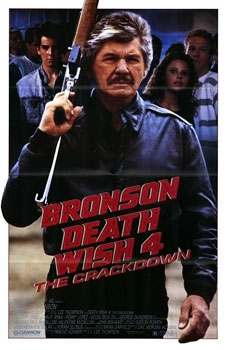
Death Wish 4: The Crackdown-1987

Death Wish 4: The Crackdown-1987

Director J. Lee Thompson

Starring Charles Bronson

Scott’s Review #1,319

Reviewed November 29, 2022

Grade: C+

I have an interesting relationship with the Death Wish films. Besides the first and maybe its follow-up, they pretty much suck, and that’s being kind.

They possess a machismo and right-wing, pro-National Rifle Association stance that’s not my cup of tea.

To make matters worse, poor acting, stagey action sequences, an explosive overuse of smoke ammunition, and endless clichés riddle the screen in nearly every scene.

Sure, there’s usually some heartwarming romantic moment or a justification for the killings, but the series is solidly amateurish.

With my nose to the grindstone, I somehow, someway, plodded through all five of the Charles Bronson film series installments and lived to tell.

I refuse to see the tepidly reviewed, unrelated 2018 incarnation starring Bruce Willis.

But the funny thing is, with all the cinematic negatives, the Death Wish films are fun in a campy, silly way. Hardly high art, they instead provide the viewer with fluff and a quick ninety-minute experience in shoot ’em-up revenge-seeking bloodletting.

With Death Wish 4: The Crackdown (1987) the filmmakers cleverly leverage the 1980s excess with a witty subtitle channeling the crack epidemic of the day set against the backdrop of lusty Los Angeles and the drug carnage seeping over the United States border from neighboring countries.

Some thirty-five years later, the premise is dated to say nothing of being riddled with stereotypes, but at the time, the plot must have seemed downright modern.

Paul Kersey (Bronson), who is no stranger to vigilante justice, is pulled back into the underworld of gritty Los Angeles when the daughter of his new girlfriend, Karen (Kay Lenz), dies after an overdose of crack cocaine.

Intent on dishing out a healthy dose of vigilante justice, he goes after the drug lord who ultimately supplied the crack, apparently forgetting to focus on the social issue of why the young girl was taking drugs in the first place.

The First Lady Nancy Reagan’s famous anti-drug slogan, ‘Just say no,’ fell on deaf ears.

As he hunts down the kingpin’s henchmen, Paul starts taking out a large part of the city’s drug-dealing population on a violent killing spree while posing as a dimwitted bartender.

The acting is laughably bad from Bronson on down to the bit players.

My favorite bad scene is when an interracial couple squabbles on their way out to dinner from the luxurious high-rise apartment they inhabit.

As she sits in the limo, brooding and cursing her mate who forgot something from the apartment, he is suddenly hurled from his penthouse onto the limo as she shrieks with anguish, after wishing him dead only seconds prior.

Director J. Lee Thompson, well past his prime in the late 1980s, forgot to tell his actors to add a bit of humor to the horrendous line delivery.

Or, he might have just phoned the whole thing in himself.

The film is by-the-numbers, and one attempt at a twist toward the end is an inspired effort. A pivotal character is shockingly killed, and it ain’t Paul who meets his maker either.

I didn’t see this surprise coming.

Nonetheless, despite the myriad of bad qualities contained within Death Wish 4: The Crackdown, the bad guys do get their just desserts, which are delightful to witness.

Death Wish 4: The Crackdown (1987) is best served up on a rainy afternoon when the viewer can munch on popcorn and lazily escape the day away with solid cinema trash.

Minority Report-2002

Minority Report-2002

Director Steven Spielberg

Starring Tom Cruise

Scott’s Review #1,318

Reviewed November 27, 2022

Grade: B+

If you study his body of film work, the fascinating thing about acclaimed director Steven Spielberg is the growth and groundbreaking cross-genre categorization of many of his films.

Traversing blockbuster popcorn films like Close Encounters of the Third Kind (1977) and E.T. the Extra-terrestrial (1982) to heavy drama with the 1993 masterpiece Schindler’s List, the man can do it all.

With 2002’s Minority Report, he bravely delves into science-fiction territory with a crime thriller and action tint.

The film is tough to follow and mostly reminds me of Inception (2010), a Christopher Nolan film influenced by it.

Despite its cerebral tone, Minority Report is a fascinating study of futuristic crime-fighting styles with enough twists and turns to keep you engaged.

It turned out well, though I confess that at times I had no real idea what was going on plot-wise.

The casting of Tom Cruise is a major win. Who better to carry a film like this, except maybe Bruce Willis, though Cruise is a better actor. Nonetheless, he is believable as a crime chief with a slick edge and a wicked smile.

Unsure whether to trust him, he remains at the heart of the film’s success.

Based on a story by science fiction writer Philip K. Dick, ‘Minority Report’ contains a perfect premise to bring to the big screen.

Set in Washington, D.C. in 2054, police are now intelligent enough to utilize psychic technology to arrest and convict murderers before they commit their crimes.

The setup is fabulous and rife with possibilities.

Cruise plays Chief John Anderton, the head of this Precrime unit, and is himself accused of the future murder of a man he hasn’t even met.

Following an audit, it is predicted that in thirty-six hours, Anderton will kill a man who is a stranger to Anderton. Anderton flees, prompting a search led by a searcher (Colin Farrell).

It is revealed that Anderton joined the Precrime program after his son was kidnapped and never found. He is depressed, withdrawn, and addicted to hard drugs, and his wife Lara (Kathryn Morris) has since left him.

But is this all a setup, and are others involved in the conspiracy?

The plot goes way off the rails in terms of explanation or logic, but the fun is in trying to put the never-ending puzzle pieces together. Truthfully, after a while, I simply gave up and enjoyed the visual eye candy and terrific futuristic style.

I rarely am a proponent of visuals over storytelling, but the intelligence of the sequences and the thrilling nature of the acting assured me there was something there.

I just wasn’t completely getting it.

Since Spielberg directs it, I was confident that the complexities I was being served were not shit. I was comforted by this knowledge, and my enjoyment escalated.

Enough props can’t be given for Cruise’s dynamic performance, heightened by the coldness and harshness of the film’s overall tone.

Many of Spielberg’s films are heartwarming, but that was not the case in Minority Report (2002), and I liked it even more for that reason.

Spielberg gets another win by suckering me into a cinematic world that he can magically create. This time with perplexities and perhaps even some influence from the Matrix (1999) movies.

Oscar Nominations: Best Sound Editing

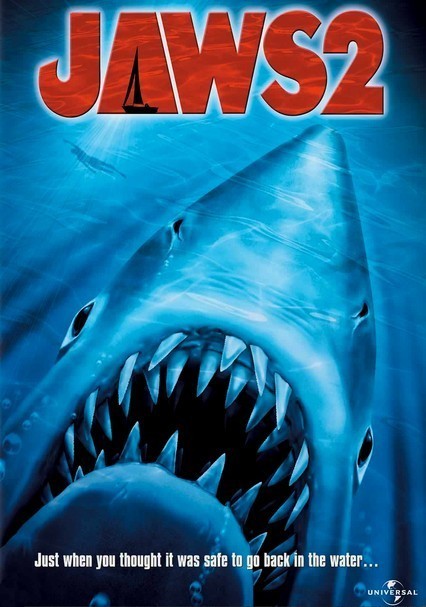
Jaws 2-1978

Jaws 2-1978

Director Jeannot Szwarc

Starring Roy Scheider, Lorraine Gary, Keith Gordon

Scott’s Review #1,307

Reviewed October 13, 2022

Grade: A-

Because of the enormous critical and commercial success of Jaws in 1975, a sequel was created. Important to keep in mind is that in the mid-1970s, it was not yet common to produce sequels, especially if the director, Steven Spielberg, had no interest in participating.

Jaws 2 (1978) was an enormous box-office success, but the reviews were only mixed.

I adore the film, which mixes thrills with the horror genre and wisely sets up the kills like a slasher film.

The teenagers are savagely attacked and killed by the Great White shark, one by one, in a style that uses a lurking and effective musical score.

The film’s tagline, “Just when you thought it was safe to go back in the water…” has become one of the most famous in film history and has been parodied and homaged several times.

I want to assume it led to a healthy, almost now-mandatory helping of sequels to other successful films.

Unfortunately, Jaws 2 also spawned a couple more sequels of its own, which were piss-poor and laughable, but we won’t get into that here.

A fun fact is that the film was nearly as troubled as Jaws. The first director of the film, John D. Hancock, was deemed incompetent and replaced by Jeannot Szwarc.

Star Roy Scheider, who only reprised his role to end a contractual issue with Universal, was also unhappy during production and had several heated exchanges with Szwarc.

Maybe that should have been a sign not to make any more Jaws films.

Years after the shark attacks that left Amity Island reeling, Sheriff Martin Brody (Scheider) finds new trouble lurking in the waters and must rise to the occasion.

To add conflict, Mayor Vaughn (Murray Hamilton) wants to end the beach town’s poor reputation. But the sudden disappearance of a pair of divers suggests that something is up. When Sheriff Brody voices his warnings about holding an exciting sailing competition, everyone thinks he is suffering the effects of post-traumatic stress.

That is, until a shark fin is spotted in the water, sending the town into panic mode.

There’s no logical plot reason to make Jaws 2, but somehow I’m okay with that. The film entertains with enough frights and jumps to satisfy, and the formulaic approach works well.

Besides the enthralling final sequence when Brody must rescue his sons, Mike and Sean (Mark Gruner and Marc Gilpin), the opening sequence involving scuba divers and a female water skier is quite enticing and the best part of the film.

The musical score by John Williams, who fortunately returned to the fold, is fabulous and enhances any peril the characters face. The slick and clever approach gives the audience a clue that danger lurks nearby, but we don’t know when or where the shark will strike.

I mentioned slasher films earlier, and this formula is used in Jaws 2. As the teens set sail for the competition, it is good fun to wonder who will get killed and who will live to see another sunny beach day.

Despite Scheider not wanting to do the film, you’d never know it by his terrific acting. He doesn’t phone in his performance, and he brings macho swagger and muscle. He’s everyone’s favorite dad who only wants to save and protect.

Jaws 2 (1978) attempts to scare and entertain, and it succeeds. There is little character development, but it’s not the type of film that needs deep texture.

The reason to watch is to see folks who intend to enjoy the water get attacked and ripped to shreds.

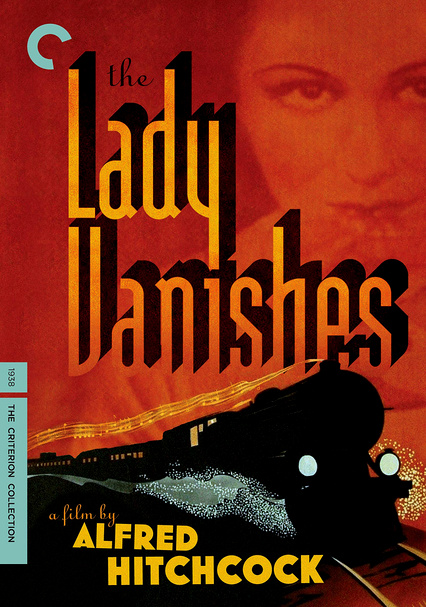
The Lady Vanishes-1938

The Lady Vanishes-1938

Director Alfred Hitchcock

Starring Margaret Lockwood, Michael Redgrave, Dame May Whitty

Scott’s Review #1,303

Reviewed September 30, 2022

Grade: A-

The Lady Vanishes (1938) is a film directed by Alfred Hitchcock that I’m embarrassed to admit I’ve only seen once. Nonetheless, it resonated well with me after that sole viewing, and its influence is palpable.

It’s a film made when Hitchcock was still making films in his native Britain before he took over Hollywood during the 1950s and 1960s. You may wonder why a dusty old film made in the 1930s and not a household name is essential, but The Lady Vanishes is.

If the film had not been made and, more importantly, not been a box-office success, films like Vertigo (1958), Psycho (1960), and The Birds (1963) might never have been made.

The Lady Vanishes followed three relatively unsuccessful efforts by Hitchcock, whose success assured his new film career in America was a go.

The film is not as brilliant as the others, but pretty close. It serves as a blueprint for future Hitchcock films.

The train sequences alone conjure thoughts of Strangers on a Train (1951) and North by Northwest (1959), while the romance between the lead actors would become a staple of Hitchcock films.

Finally, the subdued but noticeable inclusion of gay characters is forever a good debate among cinema lovers, especially Hitchcock fans, as to whether it is or isn’t showcased.

So, The Lady Vanishes is to be celebrated for its influence, but it also stands up well on its own.

A dangerous avalanche delays a group of travelers on a train to England. Forced into a hotel in the lush European country, beautiful young Iris Henderson (Margaret Lockwood) befriends an older woman named Miss Froy (Dame May Whitty).

When the train resumes travel, Iris is unconscious after being hit by a potted plant and wakes to find the older woman has mysteriously disappeared. The other passengers vehemently deny that Miss Froy ever existed, causing Iris to wonder if she has lost her marbles.

Iris determinedly begins investigating the matter with the help of another traveler, Gilbert (Michael Redgrave). The pair searches the train for clues and naturally falls in love.

They uncover a mystery, political intrigue, and peculiar characters with secrets to keep hidden.

Lockwood and Redgrave have fantastic chemistry. It’s no secret that Hitchcock intends to bring them together even though Iris is to marry when she returns home. Lockwood and Redgrave are easy on the eyes, which helps make them believable.

The pacing of The Lady Vanishes is perfect, but nowhere as astounding as the sequence of events in North by Northwest, which is the film it most resembles. That’s why the rough-cut analogy springs to mind—the film is a perfect warm-up act for the 1959 masterpiece.

From an LGBTQ+ perspective, my money is on the characters of Charters and Caldicott. Ferocious cricket enthusiasts whose only initial concern is returning to England to see the last days of a Test match. The ‘friends’ proved so popular with audiences that they returned to the film Night Train to Munich 1940, also starring Lockwood.

The revelations at the end of The Lady Vanishes surprise and satisfy, with political and espionage overtones. Frequently, in Hitchcock films, there is a McGuffin or someone who cares about the plot element.

The plot shouldn’t be overthought in the film, as the real fun is the trimmings that make the suspense so strong. The wit and snappy dialogue make the characters a pleasure to watch.

The Lady Vanishes (1938) is a terrific effort that provides strong character and stiff-upper-lip British humor. It is also the most fun to watch, highlighting the many elements that makeup Hitchcock’s masterpieces.

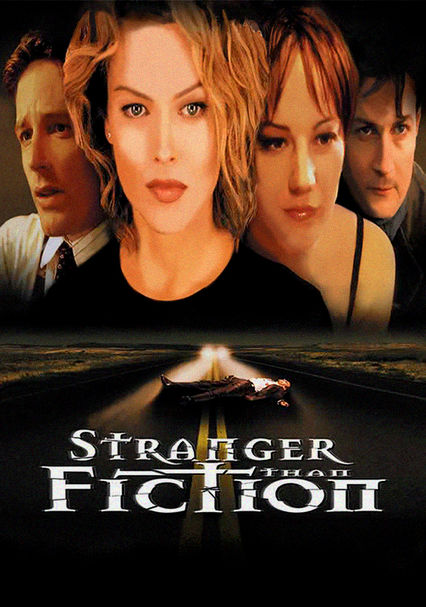
Stranger Than Fiction-2000

Stranger Than Fiction-2000

Director Eric Bross

Starring Mackenzie Astin

Scott’s Review #1,298

Reviewed September 14, 2022

Grade: B+

An interesting note about Stranger Than Fiction (2000) is that it stars director Todd Field in a dual-acting role.

The director is not a household name, at least not yet, but is known for directing two gems: In the Bedroom (2001) and Little Children (2006). Rewarded with Oscar nominations for both, he acts too.

This is not a setup for a joke that he should not act and should stick to directing, since he does a decent job acting.

The irony is that he doesn’t direct the featured film, Stranger Than Fiction; Eric Bross does.

The film has its share of intrigue, which carries through until the end when the plot gets messy and ridiculous. I mean, messy and ridiculous.

I’m all for twists and turns in a good film, but sometimes a speeding train can derail, and that’s what ultimately happens with Stranger Than Fiction.

But for most of the running time, it’s solid entertainment, black humor, and thrills.

I was immediately interested in the story when an author named Donovan Miller, with hours to kill at an airport bar because of a delayed flight, told a curious patron the story of his novel, Stranger Than Fiction.

As I drifted into the world of Salt Lake City, where the book’s events take place, I anticipated juicy drama.

An interesting bit of advice is to pay very close attention to this first bar scene.

Four twenty-something friends, Jared (Mackenzie Astin), Austin (Todd Field), Emma (Dina Meyer), and Violet (Natasha Gregson Wagner) meet for drinks at the local bar. They pull a prank on Violet’s boss for fun and call it a night.

Later, Jared shows up at Austin’s place injured and covered in blood, declares he’s gay, and spews a strange story about a dead guy in his apartment. The foursome investigates, and things get interesting.

The cinematography has a muted, dull style that feels like an independent film but also looks amateurish and made-for-television.

Even though it was made in 1999, it feels quite 1980s to me.

Unclear whether this style was used or if the budget was just low. I love independent filming, but this didn’t do Stranger Than Fiction any favors.

None of the characters are fascinating, and the writers, Tim Garrick and Scott Russell, unsuccessfully try to give the camaraderie among the four principals a sitcom feel. The constant bantering and bickering are getting tiring.

It feels like NBC’s Will and Grace meets Friends.

Where Stranger Than Fiction excels is in its twists, which make me forgive the other mistakes and the forced chemistry between the actors. I salivated for the next plot reveal and couldn’t wait to see how the events would unfold.

Once the friends agreed and made the foolish decision to dispose of the dead guy instead of calling the police, I knew I was in for hijinks or a caper.

As the gang gets deeper and deeper into shit like hitting a homeless guy with their car, parking illegally, and getting their car towed, more characters are introduced and threaten their plans.

This is all well and good until things spiral out of control with a dizzying explanation of events that involve blackmail, suicide, backstabbing, and jealousy.

Since the author is describing a fictional novel, this might have been okay until it’s revealed that the events actually occurred.

By that time, I didn’t care anymore.

Nice effort for a while by Stranger Than Fiction (2000), and fans of black comedy should take notice. With a strong premise and mostly good buildup, the follow-through failed, leaving me bewildered rather than completely satisfied.

Unfaithful-2002

Unfaithful-2002

Director Adrian Lyne

Starring Diane Lane, Richard Gere

Scott’s Review #1,278

Reviewed July 21, 2022

Grade: A-

Unfaithful (2002) is an American version of the brilliant 1969 French film The Unfaithful Wife, directed by Claude Chabrol.

Directed by Adrian Lyne, best known for the smoldering, creepy Fatal Attraction (1987), which earned him an Academy Award nomination for directing, Unfaithful is unsurprisingly brimming with the same eroticism and sexual ferocity.

What’s exceptional about it is the character development and the empathy felt for the characters and their convictions.

This makes Unfaithful work.

To say it’s watered down from the Chabrol version is a bit unfair, because it has an identity all its own. However, his version is superior in terms of suspense and, naturally, more French from a cinematic perspective.

Lyne’s film is slicker and wrapped up tighter, and much more mainstream-it does the job well and provides compelling entertainment.

In both films, the subject matter of guilt runs rampant.

Edward (Richard Gere) and Connie (Diane Lane) live seemingly happily in their upper-middle-class Westchester County, New York neighborhood.

When Edward learns that Connie has lied to him about an affair, suspicion leads him to uncover the devastating truth about her infidelity with Paul (Olivier Martinez), the hunky man who has captured her heart.

He confronts Connie’s ‘boy toy,’ which results in a deadly accident caused by Edward’s surprising rage. Edward must cover up the truth as detectives question both him and Connie about their involvement with Paul.

Can their marriage survive the damage?

The Hallmark television movie’s premise gains tremendous credibility thanks to the fantastic performances by Lane, Gere, and Martinez.

The standout is Lane, whom the audience may relate to a bit more than the other two. She gives Connie a tired, weary tone. She appreciates her good life but is nonetheless bored with it.

Some may relate to her, but others will shame her for her infidelity.

Each character provides their motivation for their character’s actions. The stoic chemistry between Lane and Gere’s characters perfectly balances the lusty dynamic between Lane and Martinez.

Wisely, the story is one that most married couples can deem true. When the romance wanes, sometimes the doldrums result.

Connie doesn’t set out to cheat on Edward, but the repetition of raising their eight-year-old son and of casserole Wednesdays leads her to seize an unexpected opportunity.

The rainy, windy setup with a sexy young French artist at her fingertips is smoldering with intrigue. The lusty scenes between Connie and Paul are rich with sex, like when they bathe together and make love in Paul’s hallway.

The titillating chemistry works well.

A clever scene in a coffee shop is daringly good. Connie’s girlfriends drool with delight as Paul walks by them, completely unaware that he is Connie’s new beau. How jealous they’d be if they knew the truth.

The face-off scene between Edward and Paul is shrouded with machismo as both struggle for the upper hand, toying with each other for power.

The tone shifts to one of Hitchcockian intrigue as Edward and Connie must forge an alliance and cover up their actions.

Not trusting each other, they have an interesting dynamic among themselves about what they tell and what they keep hidden from the flocking detectives.

After all, an upstanding white couple couldn’t possibly be involved in murder, could they, the detectives ponder?

Easily serving as the opening act to the more famous Lyne offering, Fatal Attraction, Unfaithful (2002) draws parallels with it.

They successfully manipulate the audience in a good way, using intrigue, thrills, and flesh to elicit a ‘glued to their seats’ result.

Sometimes, a good, old-fashioned thrill ride is just what the doctor ordered.

Oscar Nominations: Best Actress-Diane Lane

Cat People-1982

Cat People-1982

Director Paul Schrader

Starring Nastassja Kinski, Malcolm McDowell

Scott’s Review #1,275

Reviewed July 10, 2022

Grade: B+

Cat People (1982) is a mysterious, psychological journey into the strange universe of humans possessing cat-like qualities, sometimes with a tendency towards vicious limb extraction and other mauling techniques.

It’s an absurd premise, though admittedly clever, with an identity all its own.

Feeling slightly dated, mostly because of the early-1980s synthesizer-like score, film style, and the casting of some actors at the top of their game, Cat People is nonetheless enjoyable and sexual.

We especially recommend a late Friday or Saturday night viewing, with as little light as possible for the best ambiance.

Since our rented DVD copy was ravaged by poor visual quality and hard-to-hear sound, I’m thinking a buying the film.

The 1982 version of Cat People is directed by Paul Schrader, who is best known for writing or co-writing Scorsese’s greats Taxi Driver (1976) and Raging Bull (1980).

The director also has his own share of films, including ones as recent as 2021.

His production is a remake of one made some forty years earlier, which I have not seen.

The mood of Cat People is overwhelmingly sensual and violent, a horror-thriller tale. The action immediately gets off to a sexually perverse start when, during presumably prehistoric days, a wild black panther impregnates a young girl offered to him via sacrifice.

The message is clear that this results in a weird human/cat hybrid coming into existence.

In the present, Irena Gallier (Nastassia Kinski) harbors a dark family secret she despises. She reconnects with her estranged brother, Paul (Malcolm McDowell), who shape-shifts into a savage beast.

He lives in the southern city of New Orleans and has spent time in a mental hospital.

Irena visits the local zoo and finds herself attracted to handsome zoologist Oliver Yates (John Heard), even as her brother makes his incestuous advances toward her.

Inevitably, the family curse rears its ugly head when Paul rips the arm off one of the zoo workers played by a young Ed Begley Jr.

I really like how Schrader uses New Orleans as the central setting. Though it has nothing to do with the story, the French-influenced city is nice to look at, and the restaurant scenes feature Creole-style and other southern/European sophisticated little gems.

Ruby Dee is cast as a wacky housekeeper named Female, rippling with New Orleans flair, and who is aware of the terrible family secret.

Nastassja Kinski is perfectly cast as the provocative and sultry main character, and she effortlessly leads the charge. Others like Heard and Annette O’Toole, w-list stars in the early 1980s, provide a time capsule of Hollywood relevance.

Unfortunately, this also makes Cat People feel like it’s from another time, and the 1980s film style is painfully obvious.

The growling and vicious cats feel both scary and fake during close-ups, but imagine the trickery of using real-life leopards? The filmmakers did the best they could, and that’s obvious.

Some sequences are quite grisly, and when they aren’t, there are best-remembered scenes of peril and intrigue. O’Toole’s character of Alice (another zoologist) takes a late-night dip in a swimming pool and is harassed by a menacing Irena.

Earlier, a great scene occurs when a prostitute named Ruthie visits her client in a dingy motel room, only to realize that her john is a mean leopard.

We assume she will be ripped to shreds, but this dubious honor is saved for another slutty character whom Paul picks up at a funeral.

An attempted triangle among Irena, Oliver, and Alice goes nowhere, and it’s bewildering that anyone even tried.

The power couple is Irena and Oliver, whose smoldering love scenes are sensual and skin-heavy, and who profess almost-immediate love for each other.

With enough explicit sex and gratuitous violence to keep many viewers titillated, Cat People (1982) has positives and negatives. When it was released, I bet it was a potboiler of juicy, relevant intrigue, but the film hasn’t held up quite as well as some others.

Golden Globe Nominations: Best Original Score, Best Original Song-“Cat People (Putting Out Fire)”

Vantage Point-2008

Vantage Point-2008

Director Pete Travis

Starring Dennis Quaid, William Hurt

Scott’s Review #1,271

Reviewed June 25, 2022

Grade: B-

The premise of Vantage Point (2008) is clever and hook-laden, stirring intrigue. After all, the idea of several ‘vantage points’ to one perilous event, in this case, an assassination in a European country, exudes promise and excitement.

An imagined fun game of whodunit or what happened to whom and when, and from whose perspective, prompted me to want to see this film.

The trailer looked good.

The film doesn’t satisfy and feels like a muddled mess, with little character development and, surprisingly, mediocre acting given its A-list cast.

The dialogue is forever repetitious with characters yelling out the same expletives in frustration that soon results in the incredible, teetering on laughably bad.

It plays too much like a carbon copy of the popular and exceptional television series ’24,’ which ran on FOX during the 2000s when Vantage Point was made.

The inspiration, Vantage Point, borrows heavily from the political thriller setup and the day-in-the-life concept popular during this decade.

The editing is rapid-fire quick.

I struggled to find a couple of redeeming qualities in the otherwise forgettable film.

Usually, seeing a film on the big screen in a slick, air-conditioned movie theater is a treat and increases my enjoyment of it, and that matters here.

In the case of Vantage Point, this raised its final grade from a mediocre C+ to a not-much-improved, generous B-.

A stellar company of actors, including Dennis Quaid, Sigourney Weaver, Forest Whitaker, William Hurt, and others, joins Matthew Fox, who was then hot for his lead role in the massively successful ABC television series Lost.

Did these actors read the script before signing on?

Witnesses with different points of view try to unravel an assassination attempt on U.S. President Henry Ashton (Hurt) while he is giving an important speech in Salamanca, Spain.

Special Agents Thomas Barnes (Quaid) and Kent Taylor (Fox) are assigned to protect Ashton during the summit on the war on terror. Television producer, Rex Brooks (Weaver), directs news coverage while American tourist Howard Lewis (Whitaker) films the audience.

After the leader’s arrival, shots ring out, and Ashton is down. In the resulting chaos, Howard comes forward with his camcorder, which he believes contains an image of the shooter.

Everyone attempts to solve the mystery by giving different accounts of what transpired.

Vantage Point is fantastic for about the first thirty minutes until it quickly runs out of gas. The setups are rapid, with Rex, Howard, Barnes, and Taylor each offering different perspectives, and the film moves well through the timeline from pre- to post-shooting.

The novelty wears thin once the perspectives are revised repeatedly and the plot becomes unnecessarily complicated and downright convoluted.

This makes a normally fast-running time of one hour and twenty-nine minutes feel like a lifetime commitment.

Comparisons I’ve heard to a 1950 Japanese film called Rashomon, which I have unfortunately never seen, are laughable.

My hunch is that the art film is worlds away from the slickly Americanized Vantage Point, and a slow build in the former is superior to the quickly edited mainstream latter.

Vantage Point (2008) is not a well-remembered film, nor should it be. There is no reason to watch it a second time.

A better choice is to watch the series 24 again instead.

It’s nearly the same, with one being superior.

Unbreakable-2000

Unbreakable-2000

Director M. Night Shyamalan

Starring Bruce Willis, Samuel L. Jackson

Scott’s Review #1,260

Reviewed May 29, 2022

Grade: A-

Following the brilliant and massive critical and commercial success of The Sixth Sense (1999), M. Night Shyamalan hit his stride and became a household name for blending supernatural and psychological elements into a web of compelling storytelling.

Following 2002’s Signs, credibility tapered a bit, but Unbreakable (2000) is an overlooked gem falling in the shadows of The Sixth Sense, which everyone remembers best when they talk about the director.

The Sixth Sense and Unbreakable are also strong counterparts because they both star Hollywood legend Bruce Willis, who, it can be argued, began to gain respectability within the industry with the former.

He continues his superior acting and calm character approach.

Unbreakable is part thriller, science fiction, and superhero film, so I have categorized it accordingly.

It’s part of an Unbreakable film series and was followed by Split (2016) and Glass (2019), which took years to develop and were decent if underwhelming projects.

Unbreakable is by far the best of the bunch.

David Dunn (Willis) is a regular guy who works as a security guard at a college football stadium. He is a former star college quarterback whose dreams of stardom never materialized because of a car accident.

He lives a somewhat melancholy yet decent life with his wife, Audrey (Robin Wright), and son Joseph.

One day, David boards a train. The train experienced a devastating derailment with an enormous casualty number. David awakes in the hospital to find that he is the sole survivor of the wreck. He is left unscathed.

Elijah Price (Samuel L. Jackson) arrives on the scene as a mysterious comic book expert who takes a liking to David and his experience. He offers a bizarre explanation as to why David escaped without a single scratch that counters Elijah’s health- he is a frail man who is constantly at risk of breaking his bones.

Elijah and Joseph begin to believe that David is a superhero. At first, David rebuffs this notion but slowly begins to realize he has extrasensory perception.

What is the link between David and Elijah?

I’m not always a big superhero fan, and sometimes the storylines are riddled with cliches, stereotypes, and predictability.

But Unbreakable is fascinating and unpredictable. It’s also dark and cerebral, with a surprise ending, leaving me to summarize it as a different sort of superhero film with layers of cool elements.

It’s a non-traditional superhero film, and I love that quality.

There’s a suspension of disbelief, of course. The idea that one character can rig a train accident and other crimes is a bit of a stretch. Still, the characters David and Elijah are compelling enough that I forget those pesky little plot holes and enjoy the experience.

If the story sometimes falters, the riveting train sequence more than makes up for it. We see David quietly enjoying the train ride until all hell breaks loose.

The shattered glass, derailment, and chaos are fabulous entertainment, as well as a source of wonder about what comes next and what the sequence means for the rest of the story.

There are plenty of twists and turns in Unbreakable.

Almost as riveting, though in a different way, is the opening scene of Unbreakable, which will immediately grab the viewer.

It is 1961, and an African American woman is told that her baby’s arms and legs are broken. This is later a key to the story, but at this time, we know not what this intrigue has to do with anything.

Unbreakable (2000) is incredibly fresh and original. It can easily be watched as a double feature with The Sixth Sense, but it is nothing like that film except for its director and actor.

But, they are M. Night Shyamalan’s best films, and Unbreakable provides tremendous thought and conceptualization while creating daring camera work long remembered after the first viewing.

The Talented Mr. Ripley-1999

The Talented Mr. Ripley-1999

Director Anthony Minghella

Starring Matt Damon, Jude Law, Gwyneth Paltrow

Scott’s Review #1,259

Reviewed May 27, 2022

Grade: A

The Talented Mr. Ripley (1999) is a psychological thriller that is Hitchcockian and would make the famous director, the esteemed Alfred Hitchcock, damned proud.

The film features suspense, thrills, mystique, and great writing, and is an exceptional adaptation of Patricia Highsmith’s 1955 novel of the same name.

A fun fact is that Highsmith also wrote the novel that Hitchcock’s 1951 film Strangers on a Train was based on.

In my opinion, the title role is the best of Matt Damon’s lengthy career, rivaling that of his debut in Good Will Hunting (1998), also a tremendous effort.

His riveting portrayal showcases that he plays several layers simultaneously: calculating, sinister, vulnerable, jealous, and unhinged.

Sometimes all at once.

He was shockingly omitted from the Best Actor Oscar list, which is unforgivable considering his great work. Instead, he was nominated in later years for lesser films like Invictus (2010) and The Martian (2016).

With his blonde, clean-cut hairstyle, short and parted on the side, and big, studious glasses, he is half wholesome and half creepy.

The fact that the character is gay is icing on the cake and delicious for a film set in the 1950s, when having an alternative lifestyle was strictly forbidden.

The setting is mainly the lavish, sunny coastal Italy of the late 1950s. Tom Ripley (Damon) craves a lifestyle of luxury and manipulates his way into the life of wealthy playboy Dickie Greenleaf (Jude Law).

When Dickie’s father asks Tom to bring his errant son back home to America, Dickie, and his beautiful expatriate girlfriend, Marge Sherwood (Gwyneth Paltrow), never suspect the dangerous extremes to which Ripley will go to make their lifestyle his own.

The best part of The Talented Mr. Ripley is the compelling suspense and the twists and turns that result. It’s astounding how many layers the plot has without the experience feeling confusing or poorly paced.

Speaking of the pacing, this is another achievement of the film. Director Anthony Minghella wisely quickens the pace from the snail’s pace of his earlier film The English Patient (1996), which I loved.

We immediately learn a great deal about Tom and how he makes his living by charming people and forging signatures to make ends meet.

His innocent deceit soon turns fatal as he spirals downward and becomes a pathological liar and sociopath in addition to a cold-blooded murderer.

Law is tremendous as Dickie, and the bold character is ambiguous in his sexuality, while Tom’s is clearer. I love this about Law’s character. He is handsome and a ladies’ man, which would make him ripe for the picking for a closeted gay man in the 1950s to become enamored.

The key to ponder is whether the feeling is mutual. This remains ambiguous.

The acting, superior in every way, is made all the richer by the film’s character study, which cleverly dissects the relationship between Tom and Dickie.

The best scene occurs on a small boat as tensions reach a crescendo between the two men. This results in dire activity.

Besides the opening in New York, the rest of the story is set in Italy and is mostly shot on location. This only enhances my enjoyment of the film because it showcases the Mediterranean and southern Italy more than the more familiar cities.

Not to disappoint, astounding sequences in Rome and Venice do occur.

Because of the cinematography and locales, the film has a glossy, polished look, which is terrifically counterbalanced by the story’s darkness.

Think American Psycho (2000), but more subdued with a larger budget.

The Talented Mr. Ripley (1999) is one of the best to emerge from a terrific decade in cinema. It is not as well remembered as some others, but I strongly encourage a watch to uncover a series of riches driven by bold storytelling.

Oscar Nominations: Best Actor in a Supporting Role-Jude Law, Best Screenplay Based on Material Previously Produced or Published, Best Art Direction, Best Costume Design, Best Original Score