Category Archives: Peter Weir

The Year of Living Dangerously-1982

The Year of Living Dangerously-1982

Director Peter Weir

Starring Mel Gibson, Sigourney Weaver

Scott’s Review #1,266
Reviewed June 16, 2022

Grade: B+

The Year of Living Dangerously (1982) is a solid political drama with enough intrigue, romance, and superior cinematography by Russell Boyd to recommend it.

It’s not an American film but an Australian one, which gives it an authentic flavor even though events are primarily set in Indonesia.

If Mad Max (1979) didn’t make Mel Gibson a full-fledged pinup star, The Year of Living Dangerously certainly did because it made him a romantic ladies’ man in addition to a rugged action star. He has a ton of good looks and charisma at this point in his career and arguably has never looked better.

One could say (okay, I flat-out will) that Gibson is upstaged, unintentionally so, by stage actress Linda Hunt, who gets the role of her life as a highly intelligent Chinese-Australian man with dwarfism who is key to the entire plot.

Hunt won the Academy Award for flipping gender norms on their head and making the film more progressive and memorable than it deserves. Her performance is timeless and rich in character flavor.

If not for Hunt and Gibson as the standouts, the film would be lost in the shuffle among the myriad similar political dramas that emerged in the 1980s.

Missing (1982), starring Jack Lemmon and Sissy Spacek, and Victory (1981), starring Sylvester Stallone, are the films that remind me of The Year of Living Dangerously.

Blow Out (1981) and No Way Out (1987) are two of the best political drama films of the decade, and are assuredly influenced by All the President’s Men (1976), one of the best in the genre.

There are so many others that The Year of Living Dangerously feels forgotten and too similar to a standard formula to stand out. It also suffers at times from being either a romantic drama or a political thriller, and it struggles to mesh the two in a satisfying way.

After journalist Guy Hamilton (Gibson) arrives in Jakarta, Indonesia, he forms a friendship with dwarf photographer Billy Kwan (Hunt), through whom he meets British diplomat Jill Bryant (Sigourney Weaver).

Bryant falls in love with Hamilton and gives him key information about an impending Communist uprising. As the city becomes more dangerous, Hamilton stays to pursue the story. However, he faces more threats as he gets closer to the government, putting him and others passionate about the political turmoil in great peril.

The romance between Guy and Jill is not bad, but Weaver has had so many better roles than this one that it feels throwaway. She’s a smart lady who falls madly in love with Guy so easily that the formulaic context is obvious.

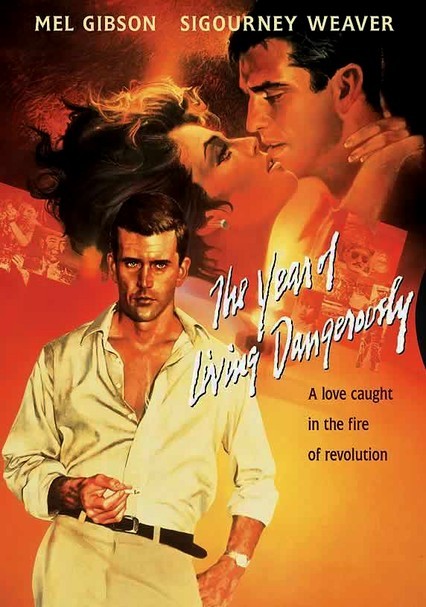
The movie poster makes the pair look like Rhett and Scarlett in Gone with the Wind (1939), unintentionally providing humor and ambiguity about what the film is going for.

It does best when it sticks to the political message.

The film is laden with foreign mystique and intrigue largely due to the exotic locale of Indonesia (the film was shot in the Philippines, which is a good double).

The plot is absorbing for what it is, and the peril the journalists face is exciting. This parleys well with the real-life situation the film is based on. In 1965, Indonesia was a hotbed of corruption and danger, and director Peter Weir managed to pull these sequences together well.

The main flaw is that Weir doesn’t seem to know if he is crafting a political thriller or a romantic drama.

Back to the astounding Linda Hunt, the best scene of the film occurs when her character dies in Guy’s arms.

Forget Weaver, the emotional core of the film belongs to Gibson and Hunt, who have tremendous chemistry. The ambiguity of Billy, mostly because we know the gender of Hunt, is delicious.

In the end, the conclusion is mostly a happy one, albeit predictable, and the storyline feels unsatisfying.

A nice effort and relevant in 1982, The Year of Living Dangerously has energy and polish. It just feels too familiar and similar to other genre films to stand out, save for Linda Hunt and Mel Gibson.

Oscar Nominations: 1 win-Best Supporting Actress-Linda Hunt (won)
Witness-1985

Witness-1985

Director Peter Weir

Starring Harrison Ford

Scott’s Review #754

Reviewed May 7, 2018

Grade: A-

Witness (1985) is a slick crime thriller that may at first glance seem like a by-the-numbers genre film, but instead is well above average.

As the plot unfolds, there are key nail-biting, edge-of-your-seat scenes that build tension in a way that the suspense master himself, Alfred Hitchcock, would be proud of.

Decades later, it is tough to watch the film without noticing a slightly dated quality, but at the time, it was well regarded and terrifically paced.

Charismatic Harrison Ford and novice child actor Lukas Haas make the film more than it could have been.

The film’s setting is twofold, presenting two distinct cultures: rural Pennsylvania’s Amish country and bustling metropolitan Philadelphia.

The death of her husband leads Amish woman Rachel (Kelly McGillis) and her son Samuel (Haas) to the big city to see her sister. While transferring trains, Samuel witnesses a brutal murder in the men’s room- unbeknownst to the killers.

This riveting scene (explained in more detail below) sets the rest of the story in motion.

When Detective John Book (Ford) is assigned to the case and questions Samuel, he is unable to determine the assailants’ identities. After Samuel’s fingers, an unthinkable suspect, events escalate, and John uncovers a mighty corruption circuit within the police force.

John, now targeted, must assimilate into the Amish culture as he strives to protect both Samuel and Rachel (as well as keep himself alive) while embarking on a relationship with Rachel.

The story wisely focuses on the differing lifestyles of the principal characters.

What I enjoy most about Witness is the nice mix between both types of people and different cultures, and how they can learn from one another. John is so used to and desensitized by being in the midst of the rat race that he often forgets the nicer things in life- peace or even love.

Rachel and Samuel, of course, are highly sheltered, living in a bubble, and are fish out of water amid the bustling streets of Philadelphia. The counter-cultures offer a nice balance to this masculine film, bringing female sensibilities.

Not to be usurped by pure romance, Witness is, at its core, a fleshy, male-driven crime thriller. Adding some softer edges, Weir pleases both male and female audience members and appeals to the masses.

John’s precinct, filled with detectives, police officers, and criminals, gives the film appropriate “guy elements”.

So director Peter Weir offers a good balance here.

I like how Weir chooses to portray the Amish- not caricatures, stereotypes, or to be made fun of, they are sweet, stoic, and intelligent, accepting of John in their lives.

As John learns more about the Amish culture and becomes one of them, this is even more prevalent as an immersion in different cultures- a good lesson to even apply to other differences between people.

The acting is a strong component of Witness.

Charismatic and handsome, Ford is believable as a fast-paced, busy detective.

To add further substance, Ford transforms his character (often written as one-note in typical films of this nature) into a sympathetic and inspiring man as he slowly becomes a father figure to the wide-eyed youngster Samuel and falls in love with Rachel.

Ford is the standout, but the film would not work with fewer supporting actors. Both innocent and gentle characters, McGillis and Haas add layers to their roles with pronounced toughness and resilience- saving John as much as he saves them.

Two scenes are pure standouts and successfully elicit tension and dramatic effect.

As Samuel witnesses the murder in the bathroom, he is seen in a stall, peeking through a crack with only one eye exposed. When he makes a slight noise, the assailant violently goes through each stall, intent on shooting whatever he finds.

Samuel must think quickly to avoid being caught. The camera goes back and forth between Samuel’s looks of panic and the assailant getting closer and closer to catching him.

The viewer’s heart will pound during this scene.

Later, as Samuel sees a newspaper clipping framed among a case of awards, he recognizes one man as the assailant. Weir shoots it in slow motion so that the reactions of John and Samuel’s characters are palpable and effective.

The scene is tremendously done and cements the bond and trust between these characters.

Thanks to a wonderful performance by Ford and the cast surrounding him, Witness (1985) successfully widens the traditionally one-dimensional masculine crime thriller into something deeper.

Providing slick entertainment with a great story and substance, the film crosses genres and offers a substantial cinematic experience woefully needed in the mid-1980s.

Oscar Nominations: 2 wins-Best Picture, Best Director-Peter Weir, Best Actor-Harrison Ford, Best Screenplay Written Directly for the Screen (won), Best Original Score, Best Art Direction, Best Cinematography, Best Film Editing (won)