Category Archives: Stuart Whitman

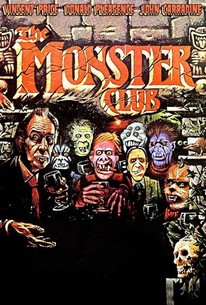
The Monster Club-1981

The Monster Club-1981

Director Roy Ward Baker

Starring Vincent Price, Donald Pleasence, John Carradine

Scott’s Review #1,378
Reviewed July 16, 2023

Grade: B

Any horror feast, including Vincent Price and Donald Pleasence, is worth a watch, and The Monster Club (1981) features both actors, though not in any scenes together.

The British horror anthology is uneven and a tad too silly, with only two of the three chapters recommended. They are based on the works of the British horror author R. Chetwynd-Hayes.

The graphics and art direction are surprisingly superior for such a low-budget production.

In between chapters, there is a jarring and unnecessary musical performance by one of the creatures. While sort of fun, it takes away from continuity and feels like it’s been thrown in rather than serving any real purpose.

Below is a summary, review, and rating of each vignette.

Prologue: B

Author R. Chetwynd-Hayes (John Carradine) is approached on a city street by a strange man (Vincent Price) who turns out to be a starving vampire named Eramus.

He bites the writer and takes the confused man to an odd club. It’s a haven for supernatural creatures as they dance, drink, and carry on together.

Eramus introduces three stories about his fellow creatures of the night.

This chapter is relevant to tie the chapters together, and any scene involving Price is good in my book. It also serves as a learning experience to explain the different types of creatures, but little more than that.

The Shadmock: A-

Angela (Barbara Kellerman) is a financially struggling woman who takes a job at a secluded mansion owned by Raven (James Laurenson), a creature called a Shadmock.

Along with her greedy boyfriend (Simon Ward), they hatch a plot to steal Raven’s great wealth after he proposes to Angela. When she is caught unlocking Raven’s safe, his demonic whistle comes into play at the expense of Angela and her boyfriend.

This chapter has a great setup and an unrequited love vibe. With a Beauty and the Beast comparison, the audience sympathizes with Raven. All he wants is love, and the ultimate climax is heartbreaking with the knowledge that he is being duped.

I longed for Angela to come to her senses, dump her boyfriend, and be carried away by Raven, but it’s horror after all, and not romance.

Starting slowly, the grotesquely exquisite gothic mansion and the fine luxuries contained are fun to feast one’s eyes on, and the sinister conclusion is not to be missed.

The Vampires: B-

A shy young boy (Warren Saire) from a kind family of vampires leads a lonely life, bullied at school, while his father (Richard Johnson) spends little time with him.

The father is hunted by a team of vampire killers led by Pickering (Donald Pleasance), who attempt to drive a stake through the father and kill him. But the tables are soon turned.

This chapter is cute but uninspired, adding more humor than horror. Pleasance isn’t given a great role, and neither is former ‘Bond girl’ Britt Eklund as the supportive mother.

It pales sharply against ‘The Shadmock’ and ‘The Ghouls.

The Ghouls: A

A movie director (Stuart Whitman) scouting locations for his next film pays a visit to an isolated village, Loughville, where the sinister residents refuse to let him leave.

While imprisoned by the ghouls, he meets Luna (Lesley Dunlop), the daughter of a ghoul father (Patrick Magee), who agrees to help him escape. But can Luna or the resident police be trusted?

The Ghouls is my favorite because it feels the most unpredictable, and I love the early shots of a movie production studio. The ghostly-looking creatures are appealing because there is an ambiguity about their motives and the secrets held in the village.

It’s also fun balancing the sophisticated style of the movie producer against the drudgery of the villagers. Also, the inclusion of actor Magee from A Clockwork Orange (1971) is a win.

Epilogue: B 

At the end of the film, Eramus cheerfully tells the other club members about all the imaginative ways humans are horrible to each other and declares that humans are the most despicable monsters of all.

Thus, Chetwynd-Hayes is made an honorary monster and member of the club.

The quick chapter is a clever wrap-up to the story and culminates as a bit of a ‘message’ about kindness and humanity.
An American Dream-1966

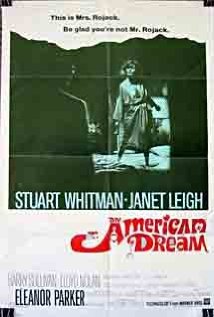
An American Dream-1966

Director Robert Gist

Starring Stuart Whitman, Janet Leigh, Eleanor Parker

Scott’s Review #879

Reviewed March 19, 2019

Grade: C-

An American Dream (1966) is a film version of the Norman Mailer novel of the same name. Directed by Robert Gist, the cast includes Stuart Whitman, Janet Leigh, and Eleanor Parker, who do what they can with mediocre writing, uneven pacing, and an unsatisfying ending.

The roles suffer from miscasts and misfires. The film plays more like an episodic television detective show or a darker version of a television movie than a compelling feature.

Except for one terrific high-rise scene, the film is essentially a waste of time.

Stephen Rojack (Whitman) is a decorated war hero who returns to Los Angeles to become a journalist. He publicly criticizes the police for failing to accost a known crime lord named Ganucci (Joe De Santis), which angers the mobster.

Simultaneously, Rojack’s alcoholic wife, Deborah (Parker), flies into a drunken rage when he asks her for a divorce, resulting in her toppling from a swanky high-rise to her death. Riddled with guilt, Rojack resumes a relationship with his former girlfriend and Ganucci’s ex, Cherry (Leigh).

The best scene is the intense confrontation between Rojack and Deborah. The sweeping, expansive balcony and the open-air locale overlooking dazzling Los Angeles should be a significant clue that something dire will transpire, especially as Deborah is drunk beyond belief and filled with fury.

Her lavish apartment is adequately decorated in the latest 1960s style, giving the scene a plush sophistication. The vicious death scene is wonderfully done as the woman not only falls to her death but is subsequently run over by a car, adding insult to injury.

The scene is also the crux of the entire film.

Harboring the thrill of the climactic scene, however, is Parker’s jarring, overacting performance, making Deborah appear crazed and animal-like. The display is understood as making the character unlikable and unbalanced- the hunky gigolo in her bed also makes her unsympathetic-but the cartoon acting seems amateurish and beneath the fabulous actress.

Remember, this is the same woman who created the sophisticated and memorable character of the Baroness in The Sound of Music (1965).

The premise of the film is illogical and unbalanced as, to my eyes, it appears Deborah falls to her death accidentally, but the reasoning of the film portrays Rojack as riddled with guilt for causing her death.

He even admits his guilt to her father in one scene. His claim to the police that Deborah committed suicide is, of course, untrue, but the unnecessary guilt seems implausible and too much of a stretch at creating the main plot point.

The most significant negative aspect of An American Dream is Janet Leigh’s casting as Cherry. Wearing an unappealing and silly wig, the Hollywood star seems unbelievable and just wrong as a mob girlfriend.

Her soft features and petite frame do not fit the part, and her lip-syncing of the Oscar-nominated theme song “A Time For Love” does nothing to elicit credibility from either the character or the actress.

When An American Dream bombed at the box office, desperate distributors retitled the film See You in Hell, Darling, but to little avail. Reducing it to weekday airings on television did nothing to change the image of a low-budget, made-for-television style look or the episodic detective tint.

The intended perception of a horror film is a strikeout, as the experience is more like a tepid thriller.

For fans of Janet Leigh, An American Dream is not recommended.

The preferred suggestion is to skip this one and delve into other gems, such as the legendary Psycho (1960) or Touch of Evil (1958).

An American Dream (1966) doesn’t utilize the legendary actresses’ talents. It is a forgettable film that is best left in the bargain bin.

Oscar Nominations: Best Original Song-“A Time For Love”

The Day the Earth Stood Still-1951

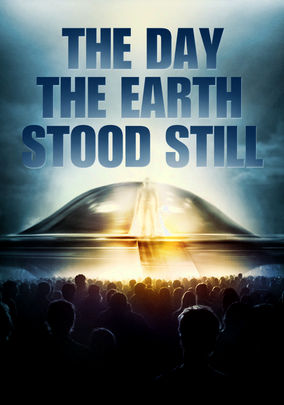
The Day the Earth Stood Still-1951

Director Robert Wise

Starring Michael Rennie

Scott’s Review #155

60026578

Reviewed August 18, 2014

Grade: B+

The Day the Earth Stood Still (1951) is one of the best, most credible, original science fiction thrillers. It has stood the test of time, considering it is over sixty years old.

Made in 1951, the film is a message movie about a spaceship that suddenly arrives on planet Earth in the United States capitol of Washington, D.C.

Michael Rennie is fantastic as Klaatu, the calm, poised leader of the spaceship. Along with Gort, a 7-foot-tall robot, Klaatu intends to deliver a message of peace and humanity to the leaders of Earth.

The arrival sets off a panic, and Klaatu is captured, only to escape and meet local townspeople as he tries to pass himself off as human and deliver his message.

The Day the Earth Stood Still is a liberal-slanted, anti-war, pro-tolerance, and acceptance movie, but also a good, old-fashioned black-and-white science fiction thriller rolled into one.

It’s an important film.

It is an edgy, questioning film that can easily still be viewed and appreciated today (sad that not much seems to have changed in the world after all these years).

It is political, and the setting of Washington, D.C., is wise and symbolic.

While a handful of humans are portrayed as intelligent and accepting, most of Earth’s human beings, especially politicians, are portrayed as war-happy, foolish individuals.

The viewer will question the world around him or herself and, hopefully, begin to question political decisions and the horrors of war that continue unabated.