Category Archives: Jean-Pierre Cassel

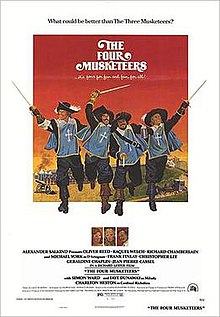
The Four Musketeers-1974

The Four Musketeers-1974

Director Richard Lester

Starring Oliver Reed, Michael York, Faye Dunaway

Scott’s Review #1,379

Reviewed July 17, 2023

Grade: B

The Four Musketeers (1974) is a sequel to the film The Three Musketeers made a mere year earlier. It takes the second half of the famous novel by French author Alexandre Dumas with the original film covering the first half.

A recommendation is to watch the sequel directly after the original so there is less struggle to figure out what is going on. I did not do that so connecting the plot points was a struggle.

A further negative is the omission of any English subtitles making hearing or ascertaining the events of the film difficult. British accents are tough.

King Louis XIII’s (Jean-Pierre Cassel) four swashbuckling heroes engage in chivalrous and daring adventures when Cardinal Richelieu (Charlton Heston) and his evil accomplice Milady de Winter (Faye Dunaway), kidnap the queen’s dressmaker, Constance (Raquel Welch).

The heroes are D’Artagnan (Michael York), Athos (Oliver Reed), Porthos (Frank Finlay), and Aramis (Richard Chamberlain).

It’s a British swashbuckler film so the adventures are prevalent and the physical comedy is fast and furious. It’s like a sitcom at times with over-the-top and outlandish fight sequences and one-liners.

The frequent low-cut tops on the female characters are intended to channel the male viewer’s thirteen-year-old boy.

The film gets darker than I anticipated in the final act which is to its credit with two deaths. This surprised me in a good way because so much of The Four Musketeers is light-hearted.

The death by the beheading of a major character is well-done. The heroes watch an executioner perform his duties to the fiendish character from across a lake. The decapitation is not exactly shown but it’s done almost in a tremendously effective silhouette and from a distance.

The costumes and attention to detail from a historic perspective are superior elements of the film. One can imagine being in the French countryside during the Anglo-French War in the 1600s. The sets and lighting are bright so the result is colorful and picturesque style.

The cast is made up of several A-list Hollywood stars of the time and each adequately does their share to light up the screen. My favorites are Dunaway as the villainess and Reed as a ‘good guy’, a refreshing change for the actor who usually appears as the heavy.

Reed and Dunaways share some scenes mostly in flashbacks that made me want to see more of their romance but this is not to be. Athos was unaware that Milady de Winter was a criminal which left a permanent branding mark.

Still, what little I got featured tremendous chemistry between the pair and I would have liked to have seen more.

Where the film loses me a bit is with the silliness which follows the same formula that made The Three Musketeers a success. Feeling redundant were the endless sword fight scenes and tongue-in-cheek winking.

The film tries hard to be a comedy but adds in darker moments too so it leaves an unbalanced quality.

Some actors get short shrift. Christopher Lee as Count De Rouchfort is a secondary villain and has little to do except prance around in a wig, uniform, and eye patch. His character is no Dracula and does not feel dangerous.

The Four Musketeers (1974) is good entertainment from a solidly professional cast. Hardly a masterpiece it’s a bang ’em up comedy adventure with a few moments of death and destruction.

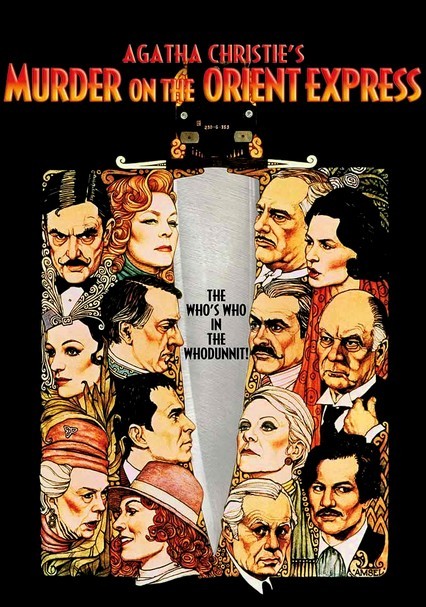
Murder on the Orient Express-1974

Murder on the Orient Express-1974

Director Sidney Lumet

Starring Albert Finney, Lauren Bacall, Ingrid Bergman

Scott’s Review #928

Reviewed August 7, 2019

Grade: A-

Based on the 1934 novel of the same name written by famous author Agatha Christie, Murder on the Orient Express (1974) brings the story to the big screen with a robust and eccentric cast of characters all drizzling with suspicion.

The classic whodunit of all whodunits, the film adds a Hollywood flair with rich costumes and an authentic feel to a budget-blasting extravaganza that keeps the audience guessing as to who the killer or killers may be.

The film was recognized with a slew of Oscar nominations that year.

The hero of the film is Hercules Poirot (Albert Finney), a well-respected yet bumbling Belgian detective, who is solicited to solve the mysterious death of a business tycoon aboard the famous and luxurious Orient Express train.

On his way to the train’s destination, he encounters such delicious characters as the glamorous Mrs. Hubbard (Lauren Bacall), the nervous Greta Ohlsson (Ingrid Bergman), and his friend Bianchi (Martin Balsam), the director of the company who owns the enormous vessel.

Many other characters are introduced to the layered story.

As the complicated plot is unraveled, most of the characters have something to hide or a connection to another character or characters.

The fun for the viewer is to live vicariously through Poirot and await the big final reveal after the film that, unless already viewed the film or read the novel, one will not see coming.

With a film of this type, a detective thriller, the audience can be assured of a resolution, like a big murder mystery dinner theater production brought to the big screen.

Formulaic, the film never drags nor feels dull.

Amid the first few minutes of Murder on the Orient Express, the intrigue is unleashed at full-throttle speed leaving one bedazzled and hooked.

The sequence is brilliantly done and thrusts the audience into a compelling back story of plot and the wonderment of what these events have to do with a train pulling out of the Orient.

Quickly edited film clippings of a news story explain the mysterious Long Island, New York abduction and murder of the infant daughter of a famed pilot.

It is suggested that the Orient Express trip embarks from Istanbul, Turkey, and is destined for London. This means that several countries will be included in the trek, creating possibilities for both geographical accompaniments and new cultural experiences which director Sidney Lumet offers generous amounts of.

Moments following the murder, the train has the unfortunate fate of colliding with an avalanche, leaving the passengers in double peril, with a killer on the loose and cabin fever to contend with.

To the compelled viewer this is snug comfort as the atmospheric locales are gorgeous and the thought of a dozen strangers trapped together with so much to hide brings the story to a frenzy.

Who did what to the murder victim is slowly revealed as several red herrings (or are they?) are revealed. Who is the mysterious woman strutting down the corridor shortly before the murder, spotted by Poirot? Is she a staged pawn or merely an innocent victim? Could she be the murderer?

The wonderful part of Murder on the Orient Express is the number of entangled possibilities.

The conclusion of the film turns the thriller into a moralistic story, to its credit. The fact that the murder victim was hateful and diabolical is a key part of the story and makes the viewer wonder if the killer or killers are justified in their actions.

Does the fact that Ratchett was stabbed a dozen times with varying degrees of severity play into the motivation?

A very compelling, and unrecognizable Finney does a fantastic job of carrying the film among such a troupe of good actors.

Murder on the Orient Express (1974) sets out to entertain and succeeds on every level, bringing the book to the silver screen with a fresh interpretation that still honors the intent that Christie had.

Stylistic and thought-provoking, the film has gorgeous costumes, a good story, and fine acting. The knowledge of who the killer is does little to take away any enjoyment that a repeated viewing will provide.

Oscar Nominations: 1 win-Best Actor-Albert Finney, Best Supporting Actress-Ingrid Bergman (won), Best Screenplay Adapted from Other Material, Best Original Dramatic Score, Best Costume Design, Best Cinematography

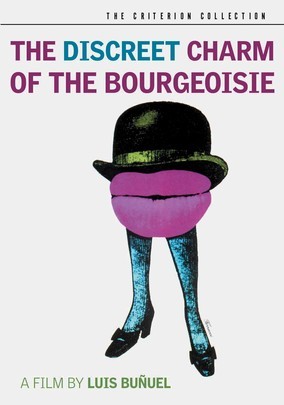
The Discreet Charm of the Bourgeoisie-1972

The Discreet Charm of the Bourgeoisie-1972

Director Luis Buñuel

Starring Fernando Rey, Paul Frankeur

Scott’s Review #13

60001469

Reviewed June 17, 2014

Grade: A-

The Discreet Charm of the Bourgeoisie (1972) is a wonderful French satire by Director Luis Buñuel.

The movie is very strange- three well-to-do couples meander from dinner party to dinner party and, due to circumstances beyond their control (an incorrect date, a mysterious corpse, and a military raid), never end up sitting down and enjoying a meal together.

How the individuals are wealthy is a bit vague, though there is mention of drug smuggling.

It’s unclear who is matched up with whom since frolicking amongst them is commonplace. Several of them experience odd fantasy/dream sequences throughout and are often seen wandering down the road.

The entire film is tongue-in-cheek, poking fun at the wealthy class.

It’s offbeat but delightful.

Oscar Nominations: 1 win-Best Screenplay Based on Factual Material or Material Not Previously Produced or Published, Best Foreign Language Film (won)