Category Archives: Michel Piccoli

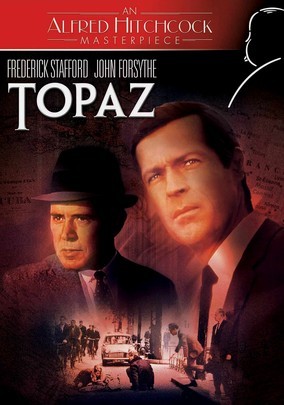
Topaz-1969

Topaz-1969

Director Alfred Hitchcock

Starring Frederick Stafford, Karin Dor

Top 250 Films #163

Scott’s Review #108
60020562

Reviewed July 12, 2014

Grade: A-

Topaz is an intriguing, suspenseful 1969 latter-day Alfred Hitchcock film.

In the political thriller vein, the film typically suffers from being both overlooked and under-appreciated, yet receives admiration from film buffs. It is certainly not one of his better-known films, and that is quite a shame.

As with many great films, it is complex and layered, requiring close attention and even multiple viewings.

The issue with Topaz is that the film suffers from a lack of recognizable stars- a trademark of Hitchcock films in his heyday. Frederick Stafford (Andre) and Karin Dor (Juanita) are the featured romantic couple.

Despite his being married to another woman, Andre and Juanita are the couple the audience is intended to root for.

The story involves competing spies from France, the United States, and Cuba, all vying for government secrets concerning the Cuban Missile Crisis in the 1960s.

Each spy does their best to obtain the secrets, some in a sinister fashion.

The French accents, especially, can be tough to understand, but it is a thrilling film that traverses New York City, Cuba, and France. The main protagonist is Andre, and Stafford has a high level of charisma and a suave manner.

The character is quite similar to James Bond. The film itself plays out like a Bond film, with exotic locales, beautiful women, and political intrigue.

As with most Hitchcock films, the set pieces and art direction are beautiful and perfect. One highlight is a particular character’s death scene in Cuba. Throughout the film, the love story is involved, and the death is tragic yet heartfelt and shocking.

Topaz, sadly, was unsuccessful at the box office due to the lack of Hollywood names attached and limited promotion, although it made several top-ten critics’ lists in 1969.

Topaz is undoubtedly one of the more obscure of Hitchcock’s films, but an excellent one to discover and revere.
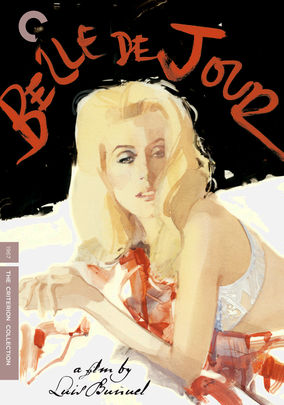
Belle De Jour-1967

Belle De Jour-1967

Director Luis Buñuel

Starring Catherine Deneuve, Jean Sorel

Scott’s Review #486

60000631

Reviewed September 29, 2016

Grade: A

Belle De Jour, the title translates to “lady of the day”, a French pun for “lady of the night”, a kind phrase for prostitution, is a fantastic art film.

Stylish, sophisticated, and open to interpretation (at least in my opinion), Belle De Jour is a late 1960s journey into eroticism, social norms, and sexual freedom.

Gorgeous star Catherine Deneuve has never looked better and calmly does mental conflict.

Luis Buñuel directs the film.

Severine is a wealthy, young, newlywed who seemingly has it all. She is showered with love and affection, not to mention material items, by her handsome hubby, Pierre, played by dashing Jean Sorel.

She wants for nothing as her husband is a doctor of great wealth. Yet she is unhappy and refuses to have physical relations with Pierre.

She begins a secret life as a prostitute in a posh home, only working in the afternoons, to avoid being found out. She has no regrets but is apprehensive about the clients she meets.

Throughout the film, Severine has secret fantasies about being kept in bondage and enduring various other sexual humiliations. All the while, the question is, “Is this all Severine’s fantasy or reality?”  Or perhaps merely a portion is.

The audience wonders.

Do we feel sorry for the character of Severine? Not. One could argue that she is spoiled and selfish, but she is not evil; she is somewhat confused. She is quite polite, and Deneuve fills her with kindness and even an angelic spirit.

One cannot despise her, even though on the surface one might be tempted to. What right does this woman have to rebuff her husband in place of sleazy clients? One particularly volatile client becomes obsessed with Severine and stalks her, going so far as to exact violence against her husband.

But wait, is this Severine’s fantasy or reality? Is she imagining everything and merely obediently waiting at home for her husband to return each day, or is she living this life?

Buñuel uses many shots of gorgeous Paris, including the famed Arc de Triomphe and other interesting streets and sights, which is a treat for culture fans. The use of these exteriors goes a long way to ensure that the film is clearly “French” from a visual perspective.

Indeed, in 1967, the sexual revolution was in full swing, and Belle De Jour epitomized the revolution of the times. Yet, it does not feel dated or reduced to a film “of its time”.

I find it more of a character study than a genre film, as Severine is an interesting study.

Belle De Jour challenges the viewer with an intense yet subtle story of a woman conflicted with sexual desire and repression- a film open to much interpretation and discussion.

It does what an art film is supposed to do- makes us think and ponder.

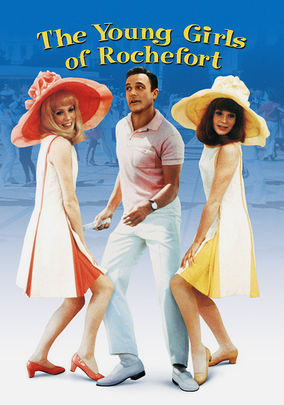
The Young Girls of Rochefort-1967

The Young Girls of Rochefort-1967

Director Jacques Demy

Starring Catherine Deneuve, George Chakiris

Scott’s Review #252

60020331

Reviewed June 30, 2015

Grade: B

The Young Girls of Rochefort (Les Demoiselles de Rochefort) is a musical fantasy set in a small French town outside of Paris.

The story focuses on a pair of gorgeous twin sisters, Delphine and Solange, played by real-life sisters Catherine Deneuve and Françoise Dorléac, who yearn to escape their small town for the bright lights of Paris and hope for romance.

The twins can have any man they want, but enjoy the thrill and excitement of conquests and being chased and sought after by seemingly all available French men. They spend their spare time discussing and fretting over various loves.

The film is so French and pure musical fantasy, and logic is not the primary focus. Much of it does not make much sense, in fact, nor does it need to. It is pure fantasy.

The film excels by being dreamlike, bright, and sunny. The vivid, bursting colors and lovely sets enhance the film’s look.

In particular, the coffee shop set is a dream. All the central characters gravitate to the café for drinks, gossip, and song and dance.

A great deal of the action takes place here, which is a significant plus to the film.

The Young Girls of Rochefort, made in 1967, is very state-of-the-art in terms of art direction and color.

The loose plot, which is not at all a reason to watch this film, is silly. The twins, longing for love, meet several men, all possible suitors, but their true motivation is to get out of Rochefort and find genuine excitement in the big city of Paris.

One cannot help but realize that the men are a means to an end for the girls.

The heartfelt part of the story belongs to that of the twins’ mother, Yvonne, who also longs for love. Yvonne runs the café and still pines for a long-lost love whom she jilted because of a funny last name. She now regrets her decision, and the audience is rooting for her to find happiness.

She is a wholesome character, whereas Delphine and Solange are selfish and are attempting to further their careers as musical artists.

My main criticism of the film is casting Gene Kelly as one of the sisters’ love interests. Far too old and well past his prime at this point, the casting doesn’t work. Yes, he is a fantastic dancer, but the age is too great to be believable.

In the end, the main reason to watch The Young Girls of Rochefort (1967) is to escape, let loose, and enjoy a bright, cheery, fantasy film.

Certainly not to be analyzed, the film succeeds in providing good escapist, cultured French fare.

Oscar Nominations: Best Score of a Musical Picture- Original or Adaptation

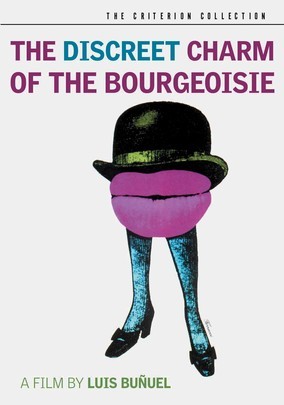
The Discreet Charm of the Bourgeoisie-1972

The Discreet Charm of the Bourgeoisie-1972

Director Luis Buñuel

Starring Fernando Rey, Paul Frankeur

Scott’s Review #13

60001469

Reviewed June 17, 2014

Grade: A-

The Discreet Charm of the Bourgeoisie (1972) is a wonderful French satire by Director Luis Buñuel.

The movie is very strange- three well-to-do couples meander from dinner party to dinner party and, due to circumstances beyond their control (an incorrect date, a mysterious corpse, and a military raid), never end up sitting down and enjoying a meal together.

How the individuals are wealthy is a bit vague, though there is mention of drug smuggling.

It’s unclear who is matched up with whom since frolicking amongst them is commonplace. Several of them experience odd fantasy/dream sequences throughout and are often seen wandering down the road.

The entire film is tongue-in-cheek, poking fun at the wealthy class.

It’s offbeat but delightful.

Oscar Nominations: 1 win-Best Screenplay Based on Factual Material or Material Not Previously Produced or Published, Best Foreign Language Film (won)