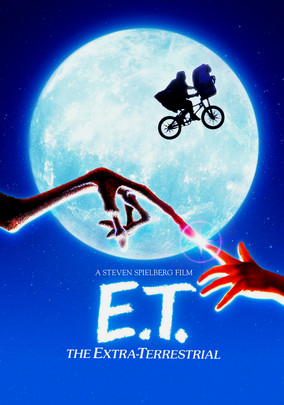
E.T. The Extra-Terrestrial-1982
Director Steven Spielberg
Starring Henry Thomas, Dee Wallace
Top 250 Films #224
Scott’s Review #756
Reviewed May 10, 2018
Grade: A
E.T. the Extra-Terrestrial (1982) is a wonderful, magical film that will melt the hearts of anyone with even a tad of cynicism. The film is otherworldly (quite literally) and contains a message of acceptance and appreciation of other beings.
Mixing many humorous moments with tender drama and tears, the film becomes part of a fantasy, science fiction, and humanistic story. The film still feels fresh and relevant today with a bevy of forever-remembered scenes and references- a wonderful story of friendship.
The audience is immediately introduced to a pack of alien botanists, arriving in a California forest from their faraway planet to study plants one night.
When government agents interrupt the peaceful moment, the “extraterrestrials” are forced to depart, leaving one creature behind.
When ten-year-old Elliott (Henry Thomas) discovers and begins to communicate with what will come to be known as “E.T.”, the duo forge a wonderful, lasting friendship as they attempt to return E.T. to his homeland.
E.T. the Extra-Terrestrial is crowd-pleasing in every way, offering a bit of everything for all of its lucky viewers.
Director Steven Spielberg reportedly made this film as a result of his desire to share a childhood imaginary friend with the world, so the charm shines through in this very personal story.
The film contains an overall innocence that is pure benevolence- E.T. teaches Elliott as much as Elliott teaches E.T.
Who can ever forget the pair’s initial interaction as the use of Reese’s Pieces candy became a huge cultural phenomenon? The lovely quote “E.T. phone home!” is still as poignant and teary-eyed as it was in 1982.
Enjoyable and recognizable, E.T. himself is becoming a cult figure. Odd-looking, wide-eyed, and yet of a lovable nature, even cute, the filmmakers were careful not to make him too frightening.
Using real actors and distorted voices, E.T. became famous, appearing on lunch boxes, tee-shirts, notebooks, and binders throughout the early 1980s.
The film, released in the “modern age” of 1982, provides a genuine portrayal of suburban life at that time.
In the sunny, subdivision-style neighborhood where Elliott and his family live, the absent father figure (so common in many 1980s films) and the single-mom/divorced-parents phenomenon take hold, making families like this commonplace.
If made in 1960, Elliott would have had two happy parents and a white picket fence.
Dee Wallace, as Elliott’s mother, Mary, received several mom roles throughout the decade, portraying them with a wholesome middle-America quality.
Henry Thomas, like Elliott, is crucial to the success of E.T. The Extra-Terrestrial, and sadly, the actor never did much beyond this great film. While it’s tough to create chemistry with a creature from outer space, the young actor does just that as we see the two as connected friends.
The duo especially shines during the emotional “death” scene and the farewell scene finale.
The other supporting characters rounding out Elliott’s family are well cast and effectively convey what a typical suburban family looks like.
Michael (Robert MacNaughton) is slightly surly yet protective as the older brother, and Gertie, played by a very young Drew Barrymore (soon to become a superstar throughout the 1980s and 1990s), is cute, bubbly, and teeters on the edge of stealing the show as the precocious five-year-old.
At its core, what makes E.T., The Extra-Terrestrial so appealing is its heart- a sympathetic creature’s desire to return home and be with his loved ones is the main focus.
Only slightly reversed is a comparison to the 1939 masterpiece The Wizard of Oz. As Dorothy yearns to return to her home amid an exotic, unfamiliar, and sometimes scary world, so does E.T., making both films similar and equally appealing.
Rich in elegance, intelligence, and creativity, Spielberg crafts a tale that is both primed for mass consumption and ripe for mainstream appeal. Rather than weave a contrived or clichéd story, he spins a magical, long-lasting good story that will appeal to the kid in all of us.
E.T. the Extra-Terrestrial (1982) reaped many Oscar nominations but lost out on the big prize to the epic Gandhi that year.
Oscar Nominations: 4 wins-Best Picture, Best Director-Steven Spielberg, Best Screenplay Written Directly for the Screen, Best Original Score (won), Best Sound Effects Editing (won), Best Sound (won), Best Cinematography, Best Film Editing, Best Visual Effects (won)