Category Archives: Delphine Seyrig

The Day of the Jackal-1973

The Day of the Jackal-1973

Director Fred Zinnemann

Starring Edward Fox, Michael Lonsdale

Scott’s Review #1,155

Reviewed June 22, 2021

Grade: A

Political thrillers can run the gamut from taut plots involving espionage, assassinations, and car chases to the political landscape. They often risk being overly complicated and losing their audience through too much wordiness and not enough meat and potatoes.

The Day of the Jackal (1973), telling the story of an assassination attempt on a world leader, is perfectly paced and intriguing, offering some titillating elements and nothing run-of-the-mill. It’s not lazy and can be classified as a thinking man’s film.

I loved it.

Certain complexities and trysts experienced by the deadly title character add extra pizazz and spiciness to the already compelling plot.

And the sequences of Paris and its lovely metropolis can aid any film.

A cagey and intelligent underground French paramilitary group is determined to execute President Charles de Gaulle (Adrien Cayla-Legrand). Still, when numerous attempts on his life fail, they resort to hiring the infamous hitman known as “The Jackal” (Edward Fox).

As he plots to assassinate de Gaulle, he takes out others who stand in his way. Meanwhile, Lebel (Michel Lonsdale), a Parisian police detective, begins to solve the mystery of the killer’s identity.

The film is not in French but in English.

Fox is the major draw. Charismatic, handsome, and athletic, he hardly looks like a fiend.  But that’s just the point. A lesser film would have cast an actor who looks like a killer. With Fox, we get many more intricacies. He beds women…..and men.

Think- a bisexual James Bond.

This is enchanting to see in 1973, though the film is British, and sometimes the Brits were well ahead of American filmmakers in this regard.

The director, Fred Zinneman, is Austrian, and boy, can he direct.

I wasn’t sure how engaged I would be. After all, the history books can tell us how the assassination attempt ended. It failed. What was the motivation for watching a film, especially one destined to be complicated? I quickly realized that The Day of the Jackal had that special sauce. It’s more than engaging, it’s enthralling.

The audience is meant to root for Lebel to beat Fox, but there is so much more bubbling under the circumstances. The villain is mysterious, and we know almost nothing about him. The ambiguity continues after the film ends.

This is a positive for the character and, by extension, for the film.

Meanwhile, the hero of the film, the guy after the “Jackal”, is your average, everyday Joe. He is unexciting but very smart and determined to capture Fox.

Lebel is quite likable for his savviness alone, but I still argue many will root for Fox to escape the clutches of Lebel. I know I did.

Great scenes occur in a swanky hotel when Fox becomes intrigued by Madame de Montpellier, played by Delphine Seyrig. He picks up the rich and mysterious woman as they chat in the dining room. He later sneaks into her room and gets the girl.

Whoever cast this woman must have seen the Hitchcock classic Frenzy (1972) because she’s a dead ringer for Brenda Blaney (Barbara Leigh-Hunt).

Is it an accident that both meet grisly ends?

Not to be satisfied with merely bedding rich women, he goes to a Turkish bath to avoid the police and picks up a French gentleman. It is implied they have a romantic date before the gentleman catches onto Fox’s identity (he is now on the run from the police) and meets his maker in his kitchen.

The Day of the Jackal (1973) is a meticulously crafted film that should be the blueprint for anyone intent on creating a political thriller. It avoids hokey stereotypes or predictability, instead offering an edge-of-your-seat experience with nuances for miles.

It’s exceptional on all levels.

Oscar Nominations: Best Film Editing
Peau d’Ane (Donkey Skin)-1970

Peau d’Ane (Donkey Skin)-1970

Director Jacques Demy

Starring Catherine Deneuve, Jacques Perrin

Scott’s Review #227

70032096

Reviewed March 11, 2015

Grade: B

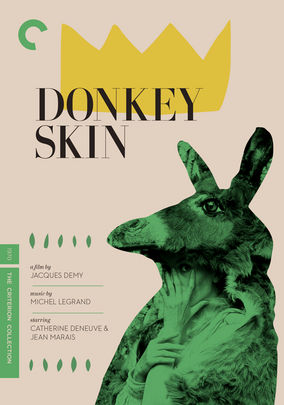
Peau d’Ane (English: Donkey Skin) is a 1970 French musical film that is a fairy tale for adults- seemingly happy, but very dark beneath the surface.

To say this film is bizarre would be an understatement. The film is a strange retelling of the classic Cinderella story.

The film is set in a peculiar medieval world and centers on a dying Queen (Catherine Deneuve), her husband, the King (Jean Marais), and the heroine, the beautiful Princess (also Catherine Deneuve).

The Queen is dying. Her last wish is for the King to marry the most beautiful woman in the land. Coincidentally, that is their daughter, The Princess! Eager to produce an heir to the throne, he is determined to marry and reproduce with his daughter.

The Princess, wanting none of it, turns herself into an ugly creature by wearing the skin of a donkey and moves to a neighboring kingdom to exist in a life of exclusion and revulsion, farming pigs and being berated by those around her.

A handsome Prince decides to pursue the woman who has baked him a delicious cake, but knows not who she is. Ironically enough, it is the Princess.

I found the film to be quite interesting, albeit in a warped way. Unusual and challenging to analyze, one must watch with an open mind.

Certainly, Donkey Skin delves headfirst into the icky world of incest. It makes no apologies for its controversial nature, all the while interspersing the film with cheery tunes, singing roses, and hatching chicks.

The donkey skin that the Princess wears is fake and unbelievably laughable, and how nobody is aware that there is a beautiful Princess underneath is silly.

And yet the film somehow works. I was transported into a magical world where nothing is normal, and one surprise after another ensues.

A couple of oddities worth mentioning: some of the film’s music a contemporary and upbeat. Also, strangely, the final scene involves a helicopter, which is completely implausible given the period.

I get the sense that this film is going for absurd and unique and succeeds on both counts.

Visually, the film is gorgeous- bright and cheerful with loads of colors. The film has awe-inspiring art direction, with the castle’s set pieces odd, engaging, and colorful. I especially enjoyed the Prince’s bedroom set.

As eccentric and seemingly dark as the film is, often a character will burst into a cheerful song, as evidenced by the Princess singing a happy tune while making a meal, all the while dressed in her donkey skin, almost like a scene out of Mary Poppins (1964) or My Fair Lady (1964) or any other wholesome musical.

To be sure, a unique film, Donkey Skin (1970) is eccentric, lively, and interestingly perverse with a French flair—fantasy for adults and a journey into the weird.

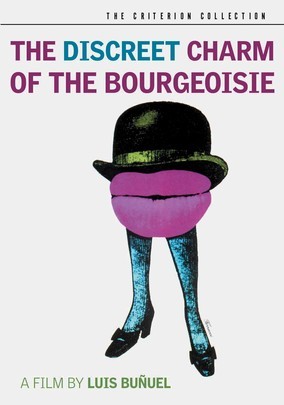
The Discreet Charm of the Bourgeoisie-1972

The Discreet Charm of the Bourgeoisie-1972

Director Luis Buñuel

Starring Fernando Rey, Paul Frankeur

Scott’s Review #13

60001469

Reviewed June 17, 2014

Grade: A-

The Discreet Charm of the Bourgeoisie (1972) is a wonderful French satire by Director Luis Buñuel.

The movie is very strange- three well-to-do couples meander from dinner party to dinner party and, due to circumstances beyond their control (an incorrect date, a mysterious corpse, and a military raid), never end up sitting down and enjoying a meal together.

How the individuals are wealthy is a bit vague, though there is mention of drug smuggling.

It’s unclear who is matched up with whom since frolicking amongst them is commonplace. Several of them experience odd fantasy/dream sequences throughout and are often seen wandering down the road.

The entire film is tongue-in-cheek, poking fun at the wealthy class.

It’s offbeat but delightful.

Oscar Nominations: 1 win-Best Screenplay Based on Factual Material or Material Not Previously Produced or Published, Best Foreign Language Film (won)