Tag Archives: Ronald Neame

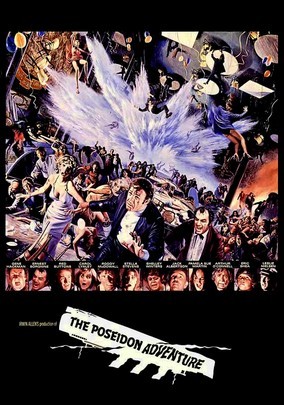
The Poseidon Adventure-1972

The Poseidon Adventure-1972

Director Ronald Neame

Starring Gene Hackman, Ernest Borgnine, Shelley Winters

Top 250 Films #30

Scott’s Review #214

867891

Reviewed January 17, 2015

Grade: A

The disaster genre, primarily represented in film during the 1970s, includes some of my personal favorites, and The Poseidon Adventure (1972) is easily at the top of the list.

Set on a lavish ocean liner, the SS Poseidon, on New Year’s Eve, the doomed ship falls victim to a powerful tsunami while sailing from New York to Athens on its final voyage, causing it to topple over and leaving a handful of survivors to meander through the bowels of the ship in an attempt to find a way out and be rescued.

They are led by a stubborn preacher, played by Gene Hackman.

The appeal of The Poseidon Adventure is, of course, watching the cast of characters in peril and guessing which ones will meet their fates and how- think of a slasher film without the horror component.

Featuring an ensemble cast of Hollywood celebs of the day, the characters are introduced to the audience before the tidal wave erupts, so we care for them immensely.

There is the former hooker with the heart of gold married to a gruff cop (Stella Stevens and Ernest Borgnine as Mike and Linda Rogo).

Then there is the sweet-natured older couple on the cruise to see their grandchild (Shelley Winters and Jack Albertson as Manny and Belle Rosen).

Pamela Sue Martin plays the teen girl, Susan, who falls madly in love with the preacher, Reverend Scott. Along with her younger brother, Robin, they are traveling to see their parents, who await their arrival.

Roddy McDowall plays a waiter named Acres.

Lastly, Red Buttons plays James Martin, a health-conscious bachelor, and Carol Lynley plays shy singer Nonnie.

Reverend Scott is the moral focal point of the film and questions god several times throughout.

The sets are extraordinary- the colorful Christmas tree in the grand dining room is fantastic. The entire New Year’s Eve party scene is my favorite- it is festive, extravagant, and mixed in with a scene where the ominous tsunami is rapidly approaching.

The festive celebration quickly turns into confusion as the sirens begin to sound, and finally, panic as furniture begins to fly.

Visually this scene is the most intricate- the ship turns upside down after the crash, thus giving the illusion that the bottom of the ship is the top.

Tricky.

From this point on all of the sets to follow are intended to be upside down- a crafty and effective style, but none more than the dining room scene.

A victim toppling and crashing into a giant clock is a memorable scene.

As the group of survivors haggardly make their way throughout the ship they encounter underwater explosions, dead bodies, rushing water, and disputes, mainly between Reverend Scott and Rogo, as to how to proceed to safety.

One by one a handful of the group meets their fates in gruesome fashion- falling into a fire, a heart attack, and falling to one’s death.

Shelley Winters is the comic relief of the film with her humorous quips about her weight, and her death scene brings me to tears each time I experience it.

A heavyset older woman who at one time was a dynamite high school swimmer, she attempts to help the group by holding her breath and swimming underneath the engine room, which is blocked- she does inevitably save the Reverend Scott’s life but succumbs to a heart attack shortly thereafter.

It is a powerful, heartbreaking scene.

The film is a great adventure. What makes The Poseidon Adventure (1972) so timeless and continues to bring so much pleasure? Certainly not high-brow nor high art, but it does not need to be.

It is simply meant to be enjoyed for what it is- a thrilling, fun, entertaining ride.

Oscar Nominations: 1 win-Best Supporting Actress-Shelley Winters, Best Song Original for the Picture-“The Morning After” (won), Best Original Dramatic Score, Best Costume Design, Best Sound, Best Art Direction, Best Cinematography, Best Film Editing

Scrooge-1970

Scrooge-1970

Director Ronald Neame

Starring Albert Finney, Alec Guinness

Top 250 Films #186

Scott’s Review #561

Reviewed December 25, 2016

Grade: A

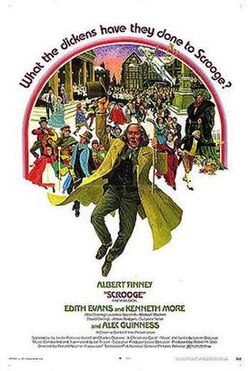
A classic perfect for watching around the holidays, perhaps accompanied by a roaring fire and a bit of brandy, Scrooge (1970) is a magical, musical experience; the entire family should adore it.

The film is a retelling of Charles Dickens’ 1843 story, A Christmas Carol.

Set in London with spectacular London-style art direction, it is perfect in its depiction of life around the holidays in the historic city, circa the nineteenth century.

To be clear, this is the musical version of the popular tale, not to be confused with the 1935 or the 1951 versions of the story.

The film is not as dark or scary as those films are. Instead, the 1970 Scrooge would be a fantastic companion piece to the 1968 classic Oliver!, both based on Dickens stories and both mixing fantastic musical scores with dramatic elements.

Albert Finney takes center stage in flawless form as the old, cantankerous, miser Ebenezer Scrooge. He plays the character as both an older man and, through flashbacks, a young man (Finney was merely 34 years old at the time of filming).

Guinness, indeed a high-caliber actor, is effective as the ghost of Jacob Marley- Scrooge’s former business partner. Scrooge is a moneylender, mainly to the working class, and is unforgiving in his collection of debts.

Filled with hatred for all things good, especially the Christmas holiday, Scrooge refuses to attend a family Christmas dinner hosted by his nephew, Fred, or to give to any charities. He begrudgingly gives his minion and bookkeeper, Bob Cratchit, Christmas Day off.

Finally left alone on Christmas Eve night, Scrooge is visited by the spirit of Jacob Marley, who tells Scrooge that three ghosts will visit him during the night.

In a chilling scene, Marley takes Scrooge on a journey through the sky, where he is greeted by spirits doomed to traverse the Earth, as Jacob is, with shackles acquired from their life as living beings.

Since they are greedy and wicked, they are doomed in the afterlife, just as Scrooge will be if he does not change his ways.

In an excellent subplot, we get to know the Cratchits, led by their father, Bob, a poor but earnest man. The family has little, but makes the most of what they do have, and appreciates the glorious holiday. They prepare a meager Christmas bird and savor being together as a family.

Their youngest, Tiny Tim, is lame, and he lusts over a lavish train set in the local toy shop. Cratchit epitomizes goodness and richness of character, contrasting with Ebenezer Scrooge.

As Scrooge is visited by the ghosts of Christmas past, present, and Christmas yet to come, he slowly realizes he needs to change his ways before it is too late. The audience is treated to stories of Scrooge’s youth, as we understand what has made him the miserly older man that he is today.

The clear highlight of this film is its musical numbers that will leave even the most tone-deaf humming along in glee. Throughout each sequence, we are treated to various numbers.

My favorite is “Thank You Very Much”, as it first appears during the Ghost of Christmas Yet To Come sequence.

By this time, feeling more sympathetic and appreciative, Scrooge merrily dances and sings along with the townspeople, unaware of the fact that they are celebrating his death and are dancing on his coffin to celebrate the fact that their debts are now free and clear.

This catchy tune is a reprise at the end of the film.

Other cheery numbers are “Father Christmas” and “I Like Life”, which perfectly categorize the film as a merry, holiday one, despite its occasional dark tone. This is necessary to avoid making Scrooge too bleak.

I also adore the vivid set designs as the gorgeous city of London is perfectly recreated to show the festive Christmas holiday. The film is not high-budget, but it makes the most of it by using small yet lavish sets.

Scrooge is a perfect holiday film, with fantastic tunes and a meaningful story that comes across on screen as a celebration of life, never edging toward contrived or oversaturated.

A wonderful holiday feast.

Oscar Nominations: Best Original Song Score, Best Original Song for the Picture-“Thank You Very Much”, Best Costume Design, Best Art Direction

Oliver Twist-1948

Oliver Twist-1948

Director David Lean

Starring Alec Guinness, Kay Walsh

Scott’s Review #279

822333

Reviewed October 3, 2015

Grade: A-

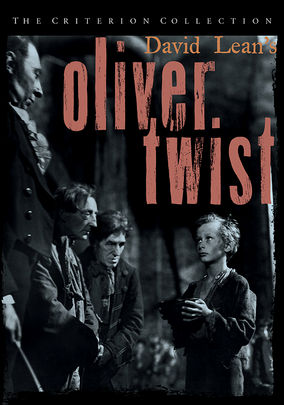
Oliver Twist, the 1948 film version, is vastly different from the 1968 version, which turned the classic Charles Dickens novel into a musical, albeit a dark one, with colorful sets and brilliant art direction.

This version, made in black and white, is a better telling of the novel and contains masterful direction and cinematography.

Given the enormous length of the novel, some characters and details are inevitably trimmed or modified to fit a one-hour and forty-eight-minute film.

The film is a gorgeous cinematic treat, with glowing lighting and creative camera angles, thanks to the outstanding direction of legend David Lean (Lawrence of Arabia, 1963).

The film begins on a stormy night with the birth of poor little Oliver. His mother was frightened and died in childbirth, leaving him to live a life of hardship in a workhouse. His mother possesses a beautiful locket stolen by an old crone, who assists in the birth.

Now a young boy, Oliver draws the shortest straw, forcing him to utter the famous line “Please Sir, I want some more”, about desiring more bland gruel that the orphans are forced to eat.

From this point, Oliver is deemed troublesome and sold to an undertaker named Mr. Sowerberry. When this doesn’t work out, Oliver takes to the harsh streets of London to make his fortune among thieves such as Fagin, Bill Sykes, and The Artful Dodger, who become his friends but also his enemies.

Since I have seen Oliver’s musical version so many times and have also read the novel, it is difficult to watch this film without comparing it to the others.

Oliver Twist is a darker, gritty experience than Oliver! It precisely and closely resembles the novel, with details surfacing, such as the backstory of the locket, which takes on a more central role when the old crone repents on her deathbed, revealing all to the equally crooked Mrs. Corney.

Another example is the casting of less polished or average-looking actors than Oliver! Had. For example, Alec Guinness’s portrayal of Fagin is heavily disguised, with stringy hair and a prosthetic nose, a close comparison to the illustration of Fagin in the novel.

Bill and Nancy have more minor, though crucial, roles but are not as fleshed out as the other versions. The timing of particular events also plays a role —Nancy does not meet Oliver until later in the story.

The film does have light-hearted moments, which perfectly balance the heavy drama. The comic shenanigans of beadle Mr. Bumble and matron Mrs. Corney, both sinister characters but together a bickering, boorish couple who eventually marry each other, add humorous moments to the story as she becomes a domineering wife throughout their many fights and schemes.

The fact that the group of young thieves (boys) all live with Fagin in close quarters, the suggestion of child molestation is certainly implied but not pursued quite as much as in the novel.

I do not think that filmmakers in 1948 would have dared to go there in a film that was arguably meant to have a wholesome feel.

The certainty that Nancy is a prostitute and primarily sleeps in the streets is also addressed, though she is still rather glamorous and clean-looking. The class distinction is evident.

The bleakness of the workhouse and Fagin’s quarters counterbalances the rich and lush home of Oliver’s savior, Mr. Brownlow. I love his estate and housekeeper, the kindly and sweet Mrs.Bedwin.

A close retelling of the novel Oliver Twist (1948) is a fantastic film that can be enjoyed by parents and children alike and appreciated through generations of families.