On a Clear Day You Can See Forever-1970
Director Vincente Minnelli
Starring Barbra Streisand, Yves Montand
Scott’s Review #921
Reviewed July 19, 2019
Grade: B+
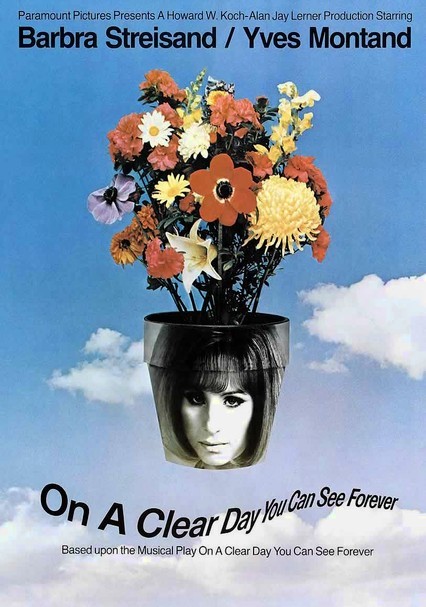
On a Clear Day You Can See Forever (1970) is a very obscure film that deserves better than to be relegated to the unknown.
Released during a time when the Hollywood musical had lost its luster, it feels like a last-gasp effort to keep the genre alive, serving as a star vehicle for Barbra Streisand.
The film suffers from severe editing problems with a large portion being cut, so much so that the result is a choppy and disjointed feel, tough to follow as is, but left untouched, the film could have been a creative masterpiece.
In a particularly convoluted plot that spans two time periods, chain-smoking New Yorker Daisy Gamble (Streisand) is convinced by her uptight fiancé Warren (Larry Blyden) to attend a class taught by Marc Cabot (Yves Montand), a psychiatrist.
When Cabot accidentally hypnotizes her, he realizes she speaks in the voice of an early-nineteenth-century woman named Melinda, and he becomes obsessed with her as she teeters between two existences.
The screenplay was written by Alan Jay Lerner and adapted from his book for the 1965 stage production.
Film director Vincente Minnelli fuses fantasy with a musical to create an extremely left-of-center experimental piece; this is not your standard 1950s or 1960s MGM experience with merry or clap-along tunes.
Some of the more memorable numbers include “On a Clear Day,” a reprise at the end of the film, “He Isn’t You,” and “Love with All the Trimmings.”
Casting Streisand is a monumental choice as she carries the film on her shoulders. Belting out numbers is the singer-turned-actress’s forte, and she never disappoints.
She is fascinating to watch in the neurotic role as she smokes and prances around, usually in a tizzy or a state of peril (self-induced).
The performance stands out as a different style from many of her other films, and she has never portrayed a livelier character. Streisand overcomes a few challenges of the film, winning in spades.
She shares little to no chemistry with co-star Montand, who is not only too old for her but also not the greatest actor. If the film’s intent, which I suspect, was to make the pair the main draw, then this failed.
Streisand’s chemistry with John Richardson, who plays Sir Robert Tentrees to her Melinda in the other time period, excites her. The duo smolders with passion, but sadly, most of the nineteenth-century scenes are sacrificed, leaving most of it a jumbled mess.
Much more interesting would have been to leave the entire film intact.
An oddity is Jack Nicholson’s almost nonexistent role as Tad Pringle, a mostly non-described brother of Daisy’s. Is he also her neighbor?
In 1970, Nicholson was only on the cusp of super-stardom, and it is questionable whether some of his parts were left on the cutting-room floor, but the limited character is strange and unsatisfying. In another role, there would have been some possibility of romantic entanglement.
Throughout the film, I wondered how On a Clear Day You Can See Forever might have worked with someone other than Streisand in the roles.
I kept ruminating on how good Liza Minnelli might have been in the roles, given her non-classic looks (like Streisand) and bombastic voice. Her high-drama flair and capable New York style would have made the results enjoyable, but Streisand hits it out of the park.
On a Clear Day You Can See Forever (1970) is a brave attempt at something fantastical, brimming with potential, but ultimately feels cluttered and messy.
With a delicious leading lady whom the camera adores and enough creative sets and rigorous energy to keep one guessing, the film stumbles with many problems and leaves viewers incomplete.