Category Archives: Kay Walsh

Scrooge-1970

Scrooge-1970

Director Ronald Neame

Starring Albert Finney, Alec Guinness

Top 250 Films #186

Scott’s Review #561
Reviewed December 25, 2016

Grade: A

A classic that is perfect to watch around the holidays, accompanied perhaps by a roaring fire and a bit of brandy, Scrooge (1970) is a magical, musical experience; the entire family should adore it.

The film is a re-telling of the 1843 Charles Dickens story, A Christmas Carol.

Set in London with spectacular London-style art direction, it is perfect in its depiction of life around the holidays in the historic city, circa the nineteenth century.

To be clear, this is the musical version of the popular tale- not to be confused with the 1935 or the 1951 versions of the story.

The film is not as dark or scary as those films are. Rather, the 1970 Scrooge would be a fantastic companion piece to the 1968 classic, Oliver!, both based on Dickens stories, as both mix fantastic musical scores with dramatic elements.

Albert Finney takes center stage in flawless form as the old, cantankerous, miser, Ebenezer Scrooge. He plays the character as both an old man and, via flashbacks, as a young man (Finney was merely thirty-four years old at the time of filming).

Guinness, certainly a high-caliber actor, is effective as the ghost of Jacob Marley- Scrooge’s former business partner. Scrooge is a money-lender, mainly to the working class, and is unforgiving in his collection of debts.

Filled with hatred for all things good, especially the Christmas holiday, Scrooge refuses to attend a family Christmas dinner hosted by his nephew, Fred, or to give to any charities. He begrudgingly gives his minion and bookkeeper, Bob Cratchit, Christmas day off.

Finally left alone on Christmas Eve night, Scrooge is visited by the spirit of Jacob Marley, who tells Scrooge that he will be visited by three ghosts during the night.

In a chilling scene, Marley takes Scrooge on a journey through the sky where he is greeted by spirits doomed to traverse the Earth as Jacob is, with shackles acquired from their life as living beings.

Since they are greedy and wicked, they are doomed in the afterlife, just as Scrooge will be if he does not change his ways.

In a wonderful sub-plot, we get to know the Cratchits, led by father Bob, a poor, but earnest man. The family has little, but make the most of what they do have, and appreciate the glorious holiday. They prepare a meager Christmas bird and savor being together as a family.

Their youngest, Tiny Tim, is lame, and he lusts over a lavish train set in the local toy shop. Cratchit epitomizes goodness and richness of character and contrasts Ebenezer Scrooge.

As Scrooge is visited by the ghosts of Christmas past, present, and Christmas yet to come, he slowly realizes he needs to change his ways before it is too late, and the audience is treated to stories of Scrooge’s youth, as we realize what has made him the miserly old man that he is today.

The clear highlight of this film is its musical numbers that will leave even the most tone-deaf humming along in glee. Throughout each sequence, we are treated to various numbers.

My favorite is “Thank You Very Much”, as first appears during the Ghost of Christmas Yet To Come sequence.

By this time feeling more sympathetic and appreciative, Scrooge merrily dances and sings along with the townspeople, unaware of the fact that they are celebrating his death and are dancing on his coffin to celebrate the fact that their debts are now free and clear.

This catchy tune is a reprise at the end of the film.

Other cheery numbers are “Father Christmas” and “I Like Life”, which perfectly categorize the film as a merry, holiday one, despite the occasional dark nature of the overall film. This is necessary to avoid making Scrooge too bleak.

I also adore the vivid set designs as the gorgeous city of London is perfectly recreated to show the festive Christmas holiday. The film is not high budget but makes the most of it by using small, yet lavish sets.

Scrooge is a perfect holiday film that contains fantastic tunes, and a meaningful story, that comes across on film as a celebratory of life, never edging toward contrived or over-saturated.

A wonderful holiday feast.

Oscar Nominations: Best Original Song Score, Best Song Original for the Picture-“Thank You Very Much”, Best Costume Design, Best Art Direction
Stage Fright-1950

Stage Fright-1950

Director Alfred Hitchcock

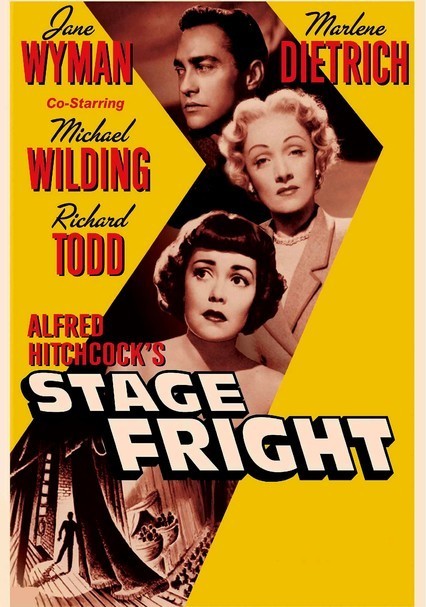
Starring Jane Wyman, Marlene Dietrich, Michael Wilding

Scott’s Review #1,160

Reviewed July 9, 2021

Grade: A-

Stage Fright (1950) is a British film directed by Alfred Hitchcock before his American invasion.

The film feels like a hybrid British/American project with the leading lady, Jane Wyman, being American, but otherwise, it is set in London with many British actors.

Hitchcock mixes plenty of film noir influences with the typical thrills and suspense, creating an excellent film that flies under the radar compared to his other films.

Wyman is cast as an attractive aspiring actress who works on her craft by going undercover to solve a mystery. The film has elements of Nancy Drew, and it’s fun to watch Wyman, who would become Mrs. Ronald Reagan before he entered politics and later became President of the United States.

She reportedly divorced him because she had little interest in entering the political spectrum by association.

The action gets off to a compelling start with two characters driving in a car in apparent peril. Hitchcock loved driving scenes like these. It is learned that the police think actor Jonathan Cooper (Richard Todd) is a murderer, and now they’re on his tail.

He seeks shelter with his ex-girlfriend Eve (Wyman), who drives him to hide with her father, Commodore Gill (Alastair Sim).

He explains that it was his lover, the famous and snobbish actress Charlotte Inwood (Marlene Dietrich), who killed the victim (not coincidentally, her husband). Convinced that Jonathan is innocent, Eve plays detective and assumes multiple disguises, slowly developing feelings for Detective Inspector Wilfred O. Smith (Michael Wilding).

Once embroiled in a web of deception, she realizes that Shakespeare was right and that all the world is a stage.

Wyman is the Hitchcock brunette as opposed to his later fascination with the blonde bombshell. Therefore, her role is more sedate and astute than the sex appeal that would come with Hitchcock’s later characters.

Eve closely resembles Charlie, the character Teresa Wright played in 1943’s Shadow of a Doubt. They are both astute and investigative, with a mystery to unravel. Interestingly, they both fall for detectives.

All the glasses! Hitchcock’s fetish for women wearing glasses is on full display, especially with the character of Nellie, a cockney opportunist played by Kay Walsh. Look closely, and one can spot several minor or background ladies sporting spectacles, and even Eve dons a pair as a disguise.

The director’s daughter, Pat Hitchcock, plays a small role as she would in Strangers on a Train (1951) and Psycho (1960).

Speaking of Strangers on a Train, there are similarities to mention.

Both involve a tit-for-tat exchange in which one character requests another kill someone for a payoff or other motivation.

Marlene Dietrich is as sexy as ever in Charlotte’s pivotal role. She is also self-centered, self-absorbed, and thoughtless. She constantly mispronounces Eve’s fictitious name and barely notices that she is covering for her regular maid/dresser.

But is she evil and capable of killing her husband?

Stage Fright has a thrilling finale. In the climax, the audience finally finds out who has been telling the truth, who has been lying, and what explanations are revealed. There is a pursuit, an attempted killing, and a shocking death by way of a falling safety curtain in the theater, naturally.

What one would expect from a Hitchcock final act.

The focus on theatrical stage actors is a nice topic and adds to the existing drama, as the implications of playing various roles are prominent. So is the prominence early on of the Big Ben landmark in London and other location trimmings.

Stage Fright (1950) doesn’t get the love saved for other Hitchcock masterpieces, and that’s a shame because the film is excellent.

The Witches-1967

The Witches-1967

Director Cyril Frankel

Starring Joan Fontaine, Kay Walsh, Alec McCowen

Scott’s Review #1,096

Reviewed December 29, 2020

Grade: B

Legendary film actress Joan Fontaine chose a Hammer horror film as her final role. While not high-brow art, these films are an entertaining treat for horror fans.

They are frequently macabre, clever, and make the most of a small budget.

In The Witches (1967), Fontaine leads the way, adding class and huge star quality. The film is good, but not great, with an unfulfilling ending. The cinematography and Fontaine’s involvement are the best aspects.

Also worthy of mention in the acting department is Kay Walsh, a talented British actress, who is terrific as the seemingly kind woman who becomes a crazed witch. She adds professionalism to a pivotal role. The other supporting actors play their parts well, ensuring that the craft of acting is respected.

I adore the British flair that Hammer films always have.

Fontaine plays Gwen Mayfield, an English schoolteacher who accepts a new job as the headmistress of the local school in the quaint village of Heddaby. The quiet town is exactly what Gwen needs after suffering a nervous breakdown while residing in Africa.

She experiences a small flirtation with the Reverend Alan Bax (Alec McCowen), who confesses that he is not overly religious. Stephanie is his sister, played by Walsh.

Before long, Gwen becomes immersed in the worlds of two of her students, Ronnie (Martin Stephens) and Linda (Ingrid Brett). Ronnie insists that Linda is being abused, which prompts Gwen to investigate. Meanwhile, Gwen discovers a voodoo doll and sleuths to find out what is going on in the village.

Events lead her to a sanitarium, and finally to a coven of witches, intent on human sacrifice.

The Witches has a late-1960s look and feel, which adds some sophistication. Gwen is draped in stylish clothes and jewelry and wears a cute, trendy bob haircut.

The set design is cool, with groovy, colorful furniture that makes the tight budget work to its full advantage.  Alan and Stephanie’s estate is particularly impressive with modern furniture, drapes, and various trimmings.

Another positive is the hefty amount of exterior sequences offered.

Director Cyril Frankel, who directed many episodes of the popular British television series The Avengers, provides a similar production, so The Witches feels like a long episodic series. The luxurious English village is sunny, calming, and atmospheric, brightening the film’s atmosphere.

This nicely counterbalances the themes of demons, voodoo, and witches.

Frankel builds the story momentum throughout The Witches at a good pace, but this is lost in the final act, which is way too abrupt. During the first three-quarters of the production, we are led to believe that Gwen is either crazy, imagining the strange events, or that one of the townspeople is gaslighting her.

It’s easy to deduce that the latter is what is going on, and the fun is figuring out who is doing the dirty deeds.

When the culprit is revealed (and it’s displayed on the cover art!), the conclusion is underwhelming. An attempted cemetery human ritual to remove life from Linda and infuse it into Stephanie so that she can live forever is weak.

After an odd sequence of the townspeople dancing and writhing around like nutcases in an unintentionally laugh-out-loud example of overacting, Gwen foils Stephanie’s plan. The witch succumbs to death, a victim of her heinous plan backfiring.

It is hinted that Gwen and Alan (who are revealed to be good) will forge a romance in the future, but I would have liked to have gotten a stronger sense of their budding attraction during the film. Still, it is likely the two will ride off into the sunset together, safely.

While not as gory as other Hammer films, The Witches (1967) instead features exceptional performances and tells a decent story, interesting until the low-key finale.

I expected a bit more from the ending, which simmers out instead of electrifying.

Oliver Twist-1948

Oliver Twist-1948

Director David Lean

Starring Alec Guinness, Kay Walsh

Scott’s Review #279

822333

Reviewed October 3, 2015

Grade: A-

Oliver Twist, the 1948 film version, is vastly different from the 1968 version, which turned the classic Charles Dickens novel into a musical, albeit a dark one, with colorful sets and brilliant art direction.

This version, made in black and white, is a better telling of the novel and contains masterful direction and cinematography.

Given the enormous length of the novel, some characters and details are inevitably trimmed or modified to fit a one-hour and forty-eight-minute film.

The film is a gorgeous cinematic treat, with glowing lighting and creative camera angles, thanks to the outstanding direction of legend David Lean (Lawrence of Arabia, 1963).

The film begins on a stormy night with the birth of poor little Oliver. His mother was frightened and died in childbirth, leaving him to live a life of hardship in a workhouse. His mother possesses a beautiful locket stolen by an old crone, who assists in the birth.

Now a young boy, Oliver draws the shortest straw, forcing him to utter the famous line “Please Sir, I want some more”, about desiring more bland gruel that the orphans are forced to eat.

From this point, Oliver is deemed troublesome and sold to an undertaker named Mr. Sowerberry. When this doesn’t work out, Oliver takes to the harsh streets of London to make his fortune among thieves such as Fagin, Bill Sykes, and The Artful Dodger, who become his friends but also his enemies.

Since I have seen Oliver’s musical version so many times and have also read the novel, it is difficult to watch this film without comparing it to the others.

Oliver Twist is a darker, gritty experience than Oliver! It precisely and closely resembles the novel, with details surfacing, such as the backstory of the locket, which takes on a more central role when the old crone repents on her deathbed, revealing all to the equally crooked Mrs. Corney.

Another example is the casting of less polished or average-looking actors than Oliver! Had. For example, Alec Guinness’s portrayal of Fagin is heavily disguised, with stringy hair and a prosthetic nose, a close comparison to the illustration of Fagin in the novel.

Bill and Nancy have more minor, though crucial, roles but are not as fleshed out as the other versions. The timing of particular events also plays a role —Nancy does not meet Oliver until later in the story.

The film does have light-hearted moments, which perfectly balance the heavy drama. The comic shenanigans of beadle Mr. Bumble and matron Mrs. Corney, both sinister characters but together a bickering, boorish couple who eventually marry each other, add humorous moments to the story as she becomes a domineering wife throughout their many fights and schemes.

The fact that the group of young thieves (boys) all live with Fagin in close quarters, the suggestion of child molestation is certainly implied but not pursued quite as much as in the novel.

I do not think that filmmakers in 1948 would have dared to go there in a film that was arguably meant to have a wholesome feel.

The certainty that Nancy is a prostitute and primarily sleeps in the streets is also addressed, though she is still rather glamorous and clean-looking. The class distinction is evident.

The bleakness of the workhouse and Fagin’s quarters counterbalances the rich and lush home of Oliver’s savior, Mr. Brownlow. I love his estate and housekeeper, the kindly and sweet Mrs.Bedwin.

A close retelling of the novel Oliver Twist (1948) is a fantastic film that can be enjoyed by parents and children alike and appreciated through generations of families.