Category Archives: Bob Newhart

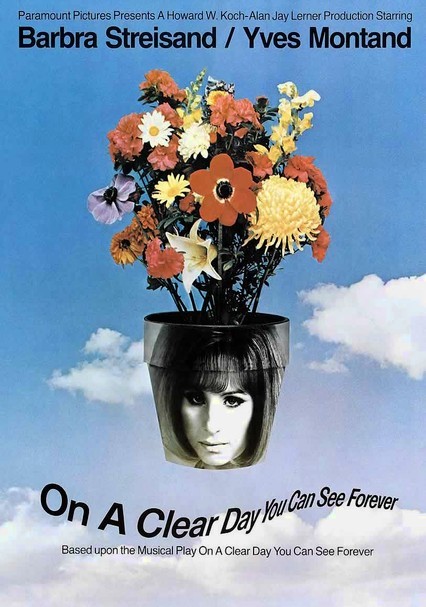
On a Clear Day You Can See Forever-1970

On a Clear Day You Can See Forever-1970

Director Vincente Minnelli

Starring Barbra Streisand, Yves Montand

Scott’s Review #921 
Reviewed July 19, 2019

Grade: B+

On a Clear Day You Can See Forever (1970) is a very obscure film that deserves better than to be relegated to the unknown.

Released during a time when the Hollywood musical had lost its luster, it feels like a last-gasp effort to keep the genre alive, serving as a star vehicle for Barbra Streisand.

The film suffers from severe editing problems with a large portion being cut, so much so that the result is a choppy and disjointed feel, tough to follow as is, but left untouched, the film could have been a creative masterpiece.

In a particularly convoluted plot that spans two time periods, chain-smoking New Yorker Daisy Gamble (Streisand) is convinced by her uptight fiancé Warren (Larry Blyden) to attend a class taught by Marc Cabot (Yves Montand), a psychiatrist.

When Cabot accidentally hypnotizes her, he realizes she speaks in the voice of an early-nineteenth-century woman named Melinda, and he becomes obsessed with her as she teeters between two existences.

The screenplay was written by Alan Jay Lerner and adapted from his book for the 1965 stage production.

Film director Vincente Minnelli fuses fantasy with a musical to create an extremely left-of-center experimental piece; this is not your standard 1950s or 1960s MGM experience with merry or clap-along tunes.

Some of the more memorable numbers include “On a Clear Day,” a reprise at the end of the film, “He Isn’t You,” and “Love with All the Trimmings.”

Casting Streisand is a monumental choice as she carries the film on her shoulders. Belting out numbers is the singer-turned-actress’s forte, and she never disappoints.

She is fascinating to watch in the neurotic role as she smokes and prances around, usually in a tizzy or a state of peril (self-induced).

The performance stands out as a different style from many of her other films, and she has never portrayed a livelier character. Streisand overcomes a few challenges of the film, winning in spades.

She shares little to no chemistry with co-star Montand, who is not only too old for her but also not the greatest actor. If the film’s intent, which I suspect, was to make the pair the main draw, then this failed.

Streisand’s chemistry with John Richardson, who plays Sir Robert Tentrees to her Melinda in the other time period, excites her. The duo smolders with passion, but sadly, most of the nineteenth-century scenes are sacrificed, leaving most of it a jumbled mess.

Much more interesting would have been to leave the entire film intact.

An oddity is Jack Nicholson’s almost nonexistent role as Tad Pringle, a mostly non-described brother of Daisy’s. Is he also her neighbor?

In 1970, Nicholson was only on the cusp of super-stardom, and it is questionable whether some of his parts were left on the cutting-room floor, but the limited character is strange and unsatisfying. In another role, there would have been some possibility of romantic entanglement.

Throughout the film, I wondered how On a Clear Day You Can See Forever might have worked with someone other than Streisand in the roles.

I kept ruminating on how good Liza Minnelli might have been in the roles, given her non-classic looks (like Streisand) and bombastic voice. Her high-drama flair and capable New York style would have made the results enjoyable, but Streisand hits it out of the park.

On a Clear Day You Can See Forever (1970) is a brave attempt at something fantastical, brimming with potential, but ultimately feels cluttered and messy.

With a delicious leading lady whom the camera adores and enough creative sets and rigorous energy to keep one guessing, the film stumbles with many problems and leaves viewers incomplete.

Elf-2003

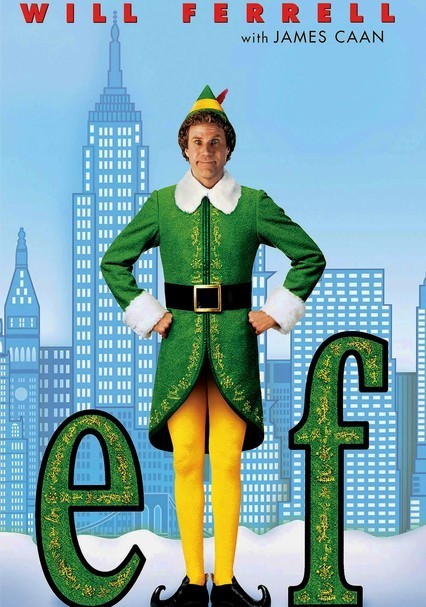
Elf-2003

Director Jon Favreau

Starring Will Ferrell, James Caan

Scott’s Review #846

Reviewed December 20, 2018

Grade: B-

Elf (2003) is one of the few lasting Christmas hits of recent memory or at least one that many fans make a regular viewing experience each holiday season.

The film is light and unarguably a safe, feel-good experience mixing a hopeful Christmas message with comic gags and romance. The key to its success is Will Ferrell who possesses wonderful comic timing.

More wholesome than my tastes and lacking plausibility the film does succeed as a family-friendly, ready-made, fun experience.

The story revolves around one of Santa’s elves (Ferrell) named Buddy who learns he is human and was orphaned as an infant. Revealed that his biological father Walter (James Caan) resides in New York City, Buddy embarks on a trip to find the man and spread Christmas cheer in a world filled with grizzled and cynical human beings.

In predictable comic form, Buddy has trouble adjusting to the human world and the fast-paced lifestyle with misunderstandings arising repeatedly. Buddy eventually wins over his father and family finding love with downtrodden Jovie (Zooey Deschanel).

Hot on the heels of his Saturday Night Live stint ending in 2002, Ferrell was primed to embark on a successful film career. Elf is a great role for him as it capitalizes on his comic timing and energy and the setup works.

At 6’3″ who better to play an elf for laughs than a hulking middle-aged man?

Due to his talents, Ferrell makes the role of Buddy fun, appealing, and the highlight of the film. With a lesser talent, the character would have been too annoying (as it is there are too many hug jokes) and the overall film would have suffered.

Other than Ferrell the supporting roles are nothing memorable other than Caan’s part. The once dashing star of films such as The Godfather (1972) Caan still has the charm and charisma to appeal, though the balding and dyed head of hair does nothing for him.

A small role by television star Bob Newhart as Papa Elf is fine, but Deschanel’s role and Mary Steenburgen’s role as Emily, Walter’s wife, could have been played by many actresses and nothing is distinguishable about either part.

Lesser roles like Walter’s secretary, Walter’s boss, and Gimble’s store manager are stock parts with no character development.

A major high-point is the New York City setting and the exterior scenes are aplenty. Filmed in 2002 and released in 2003, the location shots were completed not long after 9/11, and showcasing a city with such recent decimation adds to the film’s appeal.

Scenes in Rockefeller Center, Central Park, and the Empire State Building are prominently featured making the film festive and merry.

What greater city is there at Christmastime than New York?

Elf remains an entertaining experience with enough shiny ornaments and fun moments in the department store and Walter’s office to hold interest. The luster wears thin at the conclusion as all the traditional elements come together.

Jovie leads a chorus of strangers in “Santa Claus Is Coming to Town”, Walter quits his job without concern for paying bills, and everyone happily rides off into a sparkling winter wonderland.

This may satisfy some, but I wanted more conflict than a troupe of Central Park Rangers chasing Santa through the park.

A film that might be paired nicely with holiday favorites of similar ilk such as National Lampoon’s Christmas Vacation (1989) or Christmas with the Kranks (2004), Elf is an energetic affair with a charismatic lead actor.

Containing silly moments, but a spirited and worthwhile message nestled nicely within, the film is worth a watch if in the mood for slapstick.

More thought-provoking holiday films with deeper merriment and stronger flair exist, but for a chuckle or two Elf (2003) works well.

Catch-22-1970

Catch-22-1970

Director Mike Nichols

Starring Alan Arkin, Bob Balaban, Martin Balsam

Scott’s Review #41

60020883

Reviewed June 18, 2014

Grade: B

Catch-22 (1970) is a satirical film similar in subject matter to Robert Altman’s M*A*S*H, released the same year, though admittedly, I have not seen that film yet.

It does remind me of Dr. Strangelove (1964) and Slaughterhouse-Five (1972) in their anti-war theme.

This film is well-made and certainly effectively portrays the outrageousness and lunacy of war.

Most of the characters are portrayed as crazy, albeit in a darkly humorous, over-the-top way.

Alan Arkin is wonderful as the protagonist trying to find a way out of the island of Italy, where he and his fellow pilots are stationed.

At times, the film feels disjointed and hard to follow, which I understand the novel is too (I have not read the entire book), but Catch-22’s (1970) message comes across loud and clear.