Category Archives: James Cossins

The Man with the Golden Gun-1974

The Man with the Golden Gun-1974

Director Guy Hamilton

Starring Roger Moore, Christopher Lee, Britt Ekland

Top 250 Films #142

Scott’s Review #346
28370063

Reviewed January 9, 2016

Grade: A

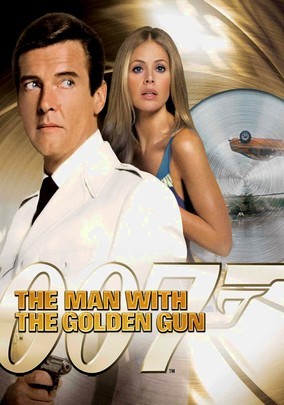
Though not typically regarded as one of the more appealing of James Bond films, and the second chapter to feature Roger Moore, Sean Connery’s replacement, The Man with the Golden Gun (1974) is one of my favorites, firmly placed in my top 5 of 007 offerings.

This could be the result of the film being one of my first introductions to the world of 007 as a child.

Moore seems more comfortable in the role than he did in the uneven Live and Let Die, released in 1973.

Qualities that make The Man with the Golden Gun a success include the wonderful casting of Christopher Lee, a famed horror film icon, in the central role of Francisco Scaramanga, the title character, and nemesis of Bond.

Who cannot think of Count Dracula while watching Lee act- his dark, swarthy looks, angular face, and his deep baritone voice make for a perfect villain.

Known in large part for participation in Hammer Horror films opposite another legend, Peter Cushing, this is casting at its finest and a true high point of the film.

To summarize the story, MI6 receives a golden bullet with “007” sketched on the side, a clear threat to the life of James Bond. It is assumed to have been sent by the famed assassin, Scaramanga, whose trademark is a deadly golden gun.

Bond is ordered to remove himself from his current mission, but he pays no mind and sets out to find Scaramanga on his own, leading him into a mystery involving a stolen solar energy weapon feared to destroy the world.

The adventure takes Bond to a bevy of gorgeous locales such as Hong Kong, Thailand, Macau, and the South China Sea where our villain resides on a private island reached only by helicopter.

I found the main locale of the sunny deserted island and Scaramanga’s dwarf sidekick, Nick Nack, great aspects of the film. Majestic caves, sandy beaches, and a gorgeous array of water set the tone with gorgeous fantasy elements.

Servant Nick Nack is sinister, but with a sweet smile, one almost trusts him as he serves lunch or expensive champagne to guests sure to be killed afterward.

The secret maze of mirrors that Bond finds himself in is made perfect by Nick Nack’s taunting and cackling. And the flying car that Scaramanga and Nick Nack drive-in, though gimmicky, is a real hoot.

A demerit to The Man with the Golden Gun that I have always been able to look past since other factors usurp her importance is the miscasting of Britt Eklund as Bond’s assistant, Mary Goodnight.

The writer’s pen Goodnight as simpering, silly, and a big goof. An attempt at comic relief falls flat as the character epitomizes a blonde bubblehead- constantly screwing up everything.

Scaramanga’s girlfriend and co-Bond girl, Andrea Anders, played by Maud Adams is much better, though we do not get to know the character very well before she is offed.

Fortunately, Adams would return to star in Octopussy in 1983.

Perhaps middling at times and suffering from some negative characteristics, The Man with the Golden Gun (1974) is a love of mine, a trip down memory lane to a time as a child when I was first discovering my love and zest for James Bond films.

This offering cemented my love of Roger Moore in the central role and I still adore watching this film.
Scrooge-1970

Scrooge-1970

Director Ronald Neame

Starring Albert Finney, Alec Guinness

Top 250 Films #186

Scott’s Review #561

Reviewed December 25, 2016

Grade: A

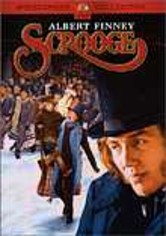
A classic perfect for watching around the holidays, perhaps accompanied by a roaring fire and a bit of brandy, Scrooge (1970) is a magical, musical experience; the entire family should adore it.

The film is a retelling of Charles Dickens’ 1843 story, A Christmas Carol.

Set in London with spectacular London-style art direction, it is perfect in its depiction of life around the holidays in the historic city, circa the nineteenth century.

To be clear, this is the musical version of the popular tale, not to be confused with the 1935 or the 1951 versions of the story.

The film is not as dark or scary as those films are. Instead, the 1970 Scrooge would be a fantastic companion piece to the 1968 classic Oliver!, both based on Dickens stories and both mixing fantastic musical scores with dramatic elements.

Albert Finney takes center stage in flawless form as the old, cantankerous, miser Ebenezer Scrooge. He plays the character as both an older man and, through flashbacks, a young man (Finney was merely 34 years old at the time of filming).

Guinness, indeed a high-caliber actor, is effective as the ghost of Jacob Marley- Scrooge’s former business partner. Scrooge is a moneylender, mainly to the working class, and is unforgiving in his collection of debts.

Filled with hatred for all things good, especially the Christmas holiday, Scrooge refuses to attend a family Christmas dinner hosted by his nephew, Fred, or to give to any charities. He begrudgingly gives his minion and bookkeeper, Bob Cratchit, Christmas Day off.

Finally left alone on Christmas Eve night, Scrooge is visited by the spirit of Jacob Marley, who tells Scrooge that three ghosts will visit him during the night.

In a chilling scene, Marley takes Scrooge on a journey through the sky, where he is greeted by spirits doomed to traverse the Earth, as Jacob is, with shackles acquired from their life as living beings.

Since they are greedy and wicked, they are doomed in the afterlife, just as Scrooge will be if he does not change his ways.

In an excellent subplot, we get to know the Cratchits, led by their father, Bob, a poor but earnest man. The family has little, but makes the most of what they do have, and appreciates the glorious holiday. They prepare a meager Christmas bird and savor being together as a family.

Their youngest, Tiny Tim, is lame, and he lusts over a lavish train set in the local toy shop. Cratchit epitomizes goodness and richness of character, contrasting with Ebenezer Scrooge.

As Scrooge is visited by the ghosts of Christmas past, present, and Christmas yet to come, he slowly realizes he needs to change his ways before it is too late. The audience is treated to stories of Scrooge’s youth, as we understand what has made him the miserly older man that he is today.

The clear highlight of this film is its musical numbers that will leave even the most tone-deaf humming along in glee. Throughout each sequence, we are treated to various numbers.

My favorite is “Thank You Very Much”, as it first appears during the Ghost of Christmas Yet To Come sequence.

By this time, feeling more sympathetic and appreciative, Scrooge merrily dances and sings along with the townspeople, unaware of the fact that they are celebrating his death and are dancing on his coffin to celebrate the fact that their debts are now free and clear.

This catchy tune is a reprise at the end of the film.

Other cheery numbers are “Father Christmas” and “I Like Life”, which perfectly categorize the film as a merry, holiday one, despite its occasional dark tone. This is necessary to avoid making Scrooge too bleak.

I also adore the vivid set designs as the gorgeous city of London is perfectly recreated to show the festive Christmas holiday. The film is not high-budget, but it makes the most of it by using small yet lavish sets.

Scrooge is a perfect holiday film, with fantastic tunes and a meaningful story that comes across on screen as a celebration of life, never edging toward contrived or oversaturated.

A wonderful holiday feast.

Oscar Nominations: Best Original Song Score, Best Original Song for the Picture-“Thank You Very Much”, Best Costume Design, Best Art Direction

The Anniversary-1968

The Anniversary-1968

Director Roy Ward Baker

Starring Bette Davis

Scott’s Review #52

70047116

Reviewed June 21, 2014

Grade: B+

The Anniversary (1968) is a British film based on a play of the same name.

The story centers on the Taggert family reunion, celebrating the anniversary of the matriarch (Bette Davis) and the deceased patriarch.

The film is set like a play, and most of the action takes place inside the Taggert family mansion.

The film is all Davis, and she gives a deliciously over-the-top performance as a vicious mother intent on controlling her son’s life and terrorizing their wives or significant others with cutting remarks and insults.

Davis must have had fun with this role, as her storied career was clearly on the downturn, and this role allowed her to let loose.

One must wonder if Davis chewed up the actors in the cast as much as the characters- rumor has it she was pretty intimidating to her fellow actors and a terror to work with, which adds to the macabre enjoyment.

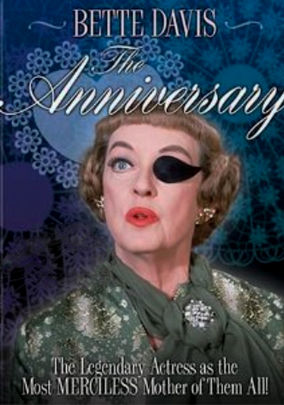
Her physical appearance, with an eye patch, wig, cigarette, and bright red lipstick, all work in her favor. Her maniacal laugh is incredibly campy and wonderful to watch.

Bette Davis is one of the greats, and The Anniversary (1968) serves as a late-career romp that is fun to watch.