Category Archives: Jon Finch

Frenzy-1972

Frenzy-1972

Director Alfred Hitchcock

Starring Jon Finch, Barry Foster, Anna Massey

Top 250 Films #28

Top 40 Horror Films #7  

Scott’s Review #244

Frenzy_movieposter

Reviewed May 17, 2015

Grade: A

Frenzy (1972) is a later-day Alfred Hitchcock film that returns the masterful director to his roots in London, England, his country of origin, and the place where his early films were made.

As with numerous other Hitchcock stories, the protagonist is falsely accused of murder and struggles mightily to prove his innocence before time runs out and he meets his doom.

The film is distinctly British, featuring an entirely British cast, and includes a humorous side story about the primary investigator’s wife. This terrible cook prepares exotic yet unappetizing meals for her husband.

This comic relief perfectly balances the heavy drama encompassing the main murder story, as Frenzy is one of Hitchcock’s most violent and graphic films.

Made in 1972, he was able to include much more explicit content. A neck-tie murderer, who also rapes his female victims, is on the loose in London.

In the opening sequence, we see a dead woman floating in the Thames River during broad daylight, nude, except for a neck-tie that she has been strangled with. A crowd of spectators races to see what all the fuss is about.

We then meet the central character of the film, down-on-his-luck bartender Richard Blaney, who is fired from his job as a bartender by his hateful boss.

Blaney has a loyal girlfriend in Babs, a barmaid at the same local watering hole. Babs is sexy, yet plain. He also has a successful ex-wife, Brenda, who runs a dating company. Blaney regularly sponges off Brenda for money and dinners. Also in the picture is successful fruit-market trader Bob Rusk, who is a friend of Blaney’s.

All four of these central characters play a significant role in the main plot.

As events begin to unfold, the film is not a whodunit as traditionally it could have been. Instead, the audience quickly learns who the murderer is and their motivations, which is an interesting twist in itself.

Despite this knowledge, the film is quite compelling as a classic Hitchcock horror-thriller.

It is interesting for Hitchcock fans to compare this film with many of his earlier works. Released in 1972, at a time in film history when such sensors were more lax, it is the first Hitchcock film to feature nudity.

It is also the film of Hitchcock’s that features the most brutal rape/murder scene of all, surpassing the shower scene from Psycho, in my opinion.

The victim’s ordeal is prolonged, as she begins praying, thinking she will only be raped, at first unaware that her attacker is also the neck-tie murderer, and her life is running short. This leads to a sad, gruesome outcome for her.

One of the most interesting murder scenes takes place off-camera and is an ingenious idea by Hitchcock. The neck-tie murderer lures a victim to his apartment complex under the guise of being a friend of hers.

They walk upstairs to his unit and go inside, all the while the camera remains outside the apartment, so the viewer only imagines the horrors unfolding inside.

The camera then slowly goes back down the stairs and out onto the street, and looks up at the murderer’s window. The fact that the victim is one of the main characters makes one’s imagination run wild about what is transpiring inside the apartment, and the viewer is filled with grief.

This is a brilliant choice by Hitchcock and so effective to the story.

Another great scene is the potato truck sequence.

As the neck-tie murderer has dumped his victim, like garbage, into a potato sack, he is panicked to realize that she has taken his pin from his jacket and presumably clenched it in her fist as a clue, despite her demise.

What will he do now?

The extended scene features the murderer inside the potato truck attempting to unclench his pin from her hand and escape the moving truck without being caught.

It is my favorite scene in Frenzy.

Frenzy (1972) is a return to triumph for Hitchcock, after the complex Topaz (1969) and Torn Curtain (1966), both underappreciated political thrillers made a few years earlier.

He returns to the horror genre like gangbusters, throwing in some good, sophisticated British humor for good measure.

What a treat this film is.

Sunday Bloody Sunday-1971

Sunday Bloody Sunday-1971

Director John Schlesinger

Starring Glenda Jackson, Peter Finch, Murray Head

Top 250 Films #182

Scott’s Review #1,062

Reviewed September 15, 2020

Grade: A

Whether it’s the late 1960s style with British sophistication or the ahead-of-its-time subject matter, John Schlesinger’s Sunday Bloody Sunday (1971) is a brazen and mature piece of filmmaking.

With fantastic acting mostly from Glenda Jackson and Peter Finch, the film is subdued enough to contain the drama while letting the underlying plot marinate and flourish rather than being forced or overdone.

That’s not to say Sunday Bloody Sunday is an easy watch. The main characters stew and simmer rather than explode as the audience comes to grips with their feelings, emotions, and motivations, as painful as they can be.

Schlesinger offers the complexities of the characters as we get inside their heads across multiple scenes, with cameras carefully panning in on their facial expressions. The intention is to read their minds or think we know what they are thinking.

The three characters featured are Alex (Glenda Jackson), a divorced, restless recruitment worker; a young, free-spirited artist, Bob (Murray Head); and a gay, Jewish doctor, Daniel (Peter Finch).

Bob openly dates both Alex and Daniel, who are aware of each other and even have common friends. Instead of scheming against the other in hopes of poisoning their character with Bob, they deal with acceptance and a host of different emotions.

A triangle ensues, though not one with a clear couple to root for, nor is it clear who we want to root for. Sunday Bloody Sunday is not that trite or simplistic, and this is the beauty of the film.

Each character can be analyzed for individual motivations, peculiarities, and desires that sometimes overlap. The added perk of one character being straight, one character being bisexual, and one character being gay only adds flavor and lustful desire.

Sunday Bloody Sunday is a character study if ever there was one.

Screenwriter Penelope Gilliatt writes a piece so bristling with unpredictability that the characters and situations are deep and troubling. My favorite character is Daniel, the most adjusted of the three, but a character who would typically be written as the most maladjusted.

Schlesinger had directed the brilliant Midnight Cowboy (1969) two mere years earlier, a film that depicted gay characters as troubled and self-hating. Gilliatt crafts Daniel as confident, booming, and masculine, avoiding all stereotypes.

I immediately had thoughts of Ken Russell’s masterpiece, Women in Love, made only one year earlier in 1970, and starring Jackson. Both films, featuring four characters rather than only three, are British and explore the complexities of sexual orientation, jealousy, and loneliness.

Women in Love is a slightly better film, but only by a small margin, probably because it adds one additional character. Both explore and barely touch territory when it was still taboo to explore homosexuality in film.

Adorable is a scene at a Bar Mitzvah given to Daniel’s nephew. As the merriment commences, several women are bound to be interested in Daniel, what with him being a successful doctor. He doesn’t have any interest in it naturally, but he politely makes small talk with one woman.

The scene is so natural and at ease that it is terrific and reaffirming to see a gay character treated with such dignity and richness, his problems not being a result of being gay but of being a human being.

Daniel and Alex compete for Bob’s affection, but in a polite way. Instead of hating each other, they hate the situation. Bob is not the nicest guy in the world, so the question arises as to why they both feel the way they do about him.

But this hardly matters when the heart wants what it wants.

The most interesting and realistic scenes occur when each couple lies in bed together or when they make small talk over a meal. This offers a glimpse of the day-to-day treasures they could each enjoy.

Those in the mood for a film rife with emotion and psychologically complex feelings, wrapped in a good drama, will find Sunday Bloody Sunday (1971) a pure treat. Trimmings like glimpses of the gorgeous city of London lend added nuance.

Each time this film is viewed, it could easily be watched from the perspective of either Alex, Bob, or Daniel.

Oscar Nominations: Best Director-John Schlesinger, Best Actor-Peter Finch, Best Actress-Glenda Jackson, Best Original Screenplay

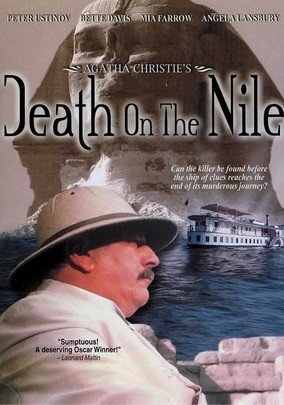
Death On The Nile-1978

Death On The Nile-1978

Director John Guillermen

Starring Peter Ustinov, Mia Farrow, Bette Davis

Scott’s Review #714

Reviewed January 14, 2018

Grade: B+

Death On The Nile is a 1978 British thriller that follows up the successful 1974 offering, Murder On The Orient Express- both films based on the fabulous Agatha Christie novels of the 1930s.

This time around, Belgian detective Hercules Poirot (Peter Ustinov) investigates a string of deaths aboard a luxurious steamer carrying the lavishly wealthy and their servants.

The film is a good, old-fashioned whodunit, perhaps not on the level of storytelling as its predecessor-the murder mystery contains not the oomph expected- but features exquisite Egyptian historical locales- worth its weight in gold.

Featuring a who’s who of famous stars and tremendous actors of the day, Death On The Nile carves a neat story right off the bat in such a way that the murder victim is fairly obvious right away- most of the characters have reason to celebrate her demise.

Rich and reviled heiress, Linnet Ridgeway (Lois Chiles), has stolen best friend Jacqueline’s (Mia Farrow) beau, Simon, sparking a bitter feud between the women. While honeymooning in Egypt, the newlyweds are continually taunted by angry Jacqueline.

Once the cruise ship departs with all on board, Jackie is the prime suspect when Linnet is murdered.

Poirot must find the killer as numerous other suspects all with grudges against Linnet, begin to emerge.

Death On The Nile serves up a stellar cast including legendary Bette Davis in the role of Marie Van Schuyler- an eccentric American socialite with an eye for Linnet’s necklace. The casting of Davis is reason enough to watch the film, though the character is not center stage but rather a supporting role.

The lead female honor is held for Farrow, who has the meatiest and most complex role in the film.

Jackie’s unstable actions make her the most likely to commit the deed, but the fun is to figure out the “whys” and the “hows” of the murder. Is there more than one killer? Are they working in cahoots or independently? As the body count increases these questions begin to resonate more and more.

The costumes and sets are gorgeous and it is no wonder the film won the Oscar for Best Costume Design. At a ball, the women are dripping with jewels and gorgeous gowns.

Along with Davis, boozy author Salome Otterbourne, hilariously played by Angela Lansbury, is granted the prize of wearing the most luxurious and interesting of all the costumes. She drips with jewels and, with a cocktail always in hand, is the film’s comic relief.

Director John Guillermin makes the film an overall light and fun experience and, despite the murderous drama, does not take matters too seriously.

Offering humorous moments, this balances nicely with the inevitable murders.

The fun for the audience is deducing whodunit- most of the characters have the motive and the cast of characters is hefty.

I had memories of the famous board game Clue- Was it Jackie in the ballroom with the revolver? You get the idea. The film makes for a good, solid game of mystery.

Comparisons to 1974’s Murder On The Orient Express cannot help but be drawn, especially in the lead casting of Hercules Poirot.

Truth be told, Albert Finney’s portrayal in “Murder” is superior to Peter Ustinov’s Poirot in “Death” and I am not sure what purpose Colonel Race (David Niven) as Poirot’s friend offers other than to be a loyal sidekick and present a character that Poirot can explain events to- think what Watson was to Sherlock Holmes.

Regardless, Finney is the superior Poirot as he musters more strength and charisma than Ustinov does.

How lovely and historic to witness the wonderful Egyptian locales- the Sphinx and the Great Pyramids are featured amid an attempt on the life of the romantic pair by way of falling rocks- this sets the tone for the perilous cruise about to be embarked upon.

Perhaps a perfect film for a Saturday stay-at-home evening with friends, complete with a serving of quality wine and cheese, Death On The Nile is a sophisticated, yet fun, British mystery film, fantastic to watch in a party setting where the audience can be kept guessing until the nice conclusion and the big reveal of who killed whom and why.

Oscar Nominations: 1 win-Best Costume Design (won)