Category Archives: Alec McCowen

Frenzy-1972

Frenzy-1972

Director Alfred Hitchcock

Starring Jon Finch, Barry Foster

Top 250 Films #28

Top 40 Horror Films #7  

Scott’s Review #244

Frenzy_movieposter

Reviewed May 17, 2015

Grade: A

Frenzy (1972) is a latter-day Alfred Hitchcock film that returns the masterful director to his roots in London, England, Hitchcock’s country of origin, and where his early films were made.

As with numerous other Hitchcock stories, the protagonist is falsely accused of murder and struggles mightily to prove his innocence before time runs out and he meets his doom.

The film is distinctly British, featuring an entirely British cast, and includes a humorous side story about the primary investigator’s wife. This terrible cook prepares exotic yet unappetizing meals for her husband.

This comic relief perfectly balances the heavy drama encompassing the main murder story, as Frenzy is one of Hitchcock’s most violent and graphic.

Made in 1972, he was able to include much more explicit content. A neck-tie murderer, who also rapes his female victims, is on the loose in London.

In the opening sequence, we see a dead woman floating in the Thames River during broad daylight, nude, except for a necktie that she has been strangled with. A crowd of spectators races to see what all the fuss is.

We then meet the central character of the film, down-on-his-luck bartender Richard Blaney, who is fired from his job as a bartender by his hateful boss.

Blaney has a loyal girlfriend in Babs, a barmaid at the same local watering hole. Babs is sexy, yet plain. He also has a successful ex-wife, Brenda, who runs a dating company. Blaney regularly sponges money and dinners from Brenda. Also in the picture is successful fruit-market trader, Bob Rusk, who is a friend of Blaney’s.

All four of these central characters have much to do with the main plot.

As events begin to unfold, the film is not a whodunit as traditionally it could have been. Instead, the audience knows very quickly who the murderer is and their motivations, which is an interesting twist in itself.

Regardless of this knowledge, the film is quite compelling as a classic Hitchcock horror thriller.

It is interesting for Hitchcock fans to compare this film with many of his earlier works. Released in 1972, at a point in film history where aforementioned sensors were more lax, it is the first Hitchcock film to feature nudity.

It is also the film of Hitchcock’s that features the most brutal rape/murder scene of all, surpassing the shower scene from Psycho, in my opinion.

The victim’s ordeal is prolonged, as she begins praying, thinking she will only be raped, at first unaware that her attacker is also the neck-tie murderer and her life is running short. This leads to a sad, gruesome outcome for her.

One of the most interesting murder scenes takes place off-camera and is an ingenious idea by Hitchcock. The neck-tie murderer lures a victim to his apartment complex under the guise of being a friend of hers.

They walk upstairs to his unit and go inside, all the while the camera remains poised outside of the apartment so the viewer only imagines the horrors occurring inside.

The camera then slowly goes back down the stairs and out onto the street and looks up at the murderer’s window. The fact that the victim is one of the principal characters makes one’s imagination run wild as to what is transpiring inside the apartment and the viewer is filled with grief.

This is a brilliant choice by Hitchcock and so effective to the story.

Another great scene is the potato truck sequence.

As the neck-tie murderer has dumped his victim, like garbage, into a potato sack, he is panicked to realize that she has taken his pin from his jacket and presumably clenched it in her fist as a clue, despite her demise.

What will he do now?

The long scene features the murderer inside the potato truck attempting to unclench his pin from her hand and escape the moving truck without being caught.

It is my favorite scene in Frenzy.

Frenzy (1972) is a return to triumph for Hitchcock, after the complex Topaz (1969) and Torn Curtain (1966), underappreciated political thrillers made a few years before this film.

He returns to the horror genre like gangbusters throwing some good, sophisticated British humor into his recipe for good measure.

What a treat this film is.
Gangs of New York-2002

Gangs of New York-2002

Director Martin Scorsese

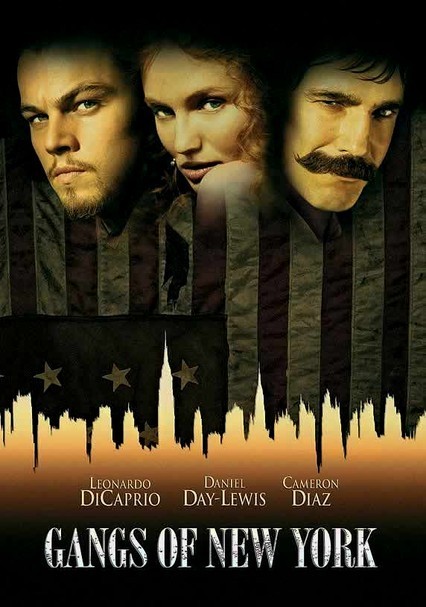
Starring Leonardo Dicaprio, Daniel Day-Lewis, Cameron Diaz

Scott’s Review #1,327

Reviewed December 26, 2022

Grade: A-

Gangs of New York (2002) is an extremely violent and bloody epic by director Martin Scorsese that is an exquisite piece of filmmaking nearly flawless in every way except maybe its length and story.

On the one hand, it’s a beautifully choreographed and filmed crime drama with perfect costumes, art direction, and cinematography. Still, on the other, it’s tedious and lengthy, especially during the final hour, with choppy storytelling and seemingly one long continuous battle.

Scorsese being Scorsese and knowing his way around crafting an excellent film or two left me ruminating over the cinema and pondering whether I’d ever need to see it again.

Usually, I’m all in when it comes to repeated viewings of his films,  especially Raging Bull (1980) or Goodfellas (1990) but with Gangs of New York, the sobering almost three hours running time and the non-stop bloodshed gives me pause.

It’s not a mafia film but it is an Irish-centered crime drama harkening back to the mid-1800s so there are historical lessons to be exposed to. Familiar with most of his films there are good guys, bad guys, and a criminal, feuding overtone, and lots of grit and grime to plow through.

I can’t say it’s one of Scorsese’s top 10 but it’s a grandiose, epic-length behemoth that features a host of top-name talent but there are nonetheless aspects that leave it slightly beneath his most famous works.

But that’s nearly akin to comparing the works of Beethoven, Rembrandt, or other geniuses of one art form or another. Anyone respecting Scorsese or appreciating good cinema should see Gangs of New York.

Amsterdam Vallon (Leonardo DiCaprio) is a young Irish immigrant released from prison. He returns to the Five Points seeking revenge against his father’s killer, William Cutting (Daniel Day-Lewis) also known as ‘The Butcher’, a brutal and powerful anti-immigrant gang leader.

He knows that revenge can only be attained by infiltrating Cutting’s inner circle. Amsterdam’s journey became a fight for personal survival and to find a place for the Irish people in 1860’s New York.

The most delicious part of the film is the rivalry between Amsterdam and ‘The Butcher’. DiCaprio and Day-Lewis make powerful sparring partners and as much as Amsterdam’s motivations are admirable it’s Day-Lewis who has the more interesting character.

To no one’s surprise, the actor channels his inner dictator as he method acts throughout the film. To no one’s additional surprise, he steals the show away from other tremendous actors like DiCaprio, Jim Broadbent, and John C. Reilly in supporting roles.

However, I need to ask why Day-Lewis was selected for the Lead Actor Oscar category when he is a supporting one.

Worthy of mention is Cameron Diaz who, for once, plays the dramatic role of a pickpocket. Typically cast in comedic roles she shows she has acting chops.

The story gets a bit wayward about halfway through and I stopped giving the story much credence about three-quarters of the way through. It’s as if Scorsese had frenetic schizophrenia moments with tons of good ideas but none of them formulating a cohesive plot.

The New York City setting is a favorite of mine especially pre-civil war and well before the NYC of modern times even existed. The prevalence of Canal Street and various others make this northeasterner heavily invested in geography.

Finally, to bring it all full circle, Gangs of New York powerfully reminds the audience of the age-old topic of immigration and how those who have citizenship too often oppose those who desire to enter a country they once also did.

‘The Butcher’s’ brutal opposition is a sad reminder of how the United States of America was never united and the senseless violence towards immigrants is never-ending.

Gangs of New York (2002) may not be Scorsese’s best work but even on his worst day, he creates a film worth watching. Mixing toxic masculinity, and revenge with a crazy story he succeeds where other directors might fail by providing compelling filmmaking with all the fixings.

Just don’t get too hung up on the story points.

Oscar Nominations: Best Picture, Best Director-Martin Scorsese, Best Actor-Daniel Day-Lewis, Best Original Screenplay, Best Art Direction, Best Cinematography, Best Costume Design, Best Film Editing, Best Original Song-“The Hands That Built America”, Best Sound

The Witches-1967

The Witches-1967

Director Cyril Frankel

Starring Joan Fontaine, Kay Walsh, Alec McCowen

Scott’s Review #1,096

Reviewed December 29, 2020

Grade: B

Legendary film actress Joan Fontaine chose a Hammer horror film as her final role. While not high-brow art, these films are an entertaining treat for horror fans.

They are frequently macabre, clever, and make the most of a small budget.

In The Witches (1967), Fontaine leads the way, adding class and huge star quality. The film is good, but not great, with an unfulfilling ending. The cinematography and Fontaine’s involvement are the best aspects.

Also worthy of mention in the acting department is Kay Walsh, a talented British actress, who is terrific as the seemingly kind woman who becomes a crazed witch. She adds professionalism to a pivotal role. The other supporting actors play their parts well, ensuring that the craft of acting is respected.

I adore the British flair that Hammer films always have.

Fontaine plays Gwen Mayfield, an English schoolteacher who accepts a new job as the headmistress of the local school in the quaint village of Heddaby. The quiet town is exactly what Gwen needs after suffering a nervous breakdown while residing in Africa.

She experiences a small flirtation with the Reverend Alan Bax (Alec McCowen), who confesses that he is not overly religious. Stephanie is his sister, played by Walsh.

Before long, Gwen becomes immersed in the worlds of two of her students, Ronnie (Martin Stephens) and Linda (Ingrid Brett). Ronnie insists that Linda is being abused, which prompts Gwen to investigate. Meanwhile, Gwen discovers a voodoo doll and sleuths to find out what is going on in the village.

Events lead her to a sanitarium, and finally to a coven of witches, intent on human sacrifice.

The Witches has a late-1960s look and feel, which adds some sophistication. Gwen is draped in stylish clothes and jewelry and wears a cute, trendy bob haircut.

The set design is cool, with groovy, colorful furniture that makes the tight budget work to its full advantage.  Alan and Stephanie’s estate is particularly impressive with modern furniture, drapes, and various trimmings.

Another positive is the hefty amount of exterior sequences offered.

Director Cyril Frankel, who directed many episodes of the popular British television series The Avengers, provides a similar production, so The Witches feels like a long episodic series. The luxurious English village is sunny, calming, and atmospheric, brightening the film’s atmosphere.

This nicely counterbalances the themes of demons, voodoo, and witches.

Frankel builds the story momentum throughout The Witches at a good pace, but this is lost in the final act, which is way too abrupt. During the first three-quarters of the production, we are led to believe that Gwen is either crazy, imagining the strange events, or that one of the townspeople is gaslighting her.

It’s easy to deduce that the latter is what is going on, and the fun is figuring out who is doing the dirty deeds.

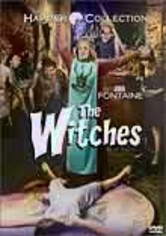
When the culprit is revealed (and it’s displayed on the cover art!), the conclusion is underwhelming. An attempted cemetery human ritual to remove life from Linda and infuse it into Stephanie so that she can live forever is weak.

After an odd sequence of the townspeople dancing and writhing around like nutcases in an unintentionally laugh-out-loud example of overacting, Gwen foils Stephanie’s plan. The witch succumbs to death, a victim of her heinous plan backfiring.

It is hinted that Gwen and Alan (who are revealed to be good) will forge a romance in the future, but I would have liked to have gotten a stronger sense of their budding attraction during the film. Still, it is likely the two will ride off into the sunset together, safely.

While not as gory as other Hammer films, The Witches (1967) instead features exceptional performances and tells a decent story, interesting until the low-key finale.

I expected a bit more from the ending, which simmers out instead of electrifying.