Category Archives: Peter Finch

Sunday Bloody Sunday-1971

Sunday Bloody Sunday-1971

Director John Schlesinger

Starring Glenda Jackson, Peter Finch, Murray Head

Top 250 Films #182

Scott’s Review #1,062

Reviewed September 15, 2020

Grade: A

Whether it’s the late 1960s style with British sophistication or the ahead-of-its-time subject matter, John Schlesinger’s Sunday Bloody Sunday (1971) is a brazen and mature piece of filmmaking.

With fantastic acting mostly on the part of Glenda Jackson and Peter Finch, the film is subdued enough to contain the drama while letting the underlying plot marinate and flourish rather than being forced or overdone.

That’s not to say Sunday Bloody Sunday is an easy watch. The main characters stew and simmer rather than explode as the audience comes to grips with their feelings, emotions, and motivations as painful as they can be.

Schlesinger offers the complexities of the characters as we get inside their heads during multiple scenes as cameras carefully pan in on their facial expressions. The intention is to read their minds or think we know what they are thinking.

The three characters featured are Alex (Glenda Jackson), a divorced and restless recruitment worker, a young, free-spirited artist, Bob (Murray Head), and a gay, Jewish, doctor named Daniel (Peter Finch).

Bob openly dates both Alex and Daniel, who are aware of the existence of the other and even have common friends. Instead of scheming against the other in hopes of poisoning their character with Bob, they deal with acceptance and a host of other emotions.

A triangle ensues, though not one with a clear couple to root for, nor is it clear who we want to root for. Sunday Bloody Sunday is not that trite or simplistic and this is the beauty of the film.

Each character can be analyzed for individual motivations, peculiarities, and desires that sometimes overlap. The added perk of one character being straight, one character being bisexual, and one character being gay only adds flavor and lustful desire. Sunday Bloody Sunday is a character study if ever there was one.

Screenwriter, Penelope Gilliatt, writes a piece so bristling with the unpredictability that the characters and situations are deep and troubling. My favorite character is Daniel, the most adjusted of the three, but a character who would typically be written as the most maladjusted.

Schlesinger had directed the brilliant Midnight Cowboy (1969) two mere years earlier, a film that depicted gay characters as troubled and self-hating. Gilliatt crafts Daniel as confident, successful, and masculine, avoiding all stereotypes.

I immediately had thoughts of Ken Russell’s masterpiece, Women in Love, made only one year earlier in 1970, and starring Jackson. Featuring four characters rather than only three, both films are British and feature the complexities of sexual orientation, jealousy, and loneliness.

Women in Love is a slightly better film, but only by a small margin, probably because there is one additional character to consider. Both explore then barely touched territory when it was still taboo to explore homosexuality in film.

Adorable is a scene at a Bar Mitzvah given to Daniel’s nephew. As the merriment commences several women are bound to be interested in Daniel, what with him being a successful doctor. He doesn’t have any interest naturally but politely makes small talk with one woman.

The scene is so natural and at ease that it is wonderful and reaffirming to see a gay character treated with such dignity and richness, his problems not being a result of being gay but of being a human being.

Daniel and Alex compete for Bob’s affection but in a polite way. Instead of hating each other, they hate the situation. Bob is not the nicest guy in the world so the question can be raised as to why they both feel the way they do about him.

But this hardly matters when the heart wants what it wants.

The most interesting and realistic scenes occur when each couple lies in bed together or makes small talk over a meal. This offers a glimpse of what day-to-day treasures they each could enjoy.

Those in the mood for a film rife with emotion and psychologically complex feelings wrapped inside a good drama will find Sunday Bloody Sunday (1971) a pure treat. Trimmings like glimpses of the gorgeous city of London lend themselves to added nuances.

Each time this film is viewed it could easily be watched from the perspective of either Alex, Bob, or Daniel.

Oscar Nominations: Best Director-John Schlesinger, Best Actor-Peter Finch, Best Actress-Glenda Jackson, Best Original Screenplay
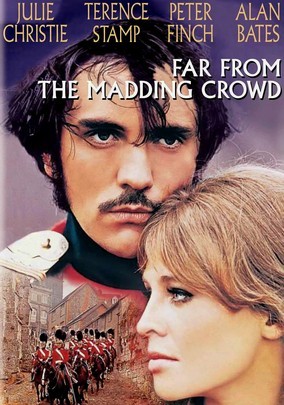
Far from the Madding Crowd-1967

Far from the Madding Crowd-1967

Director John Schlesinger

Starring Julie Christie, Terence Stamp, Alan Bates

Top 250 Films #183

Scott’s Review #315

70111488

Reviewed January 1, 2016

Grade: A-

A sweeping, gorgeous epic made in 1967, Far from the Madding Crowd is pure soap opera (this is not a negative), done very well, featuring a woman with three male suitors and many similarities to another brilliant epic, Gone with the Wind (1939).

The cinematography, score, and writing are excellent, and at close to three hours, it is a lengthy experience.

The film is based on the popular novel written by Thomas Hardy.

The setting is lovely, rural England, the landscape green and lush- mostly farmland, where Bathsheba resides, having recently inherited her Uncle’s enormous estate and is, frankly, overwhelmed with the heavy responsibility required to run it successfully.

Three men appear in one form or another to lend a hand, and each falls madly in love with her- she had her choice of any of them. Throughout the film, each is given a chance to win her heart, and each faces trials and tribulations.

The wealthy neighbor, William Boldwood, is older and insecure. Frank Troy is a bad boy who is a cavalry sergeant, and Gabriel, a former farmer, has lost all of his sheep.

Having only seen this film twice (so far), I notice more and more the similarities to Gone with the Wind. Both are set around the same period (the 1860s), and both films feature powerful, independent, gorgeous female characters with multiple male suitors.

Unlike Gone with the Wind, though, Bathsheba is not self-centered, but wholesome and honest.

Julie Christie was undoubtedly the “it” girl during the time the film was made, having recently starred in Darling (1965) and Doctor Zhivago (1965), among others, and Far from the Madding Crowd is a perfect film for her, focusing on her beauty and earnestness.

She is exceptionally cast.

What I enjoy most about the film is that we do not know which of the men Bathsheba will wind up with…if any of them. Gabriel (Alan Bates) is my personal favorite, but at the beginning of the film, she rebuffs his marriage proposal.

In a heartbreaking scene, one of his dogs goes mad and leads his entire flock of sheep to their death. He is then forced to work as her shepherd, a job beneath him. He is the most likable of the three men, and it is fun to root for their ultimate union. But is he prone to bad luck?

Frank Troy is dashing- a clear lady’s man, yet I did not root for him. A character, whom I found to have strange motivations, impregnated and almost married a young lady named Fanny, only to turn her away based on a misunderstanding, then ultimately changed his mind about Bathsheba.

In one scene, he manipulates the citizens into getting drunk on brandy, which leads to a crisis. He is charismatic and used to getting his way.

Finally, Boldwood is wealthy, sophisticated, and appealing to Bathsheba in a certain way (primary stability). Still, there is also something I find “off” about the character throughout the film- unstable, maybe, needy? I did not find his character likable either.

The overlap and the relationships between the men are also interesting aspects of Far from the Madding Crowd. Will they become friends? Would they kill each other for Bathsheba’s affection?

Many emotions run through all four characters, which makes the film rich in character development.

Grand, sweeping, and beautiful are words that describe Far from the Madding Crowd, a film I enjoy exploring and evaluating with each viewing.

Oscar Nominations: Best Original Music Score

Network-1976

Network-1976

Director Sidney Lumet

Starring Faye Dunaway, Peter Finch, William Holden

Top 250 Films #228

Scott’s Review #1,481

Reviewed May 13, 2025

Grade: A

A conceptual film laden with intelligence and satire, Network (1976) is innovative, not easily digestible, but satisfying nonetheless. It pairs well with films like All the President’s Men (1976) or Spotlight (2015), with a focus on media frenzy, ratings, and the frustrating search for the truth amid chaos.

Or, does the truth even matter? It’s a sobering question the film explores.

The film received nine Oscar nominations and won three of the four acting awards. Decades later, it holds up tremendously well and is a stark reminder of the power of television and public perception, for better or worse.

Brilliant acting, rich writing, and impressive editing make Network a timeless treasure for many generations, not to mention Lumet’s creative and sometimes shocking direction.

Over narration, we meet veteran news anchorman Howard Beale (Peter Finch). He learns from his friend and news division president, Max Schumacher (William Holden), that he has just two more weeks on the air with the UBS network because of declining ratings.

After threatening to shoot himself on live television, instead, he launches into an angry televised rant, which turns out to be a huge ratings boost for the network, and he is kept on for entertainment purposes.

But what happens when the public grows tired of his antics and craves even more outrageous programming?

Ambitious producer Diana Christensen (Faye Dunaway), obsessed with her career and ratings, takes actions to dangerous new levels.

The poignancy that immediately caught my attention was how little the bottom line has changed in almost fifty years of television since Network was released. One could argue that things have gotten worse where ratings will make or break a television broadcast.

Depressing still is the knowledge in 2025 politics where liars, cheats, and felons callously hold the highest offices and wield the most power, newscasts are currently created based on the truths their target audiences believe, regardless of the truth.

Lumet, well-known for creating the groundbreaking Dog Day Afternoon (1975) just a year earlier, uses split screens to show four perspectives and adds frightening gun-toting rebels who are angry and looking to make political statements.

But Diana needs them for a significant ratings share.

Lumet’s sequences teeter between long soliloquies in which characters reveal their deepest motivations and emotions and rapid-fire editing involving shootings and bank robberies.

I loved seeing the 1970s-style corporate offices with retro telephones, notepads, pens, pencils, stylish carpets, and colorful elevators. The glamorous and polished interiors perfectly reflect the gorgeous Manhattan skyline seen in numerous sequences.

The lavish restaurants and strong cocktails provide a luminous texture to the time.

The screenplay, written by Paddy Chayefsky, was based on the idea of a live death as his film’s terminating focal point, to say later in an interview, “Television will do anything for a rating… anything!”

The statement hit home in frigid reality.

Dunaway and Finch are clear favorites and provide the deepest character structures. Dunaway’s Diana is frigid and opportunistic, providing no vulnerability or sympathy from the audience. In a way, she is not a human being, lacking emotional depth.

I half expected her to tear her face off and reveal herself as a fembot.

Finch steals the show as the tired and depressed veteran who feels dismissed and forgotten. Even when he reveals his intent to commit suicide on live TV, the news crew tunes out his monotone voice as they do nightly.

Finally, Beatrice Straight brilliantly delivers an acting 101 tutorial as the aging housewife being cheated on by her philandering husband.

One miss is Robert DuVall in a one-note performance we’ve already seen him deliver.

Network (1976) is a top-notch film from my favorite decade in cinema. The 1970s produced many meaningful and introspective gems, and Network is one of them.

Oscar Nominations: 4 wins-Best Picture, Best Director- Sidney Lumet, Best Actor- Peter Finch (won), William Holden, Best Actress- Faye Dunaway (won), Best Supporting Actor- Ned Beatty, Best Supporting Actress- Beatrice Straight (won), Best Original Screenplay (won), Best Cinematography, Best Film Editing