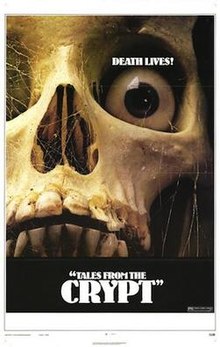
Tales from the Crypt-1972
Director Freddie Francis
Starring Joan Collins, Ian Hendry, Robin Phillips
Scott’s Review #1,200
Reviewed November 25, 2021
Grade: A-
Tales from the Crypt (1972) is a delicious British anthology based on stories from the EC Comics series. Each of the five chapters is eerie storytelling that offers horror fans glimpses into the minds of depraved, devilish characters with sinister motives.
The sheer joy is witnessing their comeuppance.
This film is the predecessor to Vault of Horror (1973) and can be watched as a companion piece.
Below is a summary, review, and rating of each vignette.
Intro
Five strangers are suddenly compelled to join a tourist group to visit the old catacombs.
Separated from the main group, the strangers find themselves in a room with the mysterious Crypt Keeper (Ralph Richardson), who details how each of them may die.
…And All Through The House- A
Joanne Clayton (Joan Collins) brutally kills her husband Richard (Martin Boddey) on Christmas Eve to get her hands on their insurance money.
She prepares to hide his body but hears a radio announcement of a homicidal maniac (Oliver MacGreevy) on the loose.
She sees the killer (who is dressed in a Santa Claus costume) outside her house, but cannot call the police without exposing her crime.
Her daughter is upstairs in her bedroom, unaware.
This is my favorite chapter, and it’s nonstop action. Collins is terrific as the greedy Englishwoman put in peril. The audience will cheer for her to get her just desserts, especially after she callously disregards a lovely Christmas gift her husband bought for her.
Reflection of Death- B+
Carl Maitland (Ian Hendry) abandons his family to be with his secretary, Susan Blake (Angela Grant). After they drive off together, they are involved in a car accident. He wakes up, having been thrown clear of the burned car. He tries to hitchhike home, but everyone he meets screams with horror when they see him.
This vignette is slightly confusing in terms of the events’ timeline, but compelling as we wait to see what Carl’s face looks like and what has happened to Susan and his wife.
Poetic Justice- A
James Elliott (Robin Phillips) lives with his father Edward (David Markham) across from the home of elderly dustman Arthur Edward Grimsdyke (Peter Cushing), who owns several dogs and entertains children in his house.
James hates Arthur’s ramshackle lawn and embarks on a scheme to rid the neighborhood of the older man.
I love seeing Cushing play against type as a kindly grandfatherly character, and this chapter is the ultimate revenge fantasy, and quite satisfying to see what happens to James.
It’s also a perfect watch for Valentine’s Day, since the holiday is in play.
Wish You Were Here- A-
Businessman Ralph Jason (Richard Greene) is on the verge of financial collapse. His wife Enid (Barbara Murray) notices the inscription on a Chinese statue the couple owns.
They are granted three wishes. Enid decides to wish for a fortune and, surprisingly, the wish comes true, but with dire results.
This one wonderfully cascades a chain of events that leaves the characters in peril. The theme is once again about greed, specifically surrounding insurance money. The fast-paced nature is appealing, and the ancient Chinese wishes leave one character in eternal suffering.
Blind Alleys- A-
Major William Rogers (Nigel Patrick) becomes the new director of a home for blind people and exploits his position to live in luxury with his dog, Shane. At the same time, his drastic cuts to food and heating worsen the residents’ living conditions.
Led by George Carter (Patrick Magee), the residents revolt after a fellow resident dies of hypothermia. Rogers and Shane are locked in the basement, where Rogers must navigate through a maze of razor blades and a now ravenous wild dog who will hungrily eat his owner.
Though far-fetched, Blind Alleys is delicious fun and contains my most hated character. This is all the more satisfying as he ‘gets it’ in the end!
Finale
After completing the final tale, the Crypt Keeper reveals that he was not warning them of what would happen, but telling them what has already happened: they have all “died without repentance.
The conclusion does nothing more than put a satisfying cap on the viewer as each character once again pays for their shenanigans.