Category Archives: Jonathan Pryce

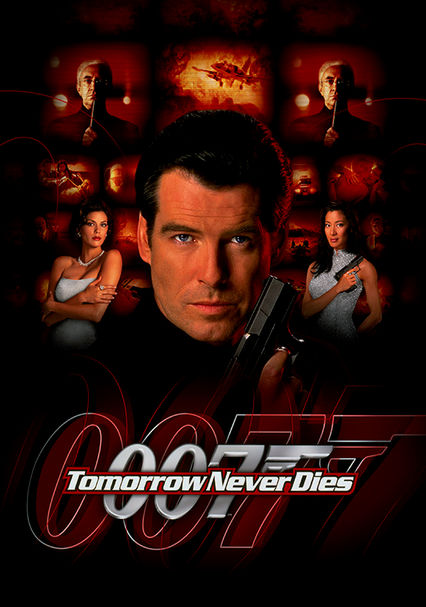
Tomorrow Never Dies-1997

Tomorrow Never Dies-1997

Director Roger Spottiswoode

Starring Pierce Brosnan, Michelle Yeoh, Jonathan Pryce

Scott’s Review #1,394
Reviewed August 28, 2023

Grade: B

Pierce Brosnan made four appearances as the legendary film character, James Bond. While he gets a marginal thumbs up as a whole and is not my favorite Bond he has the ‘look’ and suave charisma.

This works in his favor and makes him purely believable with every ridiculous one-liner or flat dialogue.

Tomorrow Never Dies (1997) is the second chapter in the Brosnan book and is only marginally superior to GoldenEye made two years earlier in 1995. All bets are that the two subsequent Bond films starring Brosnan nosedive quickly.

All good Bond films must contain specific qualities like a good villain, a sexy yet strong ‘Bond girl’, dazzling stunts and chase scenes, a memorable theme song, and more than one exotic locale.

It’s just what the blueprint is and must never be broken.

Therefore, Tomorrow Never Dies feels more like the producers, and director, Roger Spottiswoode, and writer, Bruce Feirstein sought a check box checking off exercise rather than creating anything brilliant or memorable.

I deem this film rather ordinary. Not bad but not superior either falling middle of the road when compared to other Bond franchise films.

Media mogul Elliot Carver, played completely over the top by actor Jonathan Pryce wants his news empire to reach every country on the globe, but the Chinese government will not allow him to broadcast there.

Carver then decides to use his media empire to wreak war between the Western world and China. Thankfully, James Bond (Brosnan) is on the job and travels to China to stop him with the help of Chinese secret agent Wai Lin (Michelle Yeoh).

Anyone who knows a Bond film knows that the plot is secondary to the aforementioned necessary characteristics. The story either got too complicated as the film progressed or I lost interest because at some point all I recollect was a news media tycoon wanting to start World War III over television ratings.

Yeoh is an exceptional ‘Bond girl’ though the dose of progressivism, diversity, and female empowerment she brings to the table makes the term beneath her. Her charisma, and martial arts chops, make her a kick-ass rival though she naturally ends up head over heels for Bond.

Still, the lengthy scenes between Yeoh and Brosnan do contain strong chemistry as they decimate the bad guys and save the world together.

I expected a bit more from Teri Hatcher’s character of Paris Carver, a former girlfriend of Bond who is now Carver’s trophy wife. The setup was superior and the love triangle could have gone further than killing off her character after just a couple of scenes.

As great as an actor as Pryce is it’s tough to believe he’s the same actor who made films like Two Popes (2019) and The Wife (2017) so good. He turns Elliot into a caricature dead set on controlling the world proving that an actor can’t always bring a mediocre script to life.

Tomorrow Never Dies brings the viewers to lavish locations like Bangkok, China, Hamburg, Germany, and in and around London. The tone has a definitively Asian feel which works like You Only Live Twice did in 1967.

Finally, the title theme song and opening performed by Sheryl Crow is abysmal but oddly sounds much better in the version that plays over the ending credits.

I marginally recommend Tomorrow Never Dies (1997) mostly for those in the Brosnan camp which I am aware there are many.  Its best quality lies in the level of equality between Bond and the main female character Wai Lin which is another proof of how relevant the franchise remains.
The Two Popes-2019

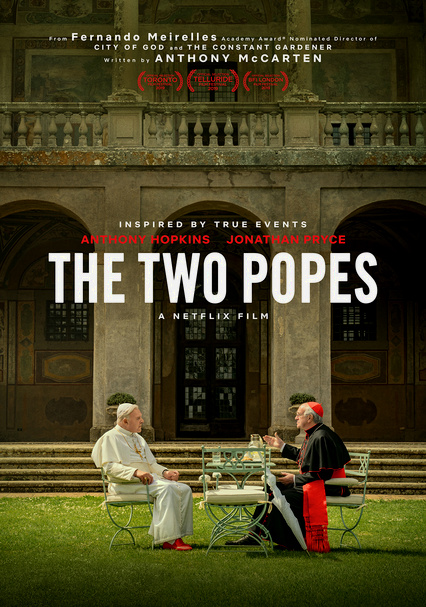
The Two Popes-2019

Director Fernando Meirelles

Starring Jonathan Pryce, Anthony Hopkins

Scott’s Review #994

Reviewed February 27, 2020

Grade: B+

The Two Popes (2019) is a biographical drama that focuses on two real-life religious figures and the close friendship they form while sharing differing ideas and viewpoints.

The two men hold the highest spiritual office, and deep respect culminates over time while past secrets are uncovered.

The film carefully balances past and present but offers too few meaty scenes between the legendary actors for my taste.

Otherwise, a thought-provoking and historical effort, with brilliant sequences of Italy and Argentina.

The film begins in April of 2005 during a pivotal moment in history, following the death of Pope John Paul II. The world is abuzz with the naming of Cardinal Joseph Ratzinger (played by Anthony Hopkins), elected Pope Benedict XVI.

At the same time, Bergoglio (Jonathan Pryce), from Argentina, receives the second-highest vote count.

Ratzinger has a stiff and more traditional approach to Christianity, while Bergoglio is more modern in thinking and open to new ideas.

Seven years later, the Catholic Church is embroiled in the Vatican leaks scandal, which tarnishes the very concept of religion. Benedict’s tenure has been marred by public accusations regarding his role in the cover-up, which has shocked the world.

Meanwhile, Bergoglio intends to retire and arrives in Rome to receive Benedict’s blessing. This is the point at which the men slowly come to terms with each other and develop mutual respect and admiration.

The Two Popes is worth the price of admission for the acting alone. With heavyweights such as Hopkins and Pryce, one can rest easy in this regard and simply enjoy the experience.

The scenes between the two actors are fantastic and fraught with energy.

As the religious figures confide in one another and secrets brim to the surface, the actors are believable as the real-life figures. Even good, old-fashioned small talk is fascinating to watch.

While the present-day sequences enthrall, the flashbacks of Bergoglio as a younger man and his journey into the church are explored a bit too much, sometimes halting the flow.

He was once engaged to be married, but instead joined the Jesuits. He was married in scandal when the perception was that he had collaborated with the Argentine military dictatorship, and he was exiled to serve as an ordinary parish priest to the poor for the next ten years.

The balance between timelines is acceptable, but the flashbacks become too prevalent as the film progresses.

Director Fernando Meirelles seems more comfortable shooting scenes within Argentina since those are best directed using black and white filming to showcase both the ravages of a chaotic nation and the decades preceding the present.

Best known for the wonderful City of God (2003), he also intersperses real-life news sequences featuring the peril of the Argentinian people. The two time periods do not always flow naturally together, though.

A huge positive is the inclusion of the child abuse scandal that rocked the religious world and the brave decision that Meirelles made to focus on the revelation that Benedict knew about the accusations and dismissed them, clearly aiding in their continuation.

Both Popes deal with the struggle between tradition and progress, guilt and forgiveness, and confronting one’s past, making it a character study.

The exterior and surrounding sequences are an absolute treat. Having visited Rome and particularly Vatican City, the Sistine Chapel, a showcase of the Vatican, is wonderful to view on a personal level.

The chapel in the Apostolic Palace, the official residence of the pope, is both astounding due to its lovely religious art and the backdrop for many scenes between Benedict and the future Pope Francis (Bergoglio).

Any viewer fond of world history or religious history will enjoy The Two Popes (2019). With great acting, secrets revealed, conflict, and loyalty, the film is crafted well.

Some momentum is lost in the story’s back and forth, and the film is hardly one that warrants repeated viewings or study in film school; however, it provides a realistic look at modern religion, complete with its arguments and discussions, to delve into.

Oscar Nominations: Best Actor-Jonathan Pryce, Best Supporting Actor-Anthony Hopkins, Best Adapted Screenplay

The Wife-2018

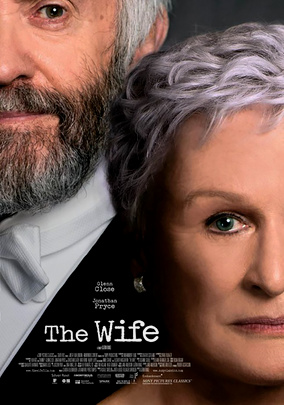
The Wife-2018

Director Bjorn Runge

Starring Glenn Close, Jonathan Pryce

Scott’s Review #809

Reviewed September 8, 2018

Grade: A

Swedish director Bjorn Runge crafts a nearly flawless film in The Wife (2018), which elicits a perfect performance from its star, Glenn Close.

The film may be a standard drama, but the performances are the star attraction here. Along with Close, Jonathan Pryce, along with many of the supporting players, deserves his share of kudos.

But the film unquestionably belongs to Close as she plays an overlooked wife with subtle intelligence and enough simmering fury and resentment to astound and compel audiences.

Professor Joe Castleman (Pryce) and his wife, Joan (Close), live charmingly in upscale Connecticut. Joe is an acclaimed author and has just been notified that he will soon be awarded the Nobel Prize in Literature.

As Joe and Joan excitedly jump up and down on the bed in celebration, there is something not altogether joyous about Joan.

Parties are thrown, and Joe and Joan, along with their son David (Max Irons), an aspiring author himself, fly to Stockholm, Sweden, for the coveted ceremony. Joe is flocked with attention while Joan is cast on the sidelines—secrets eventually bubbling to the surface through a nosy reporter, Nathaniel Bone (Christian Slater), who digs into Joe and Joan’s past.

The prime setting of Stockholm is a great plus, adding a cultural and cold vibe to the story. The snowy and blustery Scandinavian locale, with some characters of European descent, brings richness to the film.

The scenes of characters sipping brandy or other warming spirits while a bristling fireplace erupts in the background add good texture.

Close is one of the finest actresses of our time and portrays Joan with refined restraint at every turn. Yes, we know that something is bothering Joan, but we do not know what that is. Close is one of those talents whose face tells so much while she can utter so little, and for a good one-third of the film, this is all we have.

What is wrong with her? Why does she act happy for her husband and do her tasks seamlessly, but harbor rage bubbling beneath the surface?

Slowly, with the help of numerous flashback scenes, we learn how Joe and Joan met- he a young professor in the early 1960s, and she a naive student with delusions of grandeur of becoming a female novelist. She quickly learns how difficult this will be to achieve as she babysits Joe’s young kids, slowly falling in love with the married man.

From flashbacks, we learn more about Joe and Joan’s emotions, aspirations, and limitations. We also learn that Joe has always had a wandering eye for other women—after all, wasn’t Joan “the other woman”?

Back in the present day, a restless Joan needs a day to herself in the bustling city before she explodes at Joe. Before she can head out, she is talked into a drink by Nathaniel, who cagily reveals much of what he knows to Joan.

The scenes between Close and Slater crackle with passion. Is he flirting with her or attempting to get her to buckle under from compliments and booze? Close is purely in control of Joan’s emotions here, but so much is written on the actress’s face.

It is mesmerizing to watch her calm demeanor border on cold and calculated in her responses to Nathaniel’s questions.

Joe and Joan’s son David play key roles in all of this. As with Joan, David harbors resentments towards his father, but his rage is more blatant. He yearns for his father’s approval of a newly written story and is angry with every comment his father makes.

Is he simply experiencing jealousy over his father’s talents?

When David learns a secret, events get good, culminating in a fantastic blowup scene between the three characters in a hotel room, at simply the worst possible time.

Pryce must be given props for playing Joe with much complexity. Partially sympathetic and partially unforgivable, he elicited a mixed reaction from me. Not one to mistreat Joan, he sings her praises from one toast to another.

A cad, he is also a narcissist, yet he does adore and think the world of Joan, so they share a complex love.

The Wife (2018) is an excellent film that appreciates the talents of its cast.

Stalwarts such as Pryce, Slater, and newcomer Max Irons flesh out the supporting roles, which only enhances Queen Bee Close’s bravura performance.

I have always thought there would never be any way Close could rival her breathtaking portrayal of dastardly Alex in Fatal Attraction (1987), but she sure comes close in The Wife.

Oscar Nominations: Best Actress-Glenn Close

Independent Spirit Award Nominations: 1 win- Best Female Lead-Glenn Close (won)

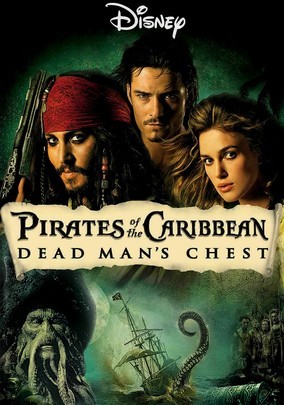
Pirates of the Caribbean: Dead Man’s Chest-2006

Pirates of the Caribbean: Dead Man’s Chest-2006

Director Gore Verbinski

Starring Johnny Depp, Orlando Bloom

Scott’s Review #606

Reviewed January 11, 2017

Grade: B-

Pirates of the Caribbean: Dead Man’s Chest is the follow-up to the original Pirates of the Caribbean: The Curse of the Black Pearl, from 2003.

The sequel is decent but inferior to Curse of the Black Pearl.

The visual effects are spectacular, and the budget is very high, but the story isn’t there. The film drags along at times as well as being a bit confusing.

Johnny Depp gives his all to his role of Jack Sparrow, performing with gusto, and is the highlight of the franchise.

The supporting characters, Bloom as Will Turner, and Keira Knightley as Elizabeth Swann, are fine, but not on the level of Depp.

Otherwise, the performances are all okay, but just a carbon copy of the first film.

Story-wise, Will and Elizabeth are arrested for aiding Jack Sparrow’s escape execution, and the plot involves the attempts at locating Sparrow along with the typical adventure aspects of a film like this and the stock character villains, with grimaces, heavy makeup, and over-acting, but I expected as much.

Not a bad sequel, certain to entertain the masses, and guaranteed to make a ton of money, inevitably ensuring another sequel will be made, with little doubt of being even less compelling.

Oscar Nominations: 1 win-Best Sound Editing, Best Sound Mixing, Best Art Direction, Best Visual Effects (won)