Category Archives: Ray Liotta

Goodfellas-1990

Goodfellas-1990

Director Martin Scorsese

Starring Ray Liotta, Robert De Niro, Joe Pesci

Top 250 Films #46

Scott’s Review #349

70002022

Reviewed January 9, 2016

Grade: A

Director Martin Scorsese adapts Goodfellas, a crime-mob film, from Nicholas Pileggi’s 1986 nonfiction book. Pileggi helped Scorsese write the screenplay.

The film is more matter-of-fact in its telling than the purely dramatic The Godfather, with added wit and humor, and excellent editing.

Featuring powerful acting by Ray Liotta, Robert De Niro, and Joe Pesci, it is a memorable classic mob film that can be enjoyed via repeated viewings.

Largely ad-libbed, the film is rich in good dialogue and contains one of the highest totals of curse words in film history.

The film is told from the first-person narrative of the lead character, Henry Hill.

Henry, now in the Witness Protection Program, recounts his years affiliated with the mob from 1955 to 1980.

We meet Henry as a youngster in Brooklyn, New York. He is half-Italian, half-Sicilian. He idolizes the “wise guys” on the streets and intends to one day join their ranks.

From there, the film describes the trials and tribulations of Henry’s group of miscreants. Henry meets and falls in love with Karen (Lorraine Bracco), and their tumultuous love story is explored through tender moments and affairs.

What I love most about Goodfellas is the love of the characters and the sense that you are part of the action. The film is a highly stylized family drama- gritty nonetheless, but the viewer feels like they are part of things and a family member- milestones are celebrated, and meals are shared.

We see Henry grow from a teenage gullible boy who idolizes the neighborhood men to being part of the group.

The other characters, such as vicious and volatile Tommy DeVito (Pesci) and Jimmy “The Gent” Conway (De Niro), are aged and mature.

Bracco’s character is interesting. Unlike most of the female characters in The Godfather films, she is not content to merely sit on the sidelines and look past her husband’s shenanigans and torrid affairs with floozies.

She is a more modern, determined woman, and Bracco plays her with intelligence and a calm demeanor. She wants to be Henry’s equal instead of just some trophy wife.

Pesci deservedly won the Best Supporting Actor Oscar for his role; he is brutal and filthy but a mesmerizing character.

During a memorable scene, his character Tommy jokingly teases Henry, but when Henry responds in a way that displeases Tommy, the scene grows tense, and Tommy becomes increasingly disturbing.

His famous line “What am I a clown- do I amuse you?” is both clever and haunting in its repercussions.

I adore the soundtrack that Scorsese chose for the film—spanning decades, he chooses songs true to the times, such as “Layla” (1970) or “Remember (Walking in the Sand)” (1964), which are just perfect.

Worth noting is that when a scene plays, sometimes the song is mixed in with the narrative so that it enhances the scene altogether—becoming a part of it rather than simply background music.

If one is looking for the perfect mob film, one that contains music, wit, charm, and fantastic writing, Goodfellas is among the best.

I prefer The Godfather and The Godfather II, but while Goodfellas has similarities to these films, it is also completely different and stands on its own merits.

Oscar Nominations: 1 win-Best Picture, Best Director-Martin Scorsese, Best Supporting Actor-Joe Pesci (won), Best Supporting Actress-Lorraine Bracco, Best Screenplay Based on Material from Another Medium, Best Film Editing
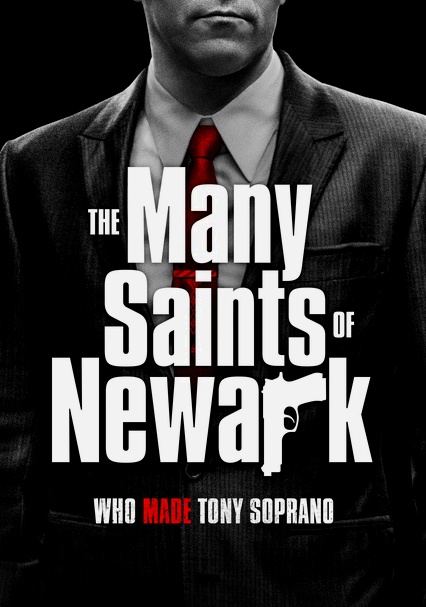
The Many Saints of Newark-2021

The Many Saints of Newark-2021

Director Alan Taylor

Starring Michael Gandolfini, Alessandro Nivola, Vera Farmiga

Scott’s Review #1,272

Reviewed July 4, 2022

Grade: B

Fans of the iconic HBO series The Sopranos, which ran from 1999 to 2007, have been chomping at the bit since the announcement of the soon-to-be-released The Many Saints of Newark (2021).

The film is a prequel to the series, centering on a young Tony Soprano. The kicker is that the actor who portrays Tony in the movie (Michael Gandolfini) is the real-life son of James Gandolfini, who played Tony in the series.

To add mustard to the on-paper perfect setup is that the film is written by David Chase, the writer and creator of The Sopranos. This ensures rich character development and dedication to the rich history.

What could go wrong?

The answer is that nothing is ‘wrong’ with The Many Saints of Newark. It’s not as brilliant as the series, and it seems unnecessary to have been made, especially after such a long gap.

While the film meanders at times, this gave me time to thoughtfully ruminate that perhaps The Many Saints of Newark would have been better as a limited series.

There are so many characters, and too few of them are familiar to audiences of The Sopranos. The two-hour and change running time couldn’t possibly provide enough time to get to know many of them, and I longed to.

On the upside, the film is shot exceptionally well, and the costumes, sets, and design of the 1960s and 1970s are incredible with superior accuracy.

It succeeds in transporting the audience to what Newark, New Jersey, was like during that time. Additionally, the film bears a striking resemblance to The Sopranos and is influenced by the legendary 1991 offering Goodfellas and other mafia-laden films.

Young Anthony Soprano (Gandolfini) is growing up in one of the most tumultuous eras in Newark’s history, as rival gangsters begin to challenge and desecrate the powerful DiMeo crime family.

As the year 1967 emerges and Newark is now an increasingly race-torn city, events take on a violent and historical tone.

Conflicted by the changing times is Tony’s Uncle Dickie (Alessandro Nivola), whom he idolizes much more than his own father, Johnny (Jon Bernthal), or domineering mother, Livia (Vera Farmiga).

The Many Saints of Newark depicts how Tony will eventually become the mob figure Tony Soprano!

Besides looking like his father, Gandolfini is not the best actor in the world, but he does his best with a small role billed as the lead. He hardly appears until thirty minutes before the film concludes, and he never carries the movie as one would expect the character to.

The real star of the film is Dickie (Nivola), who is terrific. The storyline follows his conflict and a damaged relationship with his father, wonderfully played by Ray Liotta, and his father’s horny wife, Giuseppina, who later becomes his mistress.

A shocking scene occurs when Dickie beats a significant character to death by repeatedly slamming their head against a steering wheel. The death will hold forever repercussions for Dickie, emotionally and otherwise.

The problem is that even though Dickie is a great character, the audience doesn’t know him, which is a significant issue.

Despite flaws with the marginally adequate casting, the uneven writing, and the focus on unfamiliar characters, there are other small treats to enjoy.

The film is peppered with familiar characters like Paulie, Big Pussy, and Carmella as younger people. Even though they don’t have much to do with the story, their mere presence feels like an old home week.

The racial tensions are another win, and actor Leslie Odon Jr. adds a winning formula to his character of Harold McBrayer, a black associate of Dickie’s.

I haven’t watched an episode of The Sopranos since it ended in 2007, and it may be advantageous to watch The Many Saints of Newark immediately after. Situations, history, and characters will be fresher in one’s mind, and it may result in more cohesiveness.

Or maybe the film shouldn’t have been made fourteen years after the series ended.

Regardless, The Many Saints of Newark (2021) is a pretty solid effort but completely underwhelming, especially when compared with such a groundbreaking television series.

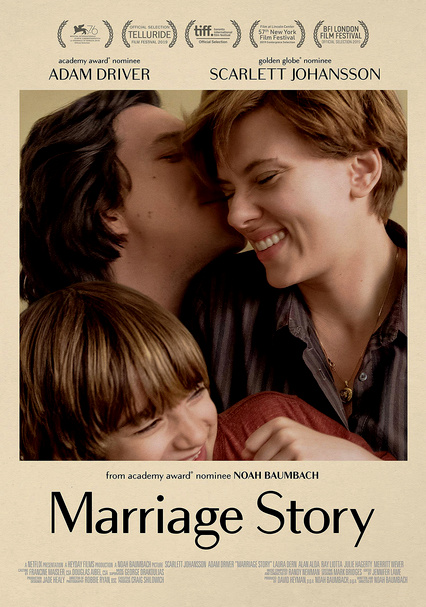
Marriage Story-2019

Marriage Story-2019

Director Noah Baumbach

Starring Adam Driver, Scarlett Johansson

Scott’s Review #959

Reviewed November 14, 2019

Grade: A

Marriage Story (2019) is a film that could have been generic, melodramatic, or contrived. Before its release, it was described as an excellent” version of Kramer vs. Kramer (1979) or Terms of Endearment (1983).

Those are excellent films, but marginally sappy and overwrought. Marriage Story excels at being a brilliant, powerful, and realistic portrayal of a marriage disintegrating, painting a picture of how good people can turn ugly under certain circumstances.

Believe the hype of how good this film is.

Taking place in both New York City and Los Angeles, we meet Charlie and Nicole Barber (Adam Driver and Scarlett Johansson), a theater director and his wife, an actress who stars in his plays.

They fill notebook paper with what they love most about each other, and the list is lengthy.

Appearing to be madly in love, the audience soon realizes that the couple is amid an amicable separation, the writings a result of an assignment by a “separations counselor”, hired to make things easier.

Charlie and Nicole share an eight-year-old son named Henry. Nicole returns to Los Angeles to resume her acting career and spend time with her mother (Julie Hagerty) and sister (Merritt Wever). Adam, successful in New York City, plans to stay and reside with his son.

Nicole hires a tough lawyer, Nora (Laura Dern), while Charlie begrudgingly hires semi-retired attorney Bert Spitz (Alan Alda), and later Jay (Ray Liotta). Nicole and Charlie are sensible, planning to work things out on their own, only needing representation for formalities, or so they think.

The situation escalates, spinning out of control as their divorce becomes increasingly hostile, as custody of their young son ups the ante. Qualities they once loved about each other become hate-filled arguments as the couple fights and feuds, as their attorneys scramble for a leg up.

Can the couple save themselves as secrets bubble to the surface, and situations be used against each other?

The film is a lengthy two hours and sixteen minutes, so the plot takes time to capture its viewer. When it eventually takes hold, it never lets go, forcefully enrapturing the watcher.

We care for both Charlie and Nicole, and while sympathizing with each other at different times, both characters are written as benevolent.

There is no villain except the divorce itself.

The key to success is in the writing. Director, Noah Baumbach, known for The Squid and the Whale (2005), and Frances Ha (2012) knows how to craft witty and clever dialogue, weaving comedy and drama intricately together.

He can make the viewer laugh and cry within the same scene.

The screenplay is the best part of the film because it is laden with crackling words and interesting situations.

Marriage Story reminds me of a Woody Allen film. Feeling improvised, unsure if any of the dialogue is, the characters speak lengthy soliloquies and engage in endless chatter with each other or themselves.

This results in a powerful medium of self-expression and a “talkie” movie.

The banter between characters is not drivel nor gibberish but contains significant, emotionally rich meaning and flavor.

The film belongs to Driver and Johansson, each delivering a home run. Driver is the stronger of the two, but not by much, and this is only because his emotional scenes feel rawer than hers do.

When the actors engage in a knock-down, drag-out fight, the scene is lengthy and exceptionally well-acted, with each taking turns verbally attacking the other. Vicious rage and emotional fury come to the forefront.

This is the best scene in the film.

Dern, Alda, and Liotta are terrific, bringing respect to the film. Each has been on the Hollywood scene for a long time, and each plays an attorney. While Dern’s and Liotta’s characters are sharks, Alda is a reasonable and realistic older man who has seen it all.

Burt lays down the facts for Charlie, making him realize how much is at stake. Dern shines as the sexy blonde attorney who wears revealing clothes and legs for miles. Grizzled Liotta plans to win at all costs. What a delight to see these veterans bring electricity to each scene.

Lastly, I adore the bi-coastal locales of New York City and Los Angeles. The big cities burst with meaning and are as different as day and night, as the film explains.

Charlie is a New Yorker, and Nicole is a California girl at heart. The numerous scenes shot on location in both cities lend the film richness and texture.

With Marriage Story (2019), Baumbach creates his best and most personal film.  Rumored to be partly autobiographical, he takes a subject matter that most assume has already been exhausted and spins the story in a different direction, making it feel fresh.

The aspects all come together in an experience that is emotional, powerful, and intelligent. The film is a treasure and a shining example to young filmmakers that good writing always prevails.

Oscar Nominations: 1 win-Best Picture, Best Actor-Adam Driver, Best Actress-Scarlett Johansson, Best Supporting Actress-Laura Dern (won), Best Original Screenplay, Best Original Score

Independent Spirit Award Nominations: 2 wins-Best Feature, Best Screenplay (won), Robert Altman Award (won)

Date Night-2010

Date Night-2010

Director Shawn Levy

Starring Steve Carell, Tina Fey, Mark Wahlberg

Scott’s Review #481

70121501

Reviewed September 17, 2016

Grade: D+

Date Night is a perfect example of mediocrity in modern filmmaking.

We have two current comedic actors here- Steve Carrell and Tina Fey- circa 2010- at the top of their game.

The filmmaker’s idea is to pair these two and make an appealing romantic comedy appealing to the masses.

The main issue with this film is that the result is generic and quite an average offering.

And the entire film is incredibly plot-driven with no character development to speak of. If I am being too harsh, admittedly there is rather nice chemistry between the two leads, but it is wasted because of sloppy writing.

A couple from the New Jersey burbs, Carrell and Fey portray husband and wife, Phil and Claire Foster. Saddled with two kids and their romance reaching dullsville, Phil decides to take Claire to a ritzy Manhattan restaurant.

When they arrive, they cannot get a table but pretend to be another couple (the Tripplehorns) to obtain their table after the other couple’s no-shows. This leads to a tale of mistaken identity as the Tripplehorns possess a flash drive that a mobster (Ray Liotta) wants.

This then leads to a chase throughout Manhattan to outrun and outwit their pursuers. Wahlberg plays a hunky client of Claire’s, always shirtless, who is meant to threaten Phil and Claire’s marriage.

Several others of the current Hollywood elite- Kristen Wiig, James Franco, Mila Kunis, and Mark Ruffalo, make small and somewhat pointless appearances. Specifically, Franco and Kunis as a stoner-type bickering couple are silly and unnecessary to the story.

Carrell and Fey are quite funny as individuals and as a duo- Date Night, though, does not capitalize on nor showcase their respective talents. The film tries too hard to come up with scenario after scenario of the two on the run and encountering one problematic situation after another.

As the plot of Date Night wears on, I find myself noticing that each situation that occurs is a measure of convenience.

Conveniently, Claire has a client in town (Wahlberg), who is a security expert. They go to him for help and, predictably, his hunkiness bothers Phil and piques Claire’s interest- though of course, we know full well Phil and Claire will end up together- that is how these mainstream films go.

In another scene. Phil and Claire can break into an office building unnoticed, trigger the alarms, conveniently find a needed file, and escape, miraculously all before the police arrive minutes later.

Very plot-driven.

The lead actors in Date Night are appealing and even charming together, but the silly, inane plot makes it unappealing to watch and the slew of stars that somebody decided would be a great addition to a lukewarm film is odd.

The roles written have little bearing on the central plot so it was apparent why they were added.

Date Night (2010) is a film we have seen time and time again with other actors in similar roles.