Carol-2015
Director Todd Haynes
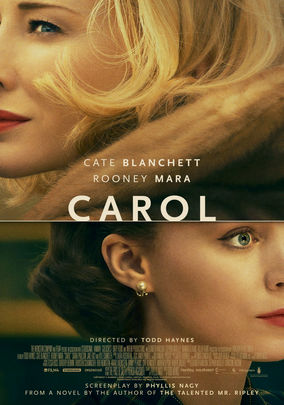
Starring Cate Blanchett, Rooney Mara
Top 250 Films #117
Scott’s Review #308
Reviewed December 27, 2015
Grade: A
I’d compare this film to Brokeback Mountain (2005), but with a female lead.
Carol is a story of hidden romance and secret lives in the early 1950s, when it was difficult to lead an alternative lifestyle openly (or even in hiding!).
The film is a marvel of honest storytelling, exquisite class, and grace, with excellent cinematography and a heartwarming tale.
Todd Haynes directs Carol, a director known for films about doomed romances facing societal challenges. Carol is a wonderful film.
The film features two equal female leads: Carol Aird (Cate Blanchett), a gorgeous, sophisticated socialite. She exudes confidence and style in everything that she does.
Always perfectly dressed and well made up, with manicured fingernails, her mannerisms convey confidence and control.
She is married to a wealthy businessman, Harge (Kyle Chandler), who is madly in love with her, yet they are divorcing because of her “problem”.
The fact that Carol is a lesbian is known to Harge, and they share somewhat of an understanding and a five-year-old daughter. Their divorce is difficult.
Therese Belevit (Rooney Mara) is the polar opposite of Carol.
Young and naïve, she is a part-time shopgirl, fascinated by photography. She dates men and goes to parties, living out a typical young girl’s life.
When Carol and Therese meet at the store where Therese works, they are immediately enamored with one another, and a friendship develops. Both seem caught off guard, and the chemistry between the two actresses sizzles.
The focus is the budding romance between Carol and Therese, and the societal differences they face, including the age gap between them.
I found the chemistry between Blanchett and Mara quite evident.
Worlds apart, the two women somehow find each other and form a bond. Their relationship is tender, gentle, and carefully presented to the audience. They are neither animalistic nor barbaric in a sexual way, but rather sweet.
When Therese takes a spontaneous car trip from New York to Chicago, conflict develops with her boyfriend, Richard.
He wants them to run off to Paris, but Therese wants to be with Carol. He breaks up with Therese and accuses her of having a crush on Carol.
Therese and Carol’s romance is finally consummated in a Midwestern hotel. It is New Year’s Eve, and Todd Haynes shoots this scene in a romantic, spontaneous way.
They are celebrating the holiday, but both are blue and vulnerable. It makes perfect sense that they would turn to one another.
The film explores many emotions Carol and Therese face: love, glee, anger, rage, confusion, rejection, and loneliness. These emotions and the film’s tone are why it succeeds.
From an acting perspective, both Blanchett and Mara are great, but I prefer Blanchett’s performance. She embodies this character.
From when she orders a martini dry with one olive, to how she brazenly approaches Therese, she is a woman in control. But when family issues arise, she becomes vulnerable, and we see her as human.
Beyond the interesting story of a love facing many challenges, the film’s look is grand. The sets, hairstyles, clothes, and makeup are graceful and rich.
Overall, everyone looks great, and it paints a perfect picture of the 1950s.
A progressive Hollywood tale, Carol showcases glamour and great acting, and sends a powerful message of acceptance and struggle during a difficult time to be “different” and fulfill one’s life.
Oscar Nominations: Best Actress-Cate Blanchett, Best Supporting Actress-Rooney Mara, Best Adapted Screenplay, Best Original Score, Best Cinematography, Best Costume Design
Independent Spirit Award Nominations: 1 win-Best Feature, Best Director-Todd Haynes, Best Female Lead-Cate Blanchett, Rooney Mara, Best Screenplay, Best Cinematography (won)