Category Archives: Cyril Frankel

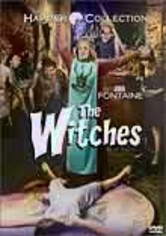
The Witches-1967

The Witches-1967

Director Cyril Frankel

Starring Joan Fontaine, Kay Walsh, Alec McCowen

Scott’s Review #1,096
Reviewed December 29, 2020

Grade: B

Legendary film actress Joan Fontaine chose a Hammer horror film as her final role. While not high-brow art, these films are an entertaining treat for horror fans.

They are frequently macabre, clever, and make the most of a small budget.

In The Witches (1967), Fontaine leads the way, adding class and huge star quality. The film is good, but not great, with an unfulfilling ending. The cinematography and Fontaine’s involvement are the best aspects.

Also worthy of mention in the acting department is Kay Walsh, a talented British actress, who is terrific as the seemingly kind woman who becomes a crazed witch. She adds professionalism to a pivotal role. The other supporting actors play their parts well, ensuring that the craft of acting is respected.

I adore the British flair that Hammer films always have.

Fontaine plays Gwen Mayfield, an English schoolteacher who accepts a new job as the headmistress of the local school in the quaint village of Heddaby. The quiet town is exactly what Gwen needs after suffering a nervous breakdown while residing in Africa.

She experiences a small flirtation with the Reverend Alan Bax (Alec McCowen), who confesses that he is not overly religious. Stephanie is his sister, played by Walsh.

Before long, Gwen becomes immersed in the worlds of two of her students, Ronnie (Martin Stephens) and Linda (Ingrid Brett). Ronnie insists that Linda is being abused, which prompts Gwen to investigate. Meanwhile, Gwen discovers a voodoo doll and sleuths to find out what is going on in the village.

Events lead her to a sanitarium, and finally to a coven of witches, intent on human sacrifice.

The Witches has a late-1960s look and feel, which adds some sophistication. Gwen is draped in stylish clothes and jewelry and wears a cute, trendy bob haircut.

The set design is cool, with groovy, colorful furniture that makes the tight budget work to its full advantage.  Alan and Stephanie’s estate is particularly impressive with modern furniture, drapes, and various trimmings.

Another positive is the hefty amount of exterior sequences offered.

Director Cyril Frankel, who directed many episodes of the popular British television series The Avengers, provides a similar production, so The Witches feels like a long episodic series. The luxurious English village is sunny, calming, and atmospheric, brightening the film’s atmosphere.

This nicely counterbalances the themes of demons, voodoo, and witches.

Frankel builds the story momentum throughout The Witches at a good pace, but this is lost in the final act, which is way too abrupt. During the first three-quarters of the production, we are led to believe that Gwen is either crazy, imagining the strange events, or that one of the townspeople is gaslighting her.

It’s easy to deduce that the latter is what is going on, and the fun is figuring out who is doing the dirty deeds.

When the culprit is revealed (and it’s displayed on the cover art!), the conclusion is underwhelming. An attempted cemetery human ritual to remove life from Linda and infuse it into Stephanie so that she can live forever is weak.

After an odd sequence of the townspeople dancing and writhing around like nutcases in an unintentionally laugh-out-loud example of overacting, Gwen foils Stephanie’s plan. The witch succumbs to death, a victim of her heinous plan backfiring.

It is hinted that Gwen and Alan (who are revealed to be good) will forge a romance in the future, but I would have liked to have gotten a stronger sense of their budding attraction during the film. Still, it is likely the two will ride off into the sunset together, safely.

While not as gory as other Hammer films, The Witches (1967) instead features exceptional performances and tells a decent story, interesting until the low-key finale.

I expected a bit more from the ending, which simmers out instead of electrifying.
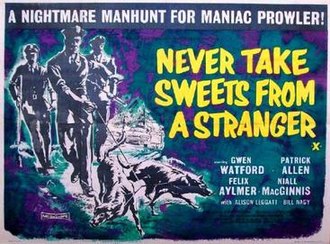
Never Take Sweets from a Stranger-1960

Never Take Sweets from a Stranger-1960

Director Cyril Frankel

Starring Patrick Allen, Gwen Watford

Scott’s Review #900

Reviewed May 17, 2019

Grade: A

Never Take Sweets from a Stranger (modified to Never Take Candy from a Stranger in the US for marketing purposes) is a 1960 British film directed by Cyril Frankel and released by Hammer Film Productions.

The film contains brilliant cinematography and cerebral quality, and it is pretty daring for the time it was made. It combines a story of pedophilia with manipulations of the legal system, allowing those to get away with this most heinous crime because of their status.

Despite the production company name being marketed as a horror film, the film is more left-of-center than a traditional horror film.

The locale is a small, sleepy lakefront Canadian town that seems like an everyday US town. The Carter family (Peter, Sally, and their 9-year-old daughter Jean) has just moved there to give Peter a fantastic job opportunity as the school principal.

Jean confides to her parents that while playing in the woods, she and her friend Lucille went into the house of an elderly man. The man asked them to remove their clothes and dance naked for him in return for some candy, which they did.

Peter and Sally are appalled and decide to file a complaint. The elderly man is one of the wealthiest and most influential in the town, the respected Clarence Olderberry, Sr.

Jean’s experience is downplayed, and the town largely shuns the Carter family. As a trial against Olderberry commences, Jean is ridiculed on the stand and her story ripped to shreds by attorneys.

After Olderberry is acquitted, he pursues Jean and Lucille in the woods, eventually catching the girls during a harrowing lakefront chase and murdering Lucille. Jean escapes, and the truth is revealed to the shocked and devastated town.

Although the cast of Never Take Sweets from a Stranger is not a household name, each performs well.

As the parents, Patrick Allen and Gwen Watford are well-cast and believable. They are upstanding strangers in the town, wanting to protect their daughter without smothering.

As old man Olderberry, Felix Aylmer plays the role not as menacing but by providing glimpses of pain and sympathy. The audience is unclear whether the man has dementia or Alzheimer’s disease, perhaps not even knowing what he has done.

The black-and-white cinematography is gorgeous, surreal, and tremendously effective.

With ghostly tones, the film gets off to a mysterious and prominent start as we see Jean and Lucille casually playing in the woods, startled to glance up at a menacing mansion (perfect for a Hammer production) to see elderly Olderberry leering at them with binoculars.

The lakefront sequences and the chase through the woods are among the best at providing superior camera angles.

As Lucille talks Jean into entering Oldberry’s house, we presume she has done this before. She knows Oldberry will provide the girls with candy, but does she understand this comes at a price?

Immediately, there is a shred of doubt about the children’s innocence—ever so quickly. The film’s decision and Oldberry’s representation are pivotal in casting even the slightest doubt on the motivations or decisions of the main characters.

Comparisons to the brilliant The Night of the Hunter (1955) are rapid. Themes of child abuse, young children in front and center roles, a creepy lake with a prominent boat, and macabre adults are prevalent, at least to some degree, in both films.

Additionally, both films were shunned at the time of release, misunderstood, and later rediscovered, subsequently seen as treasures of brilliant filmmaking.  Measuring both films as tragedies is also apparent; each results in pain and sadness for the children involved.

Never Take Sweets from a Stranger (1960) was released decades ago. It took years for its brilliance to be recognized and appreciated, as it added admirable and thought-provoking nuances to the viewer.

The subtle qualities make this film a world of its own. Sadly, the best movies are often overlooked, marinating the flavorful juices rather than a sudden bombastic reaction.

1960, the world was not ready for this film, but it is remembered as a brave, disturbing, and relevant film offering.