Category Archives: Massimo Girotti

Last Tango in Paris-1972

Last Tango in Paris-1972

Director Bernardo Bertolucci

Starring Marlon Brando, Maria Schneider

Top 250 Films #178

Top 10 Most Disturbing Films #8

Scott’s Review #202
687496

Reviewed December 5, 2014

Grade: A-

Last Tango in Paris is a very dark 1972 erotica art film directed by Bernardo Bertolucci (The Conformist-1970), starring Marlon Brando as a disturbed, angry American man named Paul, whose wife has committed suicide.

He is left to survive on his own in Paris lost and without her where he runs a decrepit apartment complex.

Lonely and bitter, he meets a much younger Parisian woman (Maria Schneider), equally disturbed for different reasons, and they forge a relationship that is sometimes brutal, and degrading, but also contains mutual affection and need.

They are addicted to each other.

This film may very well be my favorite performance by Marlon Brando. He plays a hateful, unpleasant character, yet something is appealing about him and the viewer sympathizes with his grief.

That is to Brando’s credit, of course. A lesser actor would not be as effective.

He is damaged, treats everyone like shit, but there is also a vulnerability to him that is mesmerizing to watch. Brando was such a great, method actor that he simply morphs into the characters he plays. Paul is certainly the most raw and emotional performance of his career.

Actress Maria Schneider is also tremendous in the film. Equally disturbed, her character Jeanne experienced a vastly different upbringing- that of wealth and pampering.

She has a fiancé who loves her dearly, yet she is drawn to the power and abuse of Paul- the fact that he is an older man is sexy to her.

I kept thinking, “What is wrong with this woman?” She seemingly has everything, yet she yearns for excitement. Is Paul a fling for her? Does she care about him or is she using him? Is he using her? Could they be using each other?

The film raises many psychological questions. Jeanne is clearly in emotional turmoil. Both Jeanne and Paul are.

Last Tango in Paris is a difficult film to watch- several scenes are unpleasant, even brutal, but it is a character study of two damaged individuals.

When Paul anally penetrates Jeanne on the floor of his apartment, forcing her to recite gibberish, it is almost too much to bear. Paul wants to know nothing about Jeanne. He does not want to know her name, her past, nothing- complete anonymity. He lives for the present and their sex is animalistic, filled with lust and need.

But these examples are a testament to the power of Last Tango in Paris. It is not boring.

The finale leaves you wondering what will happen to Jeanne. Will she commit suicide? Will she return to her fiancé and life of luxury, her affair with Paul over? Was the affair only a fling for her or does she love Paul?

The film is a dark, tragic, romantic story. It is brutal, raw, and honest and is not to be missed.

Oscar Nominations: Best Director-Bernardo Bertolucci, Best Actor-Marlon Brando

The Witches-1967

The Witches-1967

Director Cyril Frankel

Starring Joan Fontaine, Kay Walsh, Alec McCowen

Scott’s Review #1,096

Reviewed December 29, 2020

Grade: B

Legendary film actress Joan Fontaine chose a Hammer horror film as her final role. While not high-brow art, these films are an entertaining treat for horror fans.

They are frequently macabre, clever, and make the most of a small budget.

In The Witches (1967), Fontaine leads the way, adding class and huge star quality. The film is good, but not great, with an unfulfilling ending. The cinematography and Fontaine’s involvement are the best aspects.

Also worthy of mention in the acting department is Kay Walsh, a talented British actress, who is terrific as the seemingly kind woman who becomes a crazed witch. She adds professionalism to a pivotal role. The other supporting actors play their parts well, ensuring that the craft of acting is respected.

I adore the British flair that Hammer films always have.

Fontaine plays Gwen Mayfield, an English schoolteacher who accepts a new job as the headmistress of the local school in the quaint village of Heddaby. The quiet town is exactly what Gwen needs after suffering a nervous breakdown while residing in Africa.

She experiences a small flirtation with the Reverend Alan Bax (Alec McCowen), who confesses that he is not overly religious. Stephanie is his sister, played by Walsh.

Before long, Gwen becomes immersed in the worlds of two of her students, Ronnie (Martin Stephens) and Linda (Ingrid Brett). Ronnie insists that Linda is being abused, which prompts Gwen to investigate. Meanwhile, Gwen discovers a voodoo doll and sleuths to find out what is going on in the village.

Events lead her to a sanitarium, and finally to a coven of witches, intent on human sacrifice.

The Witches has a late-1960s look and feel, which adds some sophistication. Gwen is draped in stylish clothes and jewelry and wears a cute, trendy bob haircut.

The set design is cool, with groovy, colorful furniture that makes the tight budget work to its full advantage.  Alan and Stephanie’s estate is particularly impressive with modern furniture, drapes, and various trimmings.

Another positive is the hefty amount of exterior sequences offered.

Director Cyril Frankel, who directed many episodes of the popular British television series The Avengers, provides a similar production, so The Witches feels like a long episodic series. The luxurious English village is sunny, calming, and atmospheric, brightening the film’s atmosphere.

This nicely counterbalances the themes of demons, voodoo, and witches.

Frankel builds the story momentum throughout The Witches at a good pace, but this is lost in the final act, which is way too abrupt. During the first three-quarters of the production, we are led to believe that Gwen is either crazy, imagining the strange events, or that one of the townspeople is gaslighting her.

It’s easy to deduce that the latter is what is going on, and the fun is figuring out who is doing the dirty deeds.

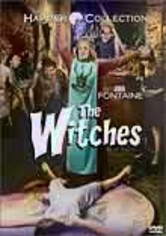
When the culprit is revealed (and it’s displayed on the cover art!), the conclusion is underwhelming. An attempted cemetery human ritual to remove life from Linda and infuse it into Stephanie so that she can live forever is weak.

After an odd sequence of the townspeople dancing and writhing around like nutcases in an unintentionally laugh-out-loud example of overacting, Gwen foils Stephanie’s plan. The witch succumbs to death, a victim of her heinous plan backfiring.

It is hinted that Gwen and Alan (who are revealed to be good) will forge a romance in the future, but I would have liked to have gotten a stronger sense of their budding attraction during the film. Still, it is likely the two will ride off into the sunset together, safely.

While not as gory as other Hammer films, The Witches (1967) instead features exceptional performances and tells a decent story, interesting until the low-key finale.

I expected a bit more from the ending, which simmers out instead of electrifying.

Teorema-1968

Teorema-1968

Director Pier Paolo Pasolini

Starring Terence Stamp, Silvana Mangano

Scott’s Review #234

70039263

Reviewed April 10, 2015

Grade: A-

Teorema is a 1968 Italian art film directed by Pier Paolo Pasolini, who later went on to direct the dark and disturbing 1975 masterpiece, Salò- 120 Days of Sodom.

If one is looking for a concise, mainstream plot with a fixed, to-the-point beginning and ending, one will be disappointed. Rather, Teorema is an exhibition in artistic style and interpretation, and it succeeds in mesmerizing this viewer with thought and contemplation.

A mysterious stranger, known as “the visitor”, suddenly arrives to stay with an affluent Italian family in their sprawling estate. The family consists of a father, mother, son, daughter, and maid, all of whom experience loneliness, boredom, fear, rage, or repression.

The handsome stranger successfully beds all the family members, and just as suddenly as he arrives, he disappears from the household, leaving the family members with different thoughts, feelings, and actions upon his departure.

The film is highly interpretive, and every character can be analyzed.

The stranger seduces all the characters, and the family’s wealth is examined. Is Teorema (which translates to the theorem in Italian) a commentary on the bourgeois society? The father, Paolo, owns a factory and appears to be in turmoil- is he a repressed homosexual?

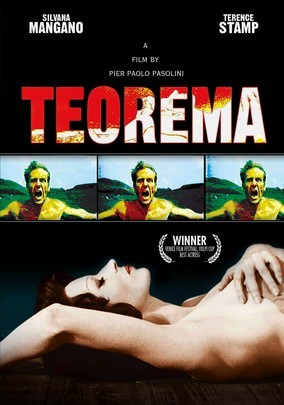
The father’s story concludes with him turning his factory over to the workers, stripping naked, and roaring with anger and frustration.

Is the mother simply a wealthy, bored housewife or much more than that? This character might have been explored more thoroughly.

The maid, devoutly religious, becomes suicidal after her tryst with the stranger. The others confide in the stranger about how they feel about themselves, and at times, the film feels like a therapy session as each character delves deeper into their personal feelings.

Only the maid is a bit different from the others, but could this be because she is working-class, while the others are affluent?

The daughter, Odessa, approximately sixteen years old, becomes depressed after her liaison. The frightened, weak son appears to have a crisis and is consoled by the stranger in a loving, tender fashion.

Interestingly, the film at the time was resoundingly denounced by the Vatican, which took offense at the controversial tone of the film and its focus on “obscenity”.

Could this be because of some people’s interpretation of “the visitor” as being a Christ-like figure? One must argue for the distinction between “obscenity” and “art” after viewing this groundbreaking, visionary film. I found Teorema to be a thought-provoking film and did not feel the movie was going for shock value.

The film is lightweight in this regard compared to the hauntingly brutal Salo (1975), which followed years later.

Teorema (1968) delves into the psychological abyss and portrays an Italian family as more than wealthy- they are people with emotions, fears, desires, and complexities.

Not for mainstream audiences, but meant for lovers of interpretive film, it can be debated and discussed for ages to come.