Tag Archives: Lance Henriksen

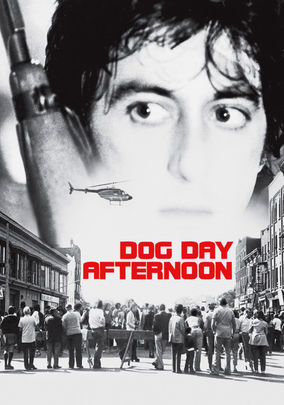
Dog Day Afternoon-1975

Dog Day Afternoon-1975

Director Sidney Lumet

Starring Al Pacino, John Cazale, Chris Sarandon

Top 250 Films #203

Scott’s Review #185
450423

Reviewed October 13, 2014

Grade: A-

Director Sidney Lumet successfully sets the smoldering hot summer afternoon in New York City for his 1975 film Dog Day Afternoon.

Al Pacino plays Sonny, an unemployed, desperate man who, while married with two kids, has a gay lover, Leon (brilliantly played by Chris Sarandon), whom he is attempting to help finance a sex change operation.

Based on a true story, Sonny, along with his dimwitted friend Sal- played by John Cazale- decides to rob First Brooklyn Savings Bank.

Predictably, their plans go awry when Sonny burns a ledger during the robbery attempt, and a pedestrian sees the smoke and alerts the police.

As the police become aware of the attempted heist, a standoff ensues between Sonny and the cops, led by Detective Moretti (Charles Durning), and the robbery receives media coverage.

Most of the action is set inside the stifling hot bank and directly outside on the street, and gradually the supporting characters come into play- the hostages, Sonny’s mother, wife, and lover all make contact with Sonny in some way or another, and his motivations become clearer to the audience.

Dog Day Afternoon is an anti-establishment movie, in this case anti-police, questioning the government and the financial establishment (Lumet also directed Network, challenging the establishment).

This is evident when, after a standoff with police, the crowd sides with Sonny as he chants “Attica!” Attica!, which is a direct reference to a recent prison riot.

Sonny speaks for the working class- the poor, struggling, underpaid workers who cannot afford to feed or adequately take care of their families.

The heat and humidity compare perfectly to the pressure felt by most middle-class people that still resonates today and leaves the viewer contemplating their life.

Sonny relates to the bank tellers who do not earn much. Besides, Sonny is sympathetic to the audience in another way. Leon, recently hospitalized at Bellevue Hospital, is emotionally dependent on Sonny. He would be lost without him.

They share a lengthy and heartfelt phone conversation that is the heart of the film- gay romance had not been explored this way by 1975 in cinema, and the romance was neither shoved down the audience’s throat nor was it looked past entirely.

Their relationship is tender and deep, yet still somewhat ambiguous.

Would they stay together? What would become of Sonny’s wife and two children? Would he leave them for Leon in a world that was not ready to accept two homosexual men together? Is that the reason for Leon’s desire for a sex change operation?

Chris Sarandon, in too small a part, is wonderful as the gay lover, struggling with a sexual identity crisis. Al Pacino gives, per usual, a brilliant portrayal as he takes on a complex character who is far from one-dimensional.

Perhaps not a masterpiece, Dog Day Afternoon is a very good film, but neither is it strictly a gay-themed movie nor an action/thriller- it’s more complex than that.

Ironically, Sonny is portrayed as the hero of the film, as it is not a standard good police versus bad bank robber type of film- quite the contrary. It is much, much more than that.

Oscar Nominations: 1 win-Best Picture, Best Director-Sidney Lumet, Best Actor-Al Pacino, Best Supporting Actor-Chris Sarandon, Best Original Screenplay (won), Best Film Editing

Network-1976

Network-1976

Director Sidney Lumet

Starring Faye Dunaway, Peter Finch, William Holden

Top 250 Films #228

Scott’s Review #1,481

Reviewed May 13, 2025

Grade: A

A conceptual film laden with intelligence and satire, Network (1976) is innovative, not easily digestible, but satisfying nonetheless. It pairs well with films like All the President’s Men (1976) or Spotlight (2015), with a focus on media frenzy, ratings, and the frustrating search for the truth amid chaos.

Or, does the truth even matter? It’s a sobering question the film explores.

The film received nine Oscar nominations and won three of the four acting awards. Decades later, it holds up tremendously well and is a stark reminder of the power of television and public perception, for better or worse.

Brilliant acting, rich writing, and impressive editing make Network a timeless treasure for many generations, not to mention Lumet’s creative and sometimes shocking direction.

Over narration, we meet veteran news anchorman Howard Beale (Peter Finch). He learns from his friend and news division president, Max Schumacher (William Holden), that he has only two more weeks on the air with the UBS network due to declining ratings.

After threatening to shoot himself on live television, instead, he launches into an angry televised rant, which turns out to be a huge ratings boost for the network, and he is kept on for entertainment purposes.

But what happens when the public grows tired of his antics and craves even more outrageous programming?

Ambitious producer Diana Christensen (Faye Dunaway), obsessed with her career and ratings, takes actions to dangerous new levels.

The poignancy that immediately caught my attention was how little the bottom line has changed in almost fifty years of television since Network was released. One could argue that things have gotten worse, with ratings making or breaking a television broadcast.

Depressing still is the knowledge in 2025 politics where liars, cheats, and felons callously hold the highest offices and wield the most power; newscasts are currently created based on the truths their target audiences believe, regardless of the truth.

Lumet, well-known for creating the groundbreaking Dog Day Afternoon (1975) just a year earlier, uses split screens to show four perspectives and adds frightening, gun-toting rebels who are angry and intent on making political statements.

But Diana needs them for a significant ratings share.

Lumet’s sequences teeter between long soliloquies in which characters reveal their deepest motivations and emotions and rapid-fire editing involving shootings and bank robberies.

I loved seeing the 1970s-style corporate offices with retro telephones, notepads, pens, pencils, stylish carpets, and colorful elevators. The glamorous and polished interiors perfectly reflect the gorgeous Manhattan skyline seen in numerous sequences.

The lavish restaurants and strong cocktails provide a luminous texture to the time.

The screenplay, written by Paddy Chayefsky, was based on the idea of a live death as the film’s central focus, as he said later in an interview, “Television will do anything for a rating… anything!”

The statement hit home in frigid reality.

Dunaway and Finch are clear favorites and provide the deepest character structures. Dunaway’s Diana is frigid and opportunistic, offering the audience no vulnerability or sympathy. In a way, she is not a human being, lacking emotional depth.

I half expected her to tear her face off and reveal herself as a fembot.

Finch steals the show as the tired and depressed veteran who feels dismissed and forgotten. Even when he reveals his intent to commit suicide on live TV, the news crew tunes out his monotone voice as they do nightly.

Finally, Beatrice Straight brilliantly delivers an acting 101 tutorial as the aging housewife being cheated on by her philandering husband.

One miss is Robert DuVall in a one-note performance we’ve already seen him deliver.

Network (1976) is a top-notch film from my favorite decade in cinema. The 1970s produced many meaningful and introspective gems, and Network is one of them.

Oscar Nominations: 4 wins-Best Picture, Best Director- Sidney Lumet, Best Actor- Peter Finch (won), William Holden, Best Actress- Faye Dunaway (won), Best Supporting Actor- Ned Beatty, Best Supporting Actress- Beatrice Straight (won), Best Original Screenplay (won), Best Cinematography, Best Film Editing

Aliens-1986

Aliens-1986

Director James Cameron

Starring Sigourney Weaver

Scott’s Review #80

Reviewed June 29, 2014

Grade: B+

Aliens (1986) takes away the rawness of the original Alien (1979) and infuses a glossier, slicker look to the film franchise.

The film was made eight years later, but story-wise, it is set fifty-seven years into the future when Ripley, played to perfection by Sigourney Weaver, awakens.

To her horror, she discovers that the aliens have colonized, and she is forced to return to prevent a catastrophe. The militia is in tow, adding a helping of masculinity that supports the film throughout.

This scenario perfectly sets the stage for what is to become an excellent sci-fi adventure story.

There are wonderful special effects that were quite extraordinary when the film was shot in 1986. The tunnels and spacecraft are perfectly lit and designed, creating a bright, fun setting, and the audience knows that doom is lurking.

The actual aliens are visually frightening and, compared to the original, are more plentiful.

Sigourney Weaver takes center stage and leads this film successfully.

I’m not sure many other actresses could pull off her level of authentic toughness and, in the process, give off no sex appeal and still get away with it.

The only detractor from the film is that it seems a bit dated in a purely 1980s way. It has an 80’s look to it, and that’s not a positive.

Not on par with the excellent original Alien, but otherwise, a well-made, supernatural thrill ride.

Oscar Nominations: 2 wins-Best Actress-Sigourney Weaver, Best Original Score, Best Sound Effects Editing (won), Best Sound, Best Art Direction, Best Film Editing, Best Visual Effects (won)