Category Archives: Wesley Addy

What Ever Happened to Baby Jane?-1962

What Ever Happened to Baby Jane? -1962

Director Robert Aldrich

Starring Bette Davis, Joan Crawford

Top 250 Films #68

Top 40 Horror Films #16

Scott’s Review #193

70048556

Reviewed November 14, 2014

Grade: A

Baby Jane kicked off a trend, prominent throughout the 1960s, of aging Hollywood actresses starring in horror films (interestingly, Bette Davis and Joan Crawford each did two—the others being Dead Ringer and Strait-Jacket), with varying degrees of success.

What Ever Happened to Baby Jane (1962), directed by Robert Aldrich, stars Davis and Crawford as, ironically enough, two aging Hollywood actresses, Jane and Blanche Hudson.

Jane (Davis), a child star in the 1920s nicknamed Baby Jane, with an adorable signature song, “I’ve Written a Letter to Daddy,” has long since faded from the spotlight but continues to dress in her Baby Jane costume, consisting of a little girl dress with hair in curls and ribbons.

Blanche, however, achieved success as an adult in the 1930s until a tragic accident left her wheelchair-bound and subsequently ruined her career. She then became a popular film star, much more popular than Jane.

Blanche and Jane now while away the years in a crumbling mansion in Los Angeles. Blanche is entirely dependent on her unbalanced sister for care. Jane is resentful of Blanche’s success and popularity and plans to relaunch her career in her once-famous alter ego.

The film has macabre comedic elements but never veers too far over the edge into camp or foolishness. It is also a very psychological film, as Jane mentally abuses Blanche and plays mind games with her to gain the upper hand.

Davis had a ball with this role, as her appearance alone is frightful – a grown woman of a certain age in blonde curls, pancake makeup, and a baby doll dress – she looks hideous!

What Ever Happened to Baby Jane reminds me quite a bit of Billy Wilder’s masterpiece Sunset Boulevard in several ways. For example, both feature successful stars of years past with delusions of returning to their former fame, both feature older women who are more than a bit unbalanced, and both films are set in sunny Los Angeles.

Two of the film’s supporting actors are well cast, adding significantly to the film, and deserve recognition. Victor Buono, later made famous for his role of King Tut in the popular late 1960s television series Batman, is highly effective as the opportunist sloth, Edwin Flagg, who aids Jane in her comeback attempt.

Maidie Norman as the Hudson sisters’ black housekeeper, Elvira, loyal to Blanche but never a fan of Jane’s, slowly becomes wise to Jane’s sinister plot and does a fantastic acting job when she stands up to the manipulative sister- for 1962, a black maid verbally assaulting a white woman employer was still somewhat taboo and kudos to the film for bravely going there is a highly effective scene.

The fact that Davis and Crawford famously despised each other in real life gives the audience an edge in scenes where the two women physically and verbally clash.

The film features wonderfully quotable dialogue. “We got rats in the cellar,” Jane utters matter-of-factly as she serves Blanche a cooked rat on a bed of lettuce for lunch one day, and cackles fiendishly when she hears Blanche scream in disgust.

One aspect of the film that has taken me three viewings to become aware of and that I love is the musical score throughout the film- it features multiple and creepy versions of Jane’s signature song, “I’ve Written a Letter to Daddy,” with varying tempos.

This film must use suspension of disbelief. Why does Blanche not pound and scream at her bedroom window to alert the neighbor of trouble instead of casually tossing a note out the window?

Blanche struggles to descend the steps by sliding down them and then cannot slide across the floor to escape the mansion, which is silly. The film is so gripping that I happily overlook these errors and instead enjoy the suspenseful film, which features two actresses, rivals both on and off-screen, that make this film a bit too realistic —a realism that makes for delightful film-watching.

Oscar Nominations: 1 win-Best Actress-Bette Davis, Best Supporting Actor-Victor Buono, Best Sound, Best Cinematography, Black-and-White, Best Costume Design, Black-and-White (won)

Network-1976

Network-1976

Director Sidney Lumet

Starring Faye Dunaway, Peter Finch, William Holden

Top 250 Films #228

Scott’s Review #1,481

Reviewed May 13, 2025

Grade: A

A conceptual film laden with intelligence and satire, Network (1976) is innovative, not easily digestible, but satisfying nonetheless. It pairs well with films like All the President’s Men (1976) or Spotlight (2015), with a focus on media frenzy, ratings, and the frustrating search for the truth amid chaos.

Or, does the truth even matter? It’s a sobering question the film explores.

The film received nine Oscar nominations and won three of the four acting awards. Decades later, it holds up tremendously well and is a stark reminder of the power of television and public perception, for better or worse.

Brilliant acting, rich writing, and impressive editing make Network a timeless treasure for many generations, not to mention Lumet’s creative and sometimes shocking direction.

Over narration, we meet veteran news anchorman Howard Beale (Peter Finch). He learns from his friend and news division president, Max Schumacher (William Holden), that he has only two more weeks on the air with the UBS network due to declining ratings.

After threatening to shoot himself on live television, instead, he launches into an angry televised rant, which turns out to be a huge ratings boost for the network, and he is kept on for entertainment purposes.

But what happens when the public grows tired of his antics and craves even more outrageous programming?

Ambitious producer Diana Christensen (Faye Dunaway), obsessed with her career and ratings, takes actions to dangerous new levels.

The poignancy that immediately caught my attention was how little the bottom line has changed in almost fifty years of television since Network was released. One could argue that things have gotten worse, with ratings making or breaking a television broadcast.

Depressing still is the knowledge in 2025 politics where liars, cheats, and felons callously hold the highest offices and wield the most power; newscasts are currently created based on the truths their target audiences believe, regardless of the truth.

Lumet, well-known for creating the groundbreaking Dog Day Afternoon (1975) just a year earlier, uses split screens to show four perspectives and adds frightening, gun-toting rebels who are angry and intent on making political statements.

But Diana needs them for a significant ratings share.

Lumet’s sequences teeter between long soliloquies in which characters reveal their deepest motivations and emotions and rapid-fire editing involving shootings and bank robberies.

I loved seeing the 1970s-style corporate offices with retro telephones, notepads, pens, pencils, stylish carpets, and colorful elevators. The glamorous and polished interiors perfectly reflect the gorgeous Manhattan skyline seen in numerous sequences.

The lavish restaurants and strong cocktails provide a luminous texture to the time.

The screenplay, written by Paddy Chayefsky, was based on the idea of a live death as the film’s central focus, as he said later in an interview, “Television will do anything for a rating… anything!”

The statement hit home in frigid reality.

Dunaway and Finch are clear favorites and provide the deepest character structures. Dunaway’s Diana is frigid and opportunistic, offering the audience no vulnerability or sympathy. In a way, she is not a human being, lacking emotional depth.

I half expected her to tear her face off and reveal herself as a fembot.

Finch steals the show as the tired and depressed veteran who feels dismissed and forgotten. Even when he reveals his intent to commit suicide on live TV, the news crew tunes out his monotone voice as they do nightly.

Finally, Beatrice Straight brilliantly delivers an acting 101 tutorial as the aging housewife being cheated on by her philandering husband.

One miss is Robert DuVall in a one-note performance we’ve already seen him deliver.

Network (1976) is a top-notch film from my favorite decade in cinema. The 1970s produced many meaningful and introspective gems, and Network is one of them.

Oscar Nominations: 4 wins-Best Picture, Best Director- Sidney Lumet, Best Actor- Peter Finch (won), William Holden, Best Actress- Faye Dunaway (won), Best Supporting Actor- Ned Beatty, Best Supporting Actress- Beatrice Straight (won), Best Original Screenplay (won), Best Cinematography, Best Film Editing

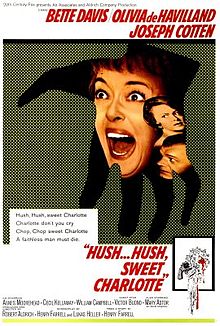
Hush…Hush, Sweet Charlotte-1964

Hush…Hush, Sweet Charlotte-1964

Director Robert Aldrich

Starring Bette Davis, Olivia de Havilland

Scott’s Review #632

Reviewed April 8, 2017

Grade: B+

The follow-up film, but not a direct sequel, to the surprise 1962 hit, What Ever Happened To Baby Jane? Hush…Hush, Sweet Charlotte (1964) is a psychological thriller directed by Robert Aldrich.

The film was intended to reunite Aldrich with stars Bette Davis and Joan Crawford. Crawford filmed several scenes, but the tension between the stars proved too much, and Crawford dropped out.

Olivia de Havilland took her place, and reportedly, the filmmakers scrambled to re-shoot the film nearly from scratch.

Shot in black and white, just like What Ever Happened To Baby Jane?, the film is very similar in style and tone, and, rather than Los Angeles as the setting, the setting is now the sprawling southern landscape of the deep south- Louisiana to be exact, a vast estate with a lavish mansion is the featured ominous setting.

The action begins in 1927 at a grand party at the well-to-do Hollis family mansion.

The night is fraught with tension, and secrets are harbored- most notably, southern belle Charlotte (Davis) and her married beau, John (Bruce Dern), plan to elope and steal away into the night together.

When John is threatened by Charlotte’s father, Sam (Victor Buono), he regrettably breaks up with Charlotte, destroying her. Later, John is decapitated and his hand severed, leaving all of the guests only to assume that Charlotte was murdered after she appears wearing a blood-soaked dress.

Due to a lack of evidence, Charlotte is set free.

The remainder of the film takes place during present times (1964) and in the same mansion, now slated to be demolished by the town in favor of a highway.

Charlotte is old and haggard, having lived a life of seclusion. Her father is long dead, and her only company is her dedicated and faithful housekeeper, Velma (Agnes Moorehead).

Frantic at the thought of leaving the safety of her estate, Charlotte asks her cousin Miriam (de Havilland) to visit. Events then become stranger and stranger as past secrets and jealousies are revealed.

Taking nothing away from the talents of Olivia de Havilland, I cannot help but imagine how much better Hush…Hush, Sweet Charlotte would have been if Joan Crawford had settled into the role of cousin Miriam.

The real-life rivalry between Crawford and Davis made What Ever Happened to Baby Jane? It is a compelling work, and the angry emotions are fresh and authentic.

Interestingly, the characters are reversed in this film—Davis plays the victimized Charlotte, while Crawford would have played the villainous Miriam, and the results would have been delicious.

The plot is decent, but nothing spectacular, and not nearly as splendid as What Ever Happened To Baby Jane? , although certain similarities abound between the two films: a giant mansion, black and white cinematography, a mentally unstable (or assumed to be) character, a character being either drugged or victimized, and two female characters who are related.

To compare the two films, which is impossible not to, What Ever Happened To Baby Jane? Wins in spades. It is the more compelling of the two films.

What sets Hush…Hush, Sweet Charlotte, well above mediocrity (with fewer actors, it may have been), is the casting of one of the greatest actresses to grace the big screen.

Bette Davis’s portrayal of the victimized Charlotte is fantastic. She encompasses vulnerability, anger, fear, and energy. Her facial expressions and those passionate eyes give so much to Charlotte.

The clever resolution to the film and the plot twist after the film is pretty well-written and surprising, given that the characters assumed to be involved in the murder are not as guilty as one might think, or at least not in the way one might think, and by the time the credits roll, the story has a satisfying, hopeful ending.

Another success of the film is its use of two gruesome scenes, which is surprising since the film predates the lifting of the film censorship rules.

When a severed head comes tumbling down the grand staircase of the mansion, it frightens and is not in the least campy or over-the-top. As John is hacked to death in the opening sequence, his hand is severed from his arm, and it dramatically tumbles to the floor.

The scenes resonate because they were rarely done in mainstream film as early as 1964.

Hush…Hush, Sweet Charlotte is a fantastic companion piece to the superior What Ever Happened To Baby Jane?

Watching back-to-back is a fantastic late-night viewing.

Successful to the film are top-notch talents such as de Havilland, Victor Buono, Bruce Dern, Agnes Moorehead, and the superior film queen, Bette Davis, which makes any film worth watching.

Oscar Nominations: Best Supporting Actress-Agnes Moorehead, Best Song-“Hush, Hush, Sweet Charlotte,” Best Music Score-Substantially Original, Best Art Direction, Black-and-White, Best Cinematography, Black-and-White, Best Costume Design, Black and White, Best Film Editing

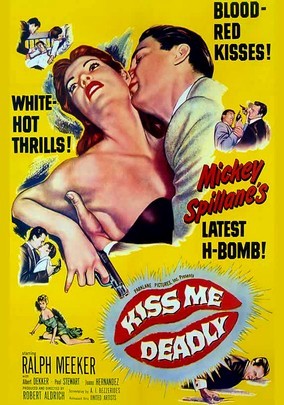
Kiss Me Deadly-1955

Kiss Me Deadly-1955

Director Robert Aldrich

Starring Ralph Meeker, Cloris Leachman

Scott’s Review #391

60020642

Reviewed April 2, 2016

Grade: A-

Kiss Me Deadly is a 1955 noir drama that influenced many subsequent films. After years of keeping it on my “to see” list, I finally got around to viewing this influential gem and now realize its power.

At times, it is confusing and perplexing and requires additional watching. I rate it an A——; however, I can see its grade rising to a solid A upon subsequent viewings.

Still, Kiss Me Deadly has much respect from me as a lover and appreciator of a good film.

The mysterious plot goes like this: Mike Hammer (played by Ralph Meeker) is a stern Los Angeles private eye. One evening, driving along a lonely country road, he picks up a hitchhiker, Christina (Cloris Leachman’s film debut), who is clad only in a trench coat.

He quickly realizes she has escaped from a mental institution but is compelled by her desperation.  When thugs catch up to them, this sets off events as Mike spends his days investigating the strange turn of events.

The plot twists and turns in innumerable ways and becomes complex but fascinating. A peculiar glowing box, which everybody seems to want, comes into play.

Wonderfully directed by Robert Aldrich, Kiss Me Deadly features unique and creative uses of lighting, camera angles, and moody shadows to significant effect, and this is one of the first aspects I noticed.

Shot in highly effective black and white, allowing Kiss Me Deadly a murky, suspicious look- as if danger and doom might be around every corner.

Meeker and Maxine Cooper as Velda, Mike’s secretary/lover, make a nice pair, as they are good-looking, but a rather B-movie type couple, in contrast, to say, Cary Grant and Eva Marie Saint, two gorgeous upper echelon Hollywood stars of the day.

Casting those stars might have changed the tone of the film.  Meeker and Cooper bring, perhaps, a blue-collar look to the film. Nevertheless, the chemistry works.

An interpretive film, Kiss Me Deadly undoubtedly influenced later film noir classics such as Chinatown (1974), L.A. Confidential (1997), and Pulp Fiction (1994), as well as science-fiction films and, arguably, Raiders of the Lost Ark (1981).

The list could go on as Kiss Me Deadly crosses into numerous genres.

The ending is highly complex, spooky, and downright weird. It is one of the craziest endings I have ever experienced.

Once the mysterious box is opened, the film becomes a strange Twilight Zone episode with screeching sounds. The explosion is open to complete interpretation and changes the dynamic. I had the enormous fortune to view the alternate ending not released in theaters.

Mike and Velda’s fates were vastly different from one end to another. My preference was the alternate ending. Sometimes, the studios play things too safe.

What does it all mean? Nuclear weapons, the apocalypse, the Cold War, glowing boxes, and detective work are many elements in one film.

A conversation about Kiss Me Deadly (1955) could be enjoyed, as it speaks volumes about the film’s high quality.

I look forward to seeing this revolutionary film again for further appreciation.