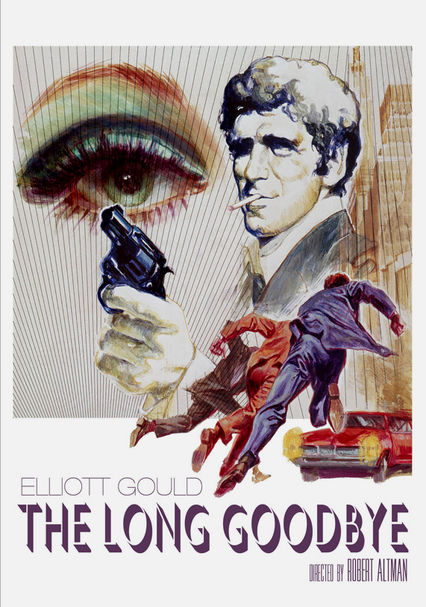
The Long Goodbye-1973
Director Robert Altman
Starring Elliott Gould, Nina van Pallandt
Top 250 Films #50
Scott’s Review #830
Reviewed November 14, 2018
Grade: A
Nearly a full-fledged character study of one man’s moral fiber, The Long Goodbye (1973) is an edgy piece of direction by the famous mastermind Robert Altman.
The setting of Los Angeles’ underbelly is both fabulous and practical, as is the dim lighting and excellent camera work prevalent throughout. The film is not cheery, but rather bleak, which suits me just fine, given the dreary locale.
Perhaps a more obscure Altman offering, but the film sizzles with zest and authenticity.
The film is based on a story written by Raymond Chandler in 1953.
Altman, however, opts to change the setting from 1950 to present times- 1970s Los Angeles and present a film noir experience involving deceit and shenanigans where all is not as it seems.
I think this is a wise move, and I could not help but draw many comparisons (mainly the overall story) to Chinatown (1974), released the year after The Long Goodbye, but a film much better remembered.
Elliott Gould is wonderful as Phillip Marlowe, a struggling private investigator and insomniac. He is asked by a friend, Terry Lennox, for a ride to the Mexico border one night and agrees to do the favor.
This leads to a mystery involving police, gangsters, and Eileen and Roger Wade after Phillip is questioned regarding his connection to Terry, who is accused of murdering his wife, Sylvia.
The seedy side and complexities of several characters are revealed as the story unfolds and the plot gradually thickens.
My favorite aspects of The Long Goodbye are not necessarily the primary storytelling, though the writing is filled with tension.
As the film opens, an extended sequence featuring a “conversation” between Phillip and his cat is both odd and humorous. The finicky feline refuses to eat anything other than one brand of cat food.
As Phillip tries to reason with the cat by talking and meowing, he is forced to venture out in the middle of the night to an all-night grocery store.
Altman, known for allowing his actors free rein with improvised dialogue, appears to let Gould experiment during this scene.
Phillip’s neighbors, a bunch of gorgeous twenty-something females, seem to do nothing except exercise on their balcony, get high, and ask him to buy them brownie mix for a “special occasion”.
As they stretch topless, usually in the background and almost out of camera range, they are a prime example of an interesting nuance of the film. The girls are mysterious but have nothing to do with the actual plot, adding even more intrigue to the film.
In one of the most frightening scenes in cinematic history and one that could be straight from The Godfather (1972), crazed gangster, Marty Augustine (Mark Rydell), slices the beautiful face of his girlfriend to prove a point to Marlowe.
In a famous line, he utters, “That’s someone I love. You, I don’t even like.” The violent act is quick, unexpected, and fraught with insanity.
Finally, the film’s conclusion contains a good old-fashioned twist worthy of any good film noir. In the end, the big reveal makes sense and begs to raise the question, “Why did we trust this character?”
In addition to the viewer being satisfied, Marlowe also gets a deserved finale and proves that he cannot be messed with or taken for a fool.
The Long Goodbye is undoubtedly the best film of Gould’s career. With a charismatic, wisecracking persona, the chain-smoking cynic is considered a loser by most.
He is an unhappy man and down on humanity, but still wants to do what is right. He lives a depressed life with few friends and the company of only his cat.
While his neighbors marginally entertain him, he goes about his days only barely getting by emotionally. Gould is brilliant at relaying all these qualities within his performance.
The addition of the title theme song in numerous renditions is a major win for the film, and something that becomes more noticeable with each viewing. The ill-fated gangster’s girlfriend hums along to the song playing on the radio at one point, and a jazz pianist plays a rendition in a smoky bar.
This is an ingenious approach by Altman and gives the film a greater sense of mystery and style.
There is no question among cinema lovers that Robert Altman is one of the best directors of all time.
In his lengthy catalog of rich, experimental films, The Long Goodbye (1973) is neither the best-remembered nor the most recognizable.
I implore film fans, especially fans of plodding mystery and intrigue, to check this great steak dinner of a film out.