Category Archives: Henry Rowland

Supervixens-1975

Supervixens-1975

Director Russ Meyer

Starring Shari Eubank, Charles Pitts, Charles Napier

Top 250 Films #62

Scott’s Review #361
220px-Supervixensposter

Reviewed January 9, 2016

Grade: A

I first watched Supervixens in 2008, and, if I am being sincere, I did not much care for it, or rather, I was very perplexed by it. I did not know what I had just viewed and was caught off guard and blown away- I have since realized that this is part of my love for the film.

Is it a comedy? Is it too over-the-top and shameless? Is it trying to degrade women? Now, a mere eight years later, it lands firmly ensconced on my Top 100 Films list, and it is similar to a fine wine- it just gets better and better with age.

Never before did I think I would fall in love with a sexploitation film, but I have.

Directed by Russ Meyer, noted for his series of 1970s sexploitation films, Supervixens is set somewhere in the desert of eastern California.

Gas station attendant Clint Ramsey, a handsome young man, is found irresistible to a series of sexy, large-breasted women, all with names beginning with “Super”.

We are introduced to his steady girlfriend, SuperAngel, a bored, horny, feisty woman played by Shari Eubank. Jealous and possessive, she commands Clint to leave his job and come home to her immediately, leading to hilarity as they spar outside, using an ax as they wrestle and fight.

Their nosy neighbor looks on, both tantalized and frightened.

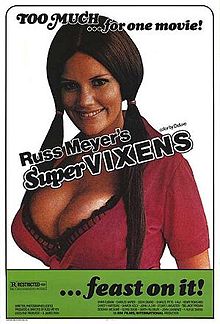
Others who make appearances during Clint’s journeys are SuperLorna, a horny gas station customer (strangely appearing in only one scene, but gracing the film cover packaging), who sets her sights on Clint, much to SuperAngel’s chagrin.

SuperCherry is a buxom girl who picks up Clint hitchhiking; SuperSoul, an Austrian farmer’s wife, seduces Clint at the farm; SuperHaji, a bartender at the local watering hole; and finally, SuperEula, who is black, deaf, and has a white father.

Supervixens, as well as some of Russ Meyer’s films, have influenced countless other famous films, and I continue to note their specific influence on Quentin Tarantino.

With the bloody violence mixed with cartoonish characters, as well as Nazi references (a frequent theme of Tarantino’s) and German marching music, Supervixens has a sly sense of humor- wicked almost, but never apologetic.

Tarantino uses a similarly outrageous style.

Carrie (SuperVixen bloody in the tub), The Shining (Harry breaking down the bathroom door amid a screaming SuperVixen), Friday the 13th- Part 3 (the camera angle at the top of the hayloft panning down on the approaching climber) are just a few film comparisons that I have noticed during repeated viewings.

My love for the film is its outrageousness, and I find it empowering to women, most of all, and not degrading. There is also male nudity and references to the male anatomy numerous times, so it is not a one-sided exploitation film.

Each female is a superhero, of sorts, and despite the sexploitation aspect, the film is quite romantic in spots- the tenderness between Clint and SuperEula is one of my favorites.

I also love the romance between Clint and SuperVixen (a dual role for Eubanks), as she is a reincarnation of SuperAngel. Working side by side at a roadside gas station that she owns, they pump gas and prepare burgers together, while running through the desert in a happy, lovely way.

Of course, their romance is threatened by the sinister Harry, who has returned for revenge.

Hilarious, outrageous, and in-your-face sexual, Supervixens (1975) is a camp classic that is so much more than that. Influential and creative, it must be seen to be believed.

I hope it is never forgotten.
Diamonds Are Forever-1971

Diamonds Are Forever-1971

Director Guy Hamilton

Starring Sean Connery, Jill St. John

Top 250 Films #100

Scott’s Review #328

60000705

Reviewed January 6, 2016

Grade: A

Despite Diamonds Are Forever (1971) being one of the lower-rated James Bond films, this is actually one of my favorite films of all time, and many would disagree with me.

Some say Sean Connery phoned this performance in; others say there was little chemistry between him and Jill St. John, and the sets were tense, leading to a sub-par offering. But I think this is a great film.

I love the Las Vegas locale, the bright lights, flashy costumes, and a ritzy underbelly- and the Vegas car chase is incredible.

A bright, shiny Ford Mustang takes center stage throughout the sequence, and if one looks closely, one will realize that nearly all the cars are Ford- fun fact!

The title song by Shirley Bassey is great, sultry and stylish, only enhanced by the glitzy setting. One immediately imagines the film oozing with diamonds as it does.

The villains are fascinating, and Mr. Wint and Mr. Kidd were the first openly gay Bond villains, which, in 1971, was groundbreaking.

Yes, they are evil and slightly silly, but what a risky, surprising, and blatant scene to see the gentlemen holding hands.

St. John is a sophisticated and intelligent Bond girl, and the action in this film is plenty.

Diamonds Are Forever (1971) contains all the elements for an enjoyable Bond experience.

Oscar Nominations: Best Sound

East of Eden-1955

East of Eden-1955

Director Elia Kazan 

Starring James Dean, Julie Harris, Jo Van Fleet

Top 250 Films #205

Scott’s Review #1,092

Reviewed December 17, 2020

Grade: A

James Dean wasn’t with us for very long, tragically dying at the tender age of twenty-four, but he made three films: Rebel Without a Cause (1955), Giant (1956), and East of Eden (1955), all-powerful showcases and unique.

Dean gives a brilliant, humanistic, and sometimes tragic performance.

East of Eden, his first film, is the only one he got to preview. I hope he liked it because it will live forever as a gem.

Based on the John Steinbeck novel of the same name, the story is also a biblical retelling of Cain and Abel, brothers who clash and spar. Director Elia Kazan, famous for supporting and using Method actors in his films, gave a tremendous performance as Dean, which was key to the film’s empathetic nature.

The key to East of Eden is that it reflects on several characters, who are both good and bad, possessing qualities of both, detailing their struggles.

Nobody is completely good or completely bad. The story analyzes good versus evil and the multitude of layers between both extremes, making the experience juicy, truthful, and brilliant.

Set in 1917, during World War I, two sunny coastal California towns are the backdrop for the action. Cal Trask (Dean) perceives his father, farmer Adam (Raymond Massey), as favoring Cal’s brother, Aron (Richard Davalos). This leads to much resentment, jealousy, and conflict. Aron is the apple of Adam’s eye, and we wonder why.

Furthering the drama is Cal’s love for Aron’s girlfriend, Abra (Julie Harris), who doesn’t rebuff any advances. Cal and Aron’s mother, Kate (Jo Van Fleet), who they think is dead, is alive and well and running a brothel in a nearby town. Assuming a different name, she harbors secrets.

Before you get the impression this is some cheesy soap opera, East of Eden, like the novel, is heavily character-driven and nuanced with development. It ultimately draws the audience in and envelops everyone in its simmering qualities.

East of Eden is packed with powerful scenes after powerful scenes, and in more than one, the allegiances and rooting values shift from character to character.

Some of the best moments are when Cal self-destructs after his father refuses his birthday gift, or when Cal cruelly reveals the true nature of their mother’s profession to the innocent and unsuspecting Aron.

Finally, Cal and Abra’s kiss atop a Ferris wheel is filled with smoldering desire and deadly consequences.

The acting was tremendous across the board. Much of the credit must go to Kazan for pulling fabulous performances out of the players, a talent only a Method acting director can achieve.

While the cast is exceptional, the film belongs to Dean, who provides enough emotion and vulnerability to sustain his character’s topsy-turvy, tortured existence. Knowing that the actor died soon after filming gives the film an eerie and sentimental feel.

This is comparable to a more modern-day example when Heath Ledger died after giving a brilliant performance in The Dark Knight (2008).

This is hardly a war film or a guy’s film, as the ladies also get to shine with rich characters. Julie Harris and Jo Van Fleet portray flawed characters in juicy roles rife with meaty scenes filled with conflict.

As with most of Steinbeck’s works, specifically The Grapes of Wrath, the landscape is a character, and East of Eden is no exception. With dusty roads and mountainous backgrounds, events ooze with atmosphere and beauty.

The lush northern coastal California landscape portrays a grandiose magnificence that counterbalances the conflict its inhabitants are experiencing.

The central note to take away from East of Eden (1955) is that we are complex creatures with a mixture of good and evil. We sometimes want to do the right thing, but in doing so, we hurt those we love. The main characters suffer from pain, regret, good intentions, poor decisions, and loss.

The rich dialogue, adaptation, acting, and cinematography make the film near perfection.

Oscar Nominations: 1 win-Best Director-Elia Kazan, Best Actor-James Dean, Best Supporting Actress-Jo Van Fleet (won), Best Screenplay

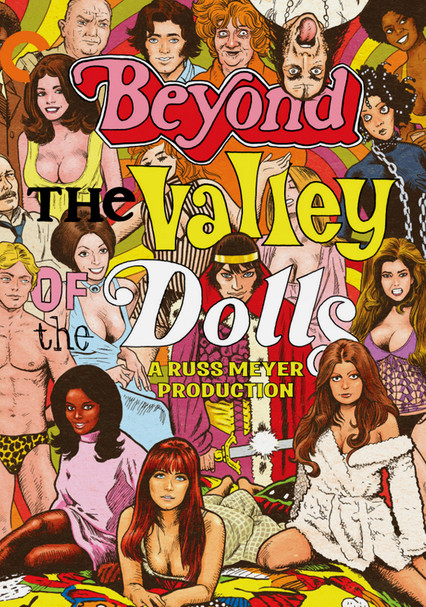
Beyond the Valley of the Dolls-1970

Beyond the Valley of the Dolls-1970

Director Russ Meyer

Starring Dolly Martin, Cynthia Myers

Scott’s Review #976

Reviewed January 2, 2020

Grade: B+

Beyond the Valley of the Dolls (1970) was initially intended as a sequel to the 1967 film Valley of the Dolls but was revised as a parody of the commercially successful but critically panned original.

This was not altogether a smart move, since it would have been interesting to see a coherent follow-up exploring the lives of the original characters, rather than a similarly named film with little to do with the first.

Instead, the film plays like frenetic mayhem, with jarring editing, a peculiar character switch and storyline, and completely over-the-top vulgarity. Still, the film is fun and extravagant, but hardly on par with Valley of the Dolls.

I would not even recommend watching them in sequence- the confusion would only be doubled.

To call Valley of the Dolls a “serious” film is laughable, but compared to Beyond the Valley of the Dolls, it is.

Director Russ Meyer is known for successful sexploitation films that feature campy humor, satire, and large-breasted women, such as Faster, Pussycat! Kill! Kill! (1965) and Supervixens (1975) are at the helm to create the bombastic and eye-dropping shenanigans.

Famous film critic Roger Ebert co-wrote the screenplay along with Meyer.

Three young women, MacNamara (Dolly Martin), Casey Anderson (Cynthia Myers), and “Pet” Danforth (Marcia McBroom), front a struggling rock band, The Kelly Affair, managed by Harris Allsworth (David Gurian), Kelly’s boyfriend.

The four travel to Los Angeles to seek Kelly’s estranged aunt, Susan Lake, an heiress to a family fortune. Fans of Valley of the Dolls will need to know that Susan is supposed to be Anne Welles, the film’s central character.

A battle ensues as Susan graciously offers to give some of her fortunes to Kelly, but Susan’s unsavory financial adviser, Porter Hall (Duncan McLeod) will have none of it. Amid the drama, Kelly meets a gigolo who feuds with Harris, while Harris is pursued by a sexually aggressive porn star named Ashley St. Ives (Edy Williams).

Events all take place against the backdrop of the nightly Los Angeles party.

While the plot is not the central aspect of Beyond the Valley of the Dolls, the renaming of Susan from Anne, the same character, and the recasting of Barbara Parkins as Phyllis Davis make things confusing.

Adding to this point, Parkins was initially cast as Anne/Susan but was abruptly fired from the production. This makes any comparisons to Valley of the Dolls other than the title alone, unwise and a waste of time.

The lively revelry is the fun and the beauty of Beyond the Valley of the Dolls.

The film has a calm, groovy vibe and epitomizes the late 1960s psychedelic, colorful aura. The free love and expressionism make the experience a wild yet liberal-minded one, which is suitable for a film like this.

The intention is to entertain and to express women’s confidence. While the female characters are exploited, they are also driven and comfortable in their own skin.

A fun fact, and cause for musing, is that as wild and exploitative to women (and men) as Beyond the Valley of the Dolls is, Ebert was primarily responsible for penning the script.

In the 1980s, the critic, whom I am a cherished fan of, panned many of the 1980s horror/slasher flicks, especially Friday the 13th (1980), for exploiting women, but he had no issue exploiting them years earlier.

Makes one ponder the hypocrisy of his comments.

Beyond the Valley of the Dolls (1970) is daring and never plays it safe. With a hip edge and plenty ahead of its time in same-sex character representation, the film is unique and brimming with hilarious, bizarre antics.

The plot is rather silly and goofy, and unsurprisingly panned by critics, but it has become a cult classic, and with repeated viewings, it has grown on me more and more.

The production is meant to be watched late at night for better appreciation.

Casablanca-1943

Casablanca-1943

Director Michael Curtiz

Starring Humphrey Bogart, Ingrid Bergman

Scott’s Review #838

Reviewed December 7, 2018

Grade: A

Casablanca (1943) is a classic style Hollywood film made during a decade when big studio productions were all the rage. The film may very well be in the top ten creations of its day and a movie that nearly everyone has either seen or is aware of.

A grand romantic World War II drama released at the perfect time, the film contains legendary stars Humphrey Bogart and Ingrid Bergman. It is flawless in nearly every way, as a lavish production should be.

Bogart stars as Rick Blaine, an expatriate who owns a lavish nightclub in Casablanca, Morocco. The film takes place in December 1941, before the United States entered the vicious World War II.

His clientele ranges from French and German officials to refugees attempting to flee the country, fearful of being stuck in a foreign land. Mixed in with the melee of varied characters is Ilsa (Bergman), a former flame of Rick’s, who appears with a new husband, Victor, a Czech leader.

Ilsa begs Rick for help escaping the country, and their romance begins to blossom again.

Through scenes, we see Rick and Ilsa living perfectly in pre-war Paris. They happily co-exist, sharing a happy life, unaware of the conflict and secrets that will emerge in Casablanca two years later.

Victor is initially presumed dead, which leads to Ilsa’s initial freedom and romance with Rick.

Back in Casablanca, Rick has essential letters that will allow the holder to escape the city and be bound for safety in another country. While Ilsa is desperate for these letters, she is also madly in love with Rick, and vice versa, adding a strong romantic element to the film.

Supporting characters are mixed into the plot as desperation and impending doom interplay.

Casablanca is a film with things happening simultaneously, which is a significant part of its draw. From the apparent romance of Rick and Ilsa- the focal point of the story part of the draw are the sub-plots weaved within.

The nasty Nazi Major Heinrich Strasser encompasses the future Third Reich and the devastation this group would ultimately cause. A multitude of supporting characters and extras perfectly flesh out both the cast and the look and feel of the film.

The most interesting character is Rick.

Once idealistic and moral, he has changed, becoming cynical and broken. In this way, the film nearly becomes a character study. The audience sees the change in Rick and slowly realizes he has given the war the culprit.

The final sequence reveals Rick and Ilsa’s fate. Their doomed romance is assuredly no surprise, true to the message. An “unhappily ever after” result was rare in a big studio production and is a testament to the well-written story.

The featured piano number and Casablanca’s “theme song” is the lovely yet melancholy “As Time Goes By.” Beautifully played by Sam (Dooley Wilson), the house pianist and close friend of Rick, the number is instrumental to the plot and specifically to Rick and Ilsa’s romance.

The song is a painful memory of the once-idyllic life the pair shared.

The film’s timing, made in 1941 and released in 1943, is the key to its unrelenting success. American audiences undoubtedly found it identifiable, and the uncertainties of the impending war threatened their current freedoms.

Casablanca was wonderfully marketed in this way, and its compelling nature resonated. Audiences shared Rick’s conflict and “for the greater good” perspective.

Casablanca (1943) is a film that educates, entertains, and romances without exhibiting a shred of pretension. The crisp black-and-white filming and the unique use of light and shadows to reflect the characters’ thoughts make the film lovely and has a lofty budget.

Immersed in the richness are sadness and a timely message about a changed man, a failed romance, and the ravages of war that still resonate decades later.

Oscar Nominations: 3 wins-Outstanding Motion Picture (won), Best Director-Michael Curtiz (won), Best Actor-Humphrey Bogart, Best Supporting Actor-Claude Rains, Best Screenplay (won), Best Scoring of a Dramatic or Comedy Picture, Best Cinematography, Black-and-White, Best Film Editing