Category Archives: Helmut Dantine

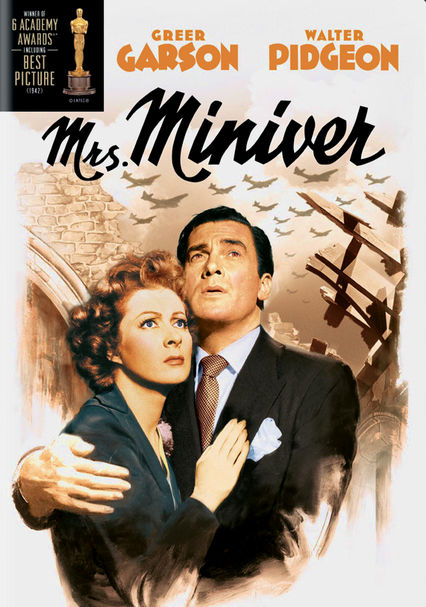
Mrs. Miniver-1942

Mrs. Miniver-1942

Director William Wyler

Starring Greer Garson, Walter Pidgeon

Scott’s Review #841
Reviewed December 13, 2018

Grade: A-

Released in 1942 amid the horrific World War II, Mrs. Miniver (1942) was a smash hit, winning over audiences concerned with the troubled and uncertain times.

Decades later, the film does not age as well as other similarly themed films, but still entertains and tells a good story with an important theme.

The film is nestled in the war drama genre with romance. The film won numerous Oscars the year of its release, including Best Picture and star Greer Garson won for Best Actress.

The story is told from the perspective of an affluent British family and the struggles they face to keep things together during growing peril. The focus primarily remains on an unassuming housewife, Kay Miniver (Garson).

The supporting players do much to flesh out the film with fantastic performances by Walter Pidgeon, Teresa Wright, and Henry Travers as Clem Miniver, Carol Beldon, and Mr. Ballard, respectively.

The direction by William Wyler is astounding and adds to the perfectly crafted ambiance and homey details.

The family lives a comfortable life in a whimsical village outside of London. Quite idealized, they own a large garden and a motorboat on the River Thames.

Along with Kay and Clem, their three children of varying ages and their housekeeper and cook reside with them. Besides the parents, the central couple is son Vin (Richard Ney) and the prominent Carol (Wright); the pair initially disagree on politics but finally fall madly in love.

As the soap opera-style family situations continue, the war grows closer and closer to their house.

As Mrs. Miniver progresses, Vin enlists in the army to assist with war efforts, a German Nazi breaks into the Miniver house, a central character dies, and bombs and planes crash.

Through it all, Kay remains stoic and takes the family through challenging situations, adding melodrama to the film. The woman’s journey and resolve to keep everything and everyone intact is at the core.

The film is mainly a family drama with the Minivers and the townspeople experiencing trials and tribulations. In this way, Mrs. Miniver risks being a one-trick pony, albeit an emotional and teary-eyed one.

The film’s rich characteristics and polished nature make it more than it ought to be, and the superlative cast, production values, and timely release undoubtedly made it what it was in 1942.

In present times, however, Mrs. Miniver seems diminished in importance and relevance with a sappy and overly sentimental feel, World War II in the distant past, and several other wars come and gone.

Wyler carefully packaged the film to hit every emotion, from the bombastic musical score to the proper English characters to the comic relief housekeeper.

The film is a giant Hollywood production, but perhaps a bit too perfect to age with any zest or reason to watch more than once.

The film might be better remembered for its strong female lead. Told from Kay’s perspective, it was unusual in 1942 for a movie (especially with a war theme) not to have the story from the male point of view. Still refreshing in 2018, this quality was downright groundbreaking at the time.

Kay stays strong and proud through the ravages of war that are closing in on her family with unbridled boldness and nary a simpering quality. Wright’s Carol is an early champion for strong, female-driven characters, and, in a more minor way, she is also a muscled female role model.

Mrs. Miniver (1942) is a well-crafted film of its time that displays lavish production values and strong characters worthy of admiration.

The film is a significant win for a glimpse of the 1940s, especially for fans of good, solid drama. There are no significant flaws to harp on, but the overall piece has not aged exceptionally well, and other similar films (Casablanca, 1942) are more memorable.

Oscar Nominations: 6 wins-Outstanding Motion Picture (won), Best Director-William Wyler (won), Best Actor-Walter Pidgeon, Best Actress-Greer Garson (won), Best Supporting Actor-Henry Travers, Best Supporting Actress-Teresa Wright (won), Dame May Whitty, Best Screenplay (won), Best Sound Recording, Best Cinematography, Black-and-White (won), Best Film Editing, Best Special Effects

Casablanca-1943

Casablanca-1943

Director Michael Curtiz

Starring Humphrey Bogart, Ingrid Bergman

Scott’s Review #838

Reviewed December 7, 2018

Grade: A

Casablanca (1943) is a classic style Hollywood film made during a decade when big studio productions were all the rage. The film may very well be in the top ten creations of its day and a movie that nearly everyone has either seen or is aware of.

A grand romantic World War II drama released at the perfect time, the film contains legendary stars Humphrey Bogart and Ingrid Bergman. It is flawless in nearly every way, as a lavish production should be.

Bogart stars as Rick Blaine, an expatriate who owns a lavish nightclub in Casablanca, Morocco. The film takes place in December 1941, before the United States entered the vicious World War II.

His clientele ranges from French and German officials to refugees attempting to flee the country, fearful of being stuck in a foreign land. Mixed in with the melee of varied characters is Ilsa (Bergman), a former flame of Rick’s, who appears with a new husband, Victor, a Czech leader.

Ilsa begs Rick for help escaping the country, and their romance begins to blossom again.

Through scenes, we see Rick and Ilsa living perfectly in pre-war Paris. They happily co-exist, sharing a happy life, unaware of the conflict and secrets that will emerge in Casablanca two years later.

Victor is initially presumed dead, which leads to Ilsa’s initial freedom and romance with Rick.

Back in Casablanca, Rick has essential letters that will allow the holder to escape the city and be bound for safety in another country. While Ilsa is desperate for these letters, she is also madly in love with Rick, and vice versa, adding a strong romantic element to the film.

Supporting characters are mixed into the plot as desperation and impending doom interplay.

Casablanca is a film with things happening simultaneously, which is a significant part of its draw. From the apparent romance of Rick and Ilsa- the focal point of the story part of the draw are the sub-plots weaved within.

The nasty Nazi Major Heinrich Strasser encompasses the future Third Reich and the devastation this group would ultimately cause. A multitude of supporting characters and extras perfectly flesh out both the cast and the look and feel of the film.

The most interesting character is Rick.

Once idealistic and moral, he has changed, becoming cynical and broken. In this way, the film nearly becomes a character study. The audience sees the change in Rick and slowly realizes he has given the war the culprit.

The final sequence reveals Rick and Ilsa’s fate. Their doomed romance is assuredly no surprise, true to the message. An “unhappily ever after” result was rare in a big studio production and is a testament to the well-written story.

The featured piano number and Casablanca’s “theme song” is the lovely yet melancholy “As Time Goes By.” Beautifully played by Sam (Dooley Wilson), the house pianist and close friend of Rick, the number is instrumental to the plot and specifically to Rick and Ilsa’s romance.

The song is a painful memory of the once-idyllic life the pair shared.

The film’s timing, made in 1941 and released in 1943, is the key to its unrelenting success. American audiences undoubtedly found it identifiable, and the uncertainties of the impending war threatened their current freedoms.

Casablanca was wonderfully marketed in this way, and its compelling nature resonated. Audiences shared Rick’s conflict and “for the greater good” perspective.

Casablanca (1943) is a film that educates, entertains, and romances without exhibiting a shred of pretension. The crisp black-and-white filming and the unique use of light and shadows to reflect the characters’ thoughts make the film lovely and has a lofty budget.

Immersed in the richness are sadness and a timely message about a changed man, a failed romance, and the ravages of war that still resonate decades later.

Oscar Nominations: 3 wins-Outstanding Motion Picture (won), Best Director-Michael Curtiz (won), Best Actor-Humphrey Bogart, Best Supporting Actor-Claude Rains, Best Screenplay (won), Best Scoring of a Dramatic or Comedy Picture, Best Cinematography, Black-and-White, Best Film Editing

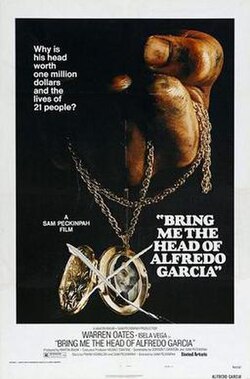
Bring Me the Head of Alfredo Garcia-1974

Bring Me the Head of Alfredo Garcia-1974

Director Sam Peckinpah

Starring Warren Oates, Isela Vega

Scott’s Review #222

Reviewed February 20, 2015

Grade: B+

Bring Me the Head of Alfredo Garcia is a 1974 Mexican cult action film directed by Sam Peckinpah that influenced famed modern movie director Quentin Tarantino in multiple ways.

The film itself is violent, bloody, and traditionally Peckinpah in tone and look, similar to his other films (Straw Dogs from 1971 and The Wild Bunch from 1967).

The premise of the film is intriguing- a powerful man known simply as “The Boss” turns furious and places a bounty on the head of the man who impregnated his daughter, whom he, by the way, tortures to garner this information out of.

He offers the enormous sum of 1 million dollars to the person who can “bring him the head of Alfredo Garcia”.

From this point, the action centers mostly on Bennie, a retired military officer intrigued by the bounty on offer.

Bennie, along with his prostitute girlfriend, Elita, traverses the lands of Mexico in search of Alfredo Garcia, whether he is already dead or still alive, which is a mysterious and fun element of the film.

I have a tough time taking the film too seriously as much as I enjoyed it- it seems an action farce and, without giving too much away, the scenes involving the carrying of a severed head, arguably the lead character, are as much comical as ghastly.

The illustrious lighting is a major focal point, especially during the outdoor scenes and specifically the nighttime desert scenes, when two bikers almost rape Elita. The moonlight radiates onscreen.

Elita’s character is a fascinating to me. On the one hand, she is an aging prostitute madly in love with Bennie and intrigued by a life with him, living off their spoils. However, she almost enjoys the sexual experience with one of the bikers, played wonderfully by Kris Kristofferson, despite being roughed up by him.

The scene, while certainly violent, is, in a way, almost tender as the biker and Elita realize their attraction for one another. It’s a surreal scene and has almost a sense of clarity for both characters. Are they in lust?

Peckinpah women are traditionally not treated well, but Elita is an exception.

The Tarantino influence is undeniable- the mixture of humor amid violence- a severed head being treated as a comical prop, is immeasurable in comparison to later Tarantino films such as the Kill Bill chapters.

Daring and pure genius, the film has a dark tone but does not take itself too seriously, avoiding melodrama or overwroughtness.

It is only a film and has fun with that fact. It tries to be nothing more and embraces being bizarre.

Tarantino films are like Peckinpah films, just made 20-30 years apart.

Bring Me the Head of Alfredo Garcia has evolved into a cult classic after flopping commercially and critically in 1974.

How wonderful when a gem is rediscovered and laden with influence, in this case as much stylistically as otherwise.