Category Archives: John LaZar

Supervixens-1975

Supervixens-1975

Director Russ Meyer

Starring Shari Eubank, Charles Napier

Top 250 Films #62

Scott’s Review #361
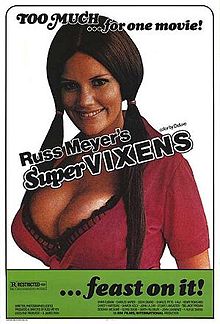
220px-Supervixensposter

Reviewed January 9, 2016

Grade: A

I first watched Supervixens in 2008, and, if I am being sincere, I did not much care for it, or rather, I was very perplexed by it. I did not know what I had just viewed and was caught off guard and blown away- I have since realized that this is part of my love for the film.

Is it a comedy? Is it too over-the-top and shameless? Is it trying to degrade women? Now, a mere eight years later, it lands firmly ensconced on my Top 100 Films list, and it is similar to a fine wine- it just gets better and better with age.

Never before did I think I would fall in love with a sexploitation film, but I have.

Directed by Russ Meyer, noted for his series of 1970s sexploitation films, Supervixens is set somewhere in the desert of eastern California.

Gas station attendant, Clint Ramsey, a handsome young man, is found irresistible to a series of sexy and large-breasted women, all with names beginning with “Super”.

We are introduced to his steady girlfriend, SuperAngel, a bored, horny, feisty woman played by Shari Eubank. Jealous and possessive, she commands Clint to leave his job and come home to her immediately, which leads to hilarity as they spar outside utilizing an ax as they wrestle and fight.

Their nosy neighbor looks on, both tantalized and frightened.

Others who make appearances during Clint’s journeys are SuperLorna, a horny gas station customer (strangely appearing in only one scene, but gracing the film cover packaging), who sets her sights on Clint much to SuperAngel’s chagrin.

SuperCherry is a buxom girl who picks up Clint hitchhiking, SuperSoul, an Austrian farmer’s wife, seduces Clint at the farm, SuperHaji, a bartender at the local watering hole, and finally, SuperEula, who is black, deaf, and with a white father.

Supervixens, as well as some of Russ Meyer’s films, have influenced countless other famous films to come, and I continue to note the overall influence Supervixens has had on Quentin Tarantino, specifically.

With the bloody violence mixed with cartoonish characters, as well as Nazi references (a frequent theme of Tarantino’s) and German marching music, Supervixens has a sly sense of humor- wicked almost, but never apologetic.

Tarantino uses a similarly outrageous style.

Carrie (SuperVixen bloody in the tub), The Shining (Harry breaking down the bathroom door amid a screaming SuperVixen), Friday the 13th- Part 3 (the camera angle at the top of the hayloft panning down on the approaching climber) are just a few film comparisons that I have noticed during repeated viewings.

My love of the film is its outrageousness and I find the film to be empowering to women most of all and not degrading. There is also male nudity and reference to the male anatomy numerous times so it is not a one-sided exploitation film.

Each female is a superhero, of sorts, and despite the sexploitation aspect, the film is quite romantic in spots- the tenderness between Clint and SuperEula is one of my favorites.

I also love the romance between Clint and SuperVixen (a dual role for Eubanks), as she is a reincarnation of SuperAngel. Working side by side at a roadside gas station that she owns, they pump gas and prepare burgers together, while running through the desert in a happy, lovely way.

Of course, their romance is threatened by the sinister Harry, who has returned for revenge.

Hilarious, outrageous, and in-your-face sexual, Supervixens (1975) is a camp classic that is so much more than that. Influential and creative, it simply must be seen to be believed.

I hope it is never forgotten.
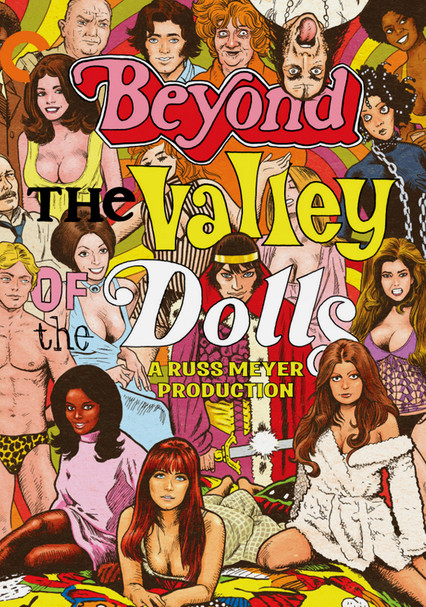
Beyond the Valley of the Dolls-1970

Beyond the Valley of the Dolls-1970

Director Russ Meyer

Starring Dolly Martin, Cynthia Myers

Scott’s Review #976

Reviewed January 2, 2020

Grade: B+

Beyond the Valley of the Dolls (1970) was initially intended as a sequel to the 1967 film Valley of the Dolls but was revised as a parody of the commercially successful but critically panned original.

This was not altogether a smart move, since it would have been interesting to see a coherent follow-up exploring the lives of the original characters, rather than a similarly named film with little to do with the first.

Instead, the film plays like frenetic mayhem, with jarring editing, a peculiar character switch and storyline, and completely over-the-top vulgarity. Still, the film is fun and extravagant, but hardly on par with Valley of the Dolls.

I would not even recommend watching them in sequence- the confusion would only be doubled.

To call Valley of the Dolls a “serious” film is laughable, but compared to Beyond the Valley of the Dolls, it is.

Director Russ Meyer is known for successful sexploitation films that feature campy humor, satire, and large-breasted women, such as Faster, Pussycat! Kill! Kill! (1965) and Supervixens (1975) are at the helm to create the bombastic and eye-dropping shenanigans.

Famous film critic Roger Ebert co-wrote the screenplay along with Meyer.

Three young women, MacNamara (Dolly Martin), Casey Anderson (Cynthia Myers), and “Pet” Danforth (Marcia McBroom), front a struggling rock band, The Kelly Affair, managed by Harris Allsworth (David Gurian), Kelly’s boyfriend.

The four travel to Los Angeles to seek Kelly’s estranged aunt, Susan Lake, an heiress to a family fortune. Fans of Valley of the Dolls will need to know that Susan is supposed to be Anne Welles, the film’s central character.

A battle ensues as Susan graciously offers to give some of her fortunes to Kelly, but Susan’s unsavory financial adviser, Porter Hall (Duncan McLeod) will have none of it. Amid the drama, Kelly meets a gigolo who feuds with Harris, while Harris is pursued by a sexually aggressive porn star named Ashley St. Ives (Edy Williams).

Events all take place against the backdrop of the nightly Los Angeles party.

While the plot is not the central aspect of Beyond the Valley of the Dolls, the renaming of Susan from Anne, the same character, and the recasting of Barbara Parkins as Phyllis Davis make things confusing.

Adding to this point, Parkins was initially cast as Anne/Susan but was abruptly fired from the production. This makes any comparisons to Valley of the Dolls other than the title alone, unwise and a waste of time.

The lively revelry is the fun and the beauty of Beyond the Valley of the Dolls.

The film has a calm, groovy vibe and epitomizes the late 1960s psychedelic, colorful aura. The free love and expressionism make the experience a wild yet liberal-minded one, which is suitable for a film like this.

The intention is to entertain and to express women’s confidence. While the female characters are exploited, they are also driven and comfortable in their own skin.

A fun fact, and cause for musing, is that as wild and exploitative to women (and men) as Beyond the Valley of the Dolls is, Ebert was primarily responsible for penning the script.

In the 1980s, the critic, whom I am a cherished fan of, panned many of the 1980s horror/slasher flicks, especially Friday the 13th (1980), for exploiting women, but he had no issue exploiting them years earlier.

Makes one ponder the hypocrisy of his comments.

Beyond the Valley of the Dolls (1970) is daring and never plays it safe. With a hip edge and plenty ahead of its time in same-sex character representation, the film is unique and brimming with hilarious, bizarre antics.

The plot is rather silly and goofy, and unsurprisingly panned by critics, but it has become a cult classic, and with repeated viewings, it has grown on me more and more.

The production is meant to be watched late at night for better appreciation.