Tag Archives: Charles Gray

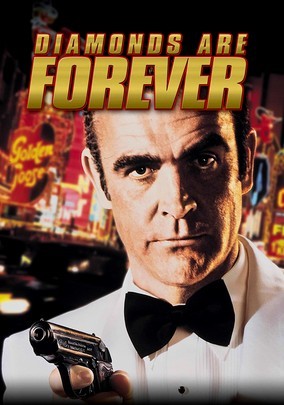
Diamonds Are Forever-1971

Diamonds Are Forever-1971

Director Guy Hamilton

Starring Sean Connery, Jill St. John

Top 250 Films #100

Scott’s Review #328

60000705

Reviewed January 6, 2016

Grade: A

Despite Diamonds Are Forever (1971) being one of the lower-rated James Bond films, this is actually one of my favorite films of all time, and many would disagree with me.

Some say Sean Connery phoned this performance in; others say there was little chemistry between him and Jill St. John, and the sets were tense, leading to a sub-par offering. But I think this is a great film.

I love the Las Vegas locale, the bright lights, flashy costumes, and a ritzy underbelly- and the Vegas car chase is incredible.

A bright, shiny Ford Mustang takes center stage throughout the sequence, and if one looks closely, one will realize that nearly all the cars are Ford- fun fact!

The title song by Shirley Bassey is great, sultry and stylish, only enhanced by the glitzy setting. One immediately imagines the film oozing with diamonds as it does.

The villains are fascinating, and Mr. Wint and Mr. Kidd were the first openly gay Bond villains, which, in 1971, was groundbreaking.

Yes, they are evil and slightly silly, but what a risky, surprising, and blatant scene to see the gentlemen holding hands.

St. John is a sophisticated and intelligent Bond girl, and the action in this film is plenty.

Diamonds Are Forever (1971) contains all the elements for an enjoyable Bond experience.

Oscar Nominations: Best Sound

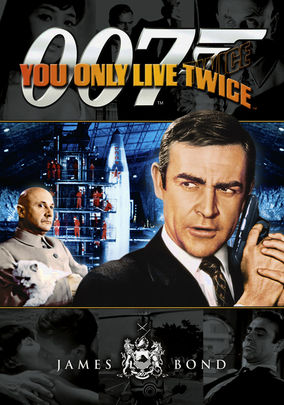
You Only Live Twice-1967

You Only Live Twice-1967

Director Lewis Gilbert

Starring Sean Connery, Akiko Wakabayashi

Scott’s Review #636

Reviewed April 23, 2017

Grade: B+

You Only Live Twice (1967) is the fifth in the James Bond film franchise and the fifth to star iconic Bond, Sean Connery, in the lead role.

Reportedly growing bored with the role and eager to move on to meatier acting challenges, Sean Connery is not quite as mesmerizing in the role this time around, but is still indisputably charismatic and sexy with his delivery of one-liners and various affairs with women.

You Only Live Twice is the last to feature Connery until he is coaxed back into the role four years later with 1971’s Diamonds Are Forever.

The film is not among my favorite Bond films of all time, nor is it even in the top ten, for that matter, but it is still quite an enjoyable watch, and the Japanese locales are undoubtedly the highlight.

The film as a whole suffers from a silly story, dated special effects, and a completely lackluster villain, but it does have Connery to rescue it and a nice little romance between Bond and the main girl, Aki, played by Japanese actress Akiko Wakabayashi- that is, until she is unceremoniously poisoned.

The plot involves the hijacking of an American NASA spacecraft by another mysterious spacecraft. The Americans suspect the Russians of the action, and the British suspect the Japanese since the aircraft landed in the Sea of Japan.

MI6 (Bond) fakes his death in Hong Kong and subsequently begins to investigate who is responsible. His search brings him to Tokyo, where he investigates Osato Chemicals and stumbles upon evidence.

He is aided by both Aki and Tiger Tanaka, leaders of the Japanese Secret Service. Soon, it is revealed that the mastermind is SPECTRE villain Ernst Stavro Blofeld, in this installment played by Donald Pleasence.

Mr. Bond must destroy his enemy and inevitably save the world from a global nuclear war.

Though a timely storyline since 1967 was in the midst of the Cold War, the plot seems somewhat forced and a bit uninteresting. The countries blame each other for the hijacked ship, but this comes across as extremely plot-driven and secondary.

The “swallowing” of the aircraft seems cheesy and preposterous, even given the year the film was made, and the writing is not as rich as in some of the preceding Bond films, like From Russia With Love or Thunderball.

The film also has an overall “cheap” look. However, the film does have plenty of positives worth mentioning.

The gadgets that James Bond fixture, Q (the MI6 technical wizard) creates are state-of-the-art and fun. The mini-flying helicopter Bond uses is creative and offers even more views.

Bond faking his death in the opening sequence is a treat (albeit having been done before), and ceremoniously being cast off into the sea in a coffin, only to be wearing a suit and an oxygen mask inside the casket, is clever and light.

Donald Pleasence, a storied, fantastic actor, is not well cast as the main villain, Stavros, and I am not entirely sure why. The fact that his face is not shown until the last act is not helpful, and the character (though seen in other Bond films) is not compelling and is underutilized.

I would have liked the character to be a bit more visible, though surprisingly, the character was highly influential in the 1990s spoof Austin Powers films. Adorable yet creepy is Stavros, only being seen clutching and stroking a gorgeous white cat.

As for the Bond women, the Aki mentioned above is the best of the bunch. Gone too soon in the story, she is replaced by Kissy Suzuki, who is rather unappealing. Mostly clad in a skimpy white bikini and heels, and wearing a black wig, the character is forgettable and serves no purpose.

Conversely, villainous Helga Brandt, SPECTRE assassin, is very well cast and shares good chemistry with Connery. After an unsuccessful attempt to kill Bond, she is fated with a date with killer Piranhas as payment for her failure.

You Only Live Twice (1967) has a myriad of ups and downs, but it is worth watching for fans of the franchise, and specifically, fans of the classic Bond films featuring Sean Connery.

Some will argue that the film feels dated and chauvinistic, and to some degree, they are correct, but it is also a large part of a treasured franchise and a fun experience.
Theatre of Blood-1973

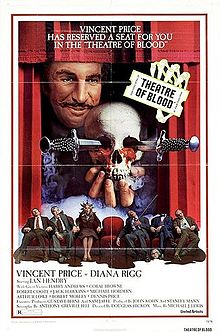
Theatre of Blood-1973

Director Douglas Hickox

Starring Vincent Price, Diana Rigg

Scott’s Review #230

220px-Theatreofbloodposter

Reviewed March 23, 2015

Grade: B

Theatre of Blood (1973) stars Vincent Price, a long-time fixture in the classic/campy horror scene, as a demented Shakespearean theatre actor who enacts revenge on the critics who fail to recognize him with a coveted award that he cherishes.

Price, as always frighteningly good, delivers a campy, but not ridiculous, turn as the crazed actor.

Price’s appearance alone- tall, wiry, with sinister facial expressions, poises him perfectly to believability in any dastardly role he portrayed in his heyday and the performance he gives as Edward Lionheart is no exception.

Not solely a campy, melodramatic horror film, Theatre of Blood rises above that categorization with humorous tributes to Shakespeare and a unique chronicle of the Shakespearean works used to systematically off the critics one by one about the Shakespearean story- quite frankly in a comical and witty way.

Price eerily dresses in many different elaborate costumes to commit the murders- a wine-tasting expert, and a television host, among other interesting characters, and oftentimes, taunts his victims before permanently dispensing them.

The film is quite British in tone and humor and done in a tongue-in-cheek manner so that the murders are not to be taken at all too seriously.

The critics themselves- seven or eight of them- are deliciously fun. One is a loud boisterous fat man who always has his beloved poodles at his side.

What happens to him and the dogs is better left unsaid.

Another is an uptight, sophisticated woman (played by Price’s real-life wife Coral Browne). Several of the critics are created as comic villains so their demises are not all too devastating for the audience as they are rather unlikeable characters, to begin with.

I found myself rooting for Lionheart and looking forward to the next murder!

One criticism involves Diana Rigg, who plays Price’s daughter Edwina, accomplice to his dirty deeds. Well known for her starring role in On Her Majesty’s Secret Service and the 1960s Avengers series, Rigg has little substance to do in Theatre of Blood.

Perhaps by 1973, her film career was on the downturn and she was not winning the coveted roles any longer. I would have loved to see her sink her teeth into a meatier role.

A side-kick, Edwina could have done much more.

The film belongs to Price and the unique storytelling of Shakespearean works made only possible by this great actor.

Not overly serious and played for some laughs, Theatre of Blood (1973) is successful in its telling of an interesting British horror story.

It’s a nice late-night treat for fans of the British horror genre especially.