Category Archives: Priscilla Pointer

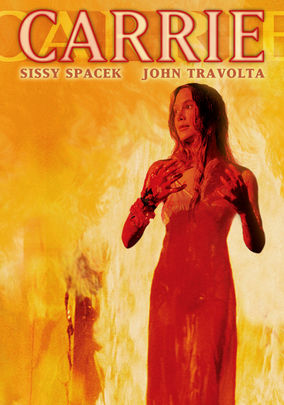
Carrie-1976

Carrie-1976

Director Brian De Palma

Starring Sissy Spacek, Piper Laurie

Top 250 Films #63

Top 40 Horror Films #14

Scott’s Review #325
352989

Reviewed January 5, 2016

Grade: A

Carrie is a 1976 horror film adapted from Stephen King’s novel of the same name.

Many King adaptations have failed, but Carrie (along with The Shining) is among the best.

Going beyond the scope of horror and receiving more than one major Oscar nomination (largely unheard of in horror), Carrie influenced films and filmmakers for decades beyond its release.

This is due mainly to the dream-like and breathtaking direction of mood master Brian De Palma.

By this time (2016), the film and the character of Carrie White were legendary.

Carrie (Sissy Spacek) is a lonely suburban teenager, ostracized by her classmates for being “weird”. Her mother (Piper Laurie) is a devout Christian who spreads the word of god amongst the neighbors.

Carrie has a special ability to move things, usually during anger- this is called telekinesis.

After a humiliating incident in the girl’s locker room when Carrie begins menstruating, one of the nicer girls in the class, Sue Snell (Amy Irving) feels sorry for Carrie and convinces her boyfriend, Tommy Ross, to take Carrie to the prom.

When others in the class take revenge upon Carrie with a sick joke, things take a horrific turn.

Betty Buckley as the empathetic gym teacher, Miss Collins, and John Travolta and Nancy Allen, as dastardly Billy and Chris, also star and are perfectly cast.

The direction in the film is second to none. De Palma adds interesting camera work throughout the film.

During a tender, lovely prom dance between Carrie and Tommy, the camera circles the pair repeatedly, giving a spellbinding, but not dizzying quality.

The use of slow-motion in the important “pig blood” scene is immeasurably effective.

The seemingly eternal time it takes for the blood spilling to occur, and the camera (in slow motion) goes from Sue to Miss Collins to Chris to the bucket of blood is fantastic.

The list of inspired and intense scenes goes on and on- from the climactic scene between Carrie and Mrs. White to the “jump out of your seat” final scene.

The acting is also worthy of high praise. Spacek and Laurie deservedly received Oscar nominations for their work. Spacek elicits so much rooting value into her role with a shred of psychosis bubbling just beneath the surface.

Carrie wants to fit in and have a happy life so the audience is immersed in her corner and celebrates her short-lived happiness with Tommy at the prom. Spacek is just perfectly cast.

Laurie on the other hand exudes crazy in every sense, but we do feel pangs of sympathy for her. We largely believe she cares for her daughter and wants to protect her from the dangerous world.

Carrie (1976) is a masterpiece that continues to hold up well and influence generations who can relate to school bullying,  taunting, and the desire to see the nasty popular kids get their just desserts.

More than a great horror film, it is a revered classic with a dreamy, moody vibe.

One of my all-time favorites.

Oscar Nominations: Best Actress-Sissy Spacek, Best Supporting Actress-Piper Laurie

Blue Velvet-1986

Blue Velvet-1986

Director David Lynch

Starring Kyle MacLachlan, Laura Dern

Top 250 Films #65

Scott’s Review #343

319022

Reviewed January 9, 2016

Grade: A

Taken from a 1963 Bobby Vinton tune of the same name, Blue Velvet (1986) is an independent thriller noir film directed by the master of the weird and the unusual, David Lynch.

It is surreal in look and so mysterious- almost a pre-cursor to Lynch’s fantastic television series, Twin Peaks. I adore the film and find new facets to it with each passing viewing.

Though it’s not an easy or mainstream watch- the payoff can be big and you know you are watching a deep, layered, film.

The story can be tough to completely understand with only one show, but it goes something like this- Under the guise of a cheerful, suburban surface, evil is lurking somewhere. College student, Jeffrey (MacLachlan) discovers a severed human ear lying in an abandoned lot delivers it to police detective John Williams, and reconnects with the detective’s daughter, Sandy (Dern).

Sandy, being privy to secret information about the case, reveals that a mysterious woman, Dorothy Valens (Isabella Rossellini) resides in an apartment key to the case. Jeffrey and Sandy decide to investigate further and get themselves in over their heads as the mystery deepens.

The dreamlike quality of the film is very compelling and intriguing. Layers upon layers come to the forefront as the story unfolds and very few answers are ever provided- this adds to the mystery and is really the point of the film.

Many aspects are open to interpretation.

The relationship between Jeffrey and the much older Dorothy is fascinating, but what about his chemistry with the innocent Sandy? And who is the Yellowman? When the youngsters see Dorothy perform “Blue Velvet” at her nightclub, it is a great moment in the film.

The character of Frank Booth, played by Dennis Hopper, must be one of the strangest in film history as the man is maniacal and bizarre beyond measure. With his unusual sexual tastes- he enjoys inhaling gas, and sadomasochism, he is a unique character. He is also quite abusive to Dorothy.

The film is a throwback to classic film noir from the 1950s and a clear femme fatale in Dorothy is central to the film.

I find the film so compelling since its subject matter is secrets. Many secrets and dark corruption or various forms of left-of-center dealings reside in this small North Carolina town- it is the audience’s challenge to put all the pieces of this puzzle together.

Oscar Nominations: Best Director-David Lynch

Independent Spirit Award Nominations: 1 win-Best Feature, Best Director-David Lynch, Best Male Lead-Dennis Hopper, Best Female Lead-Isabella Rossellini (won), Laura Dern, Best Screenplay, Best Cinematography

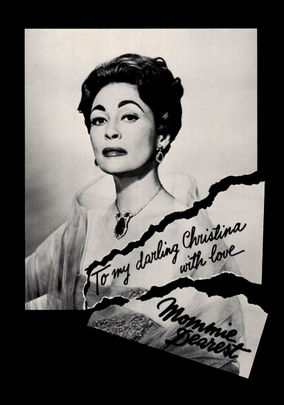
Mommie Dearest-1981

Mommie Dearest-1981

Director Frank Perry

Starring Faye Dunaway

Top 250 Films #154

Scott’s Review #195

60020629

Reviewed November 20, 2014

Grade: A

Camp, camp, camp!

By this point in film history, Mommie Dearest and this description go hand in hand, but when made in 1981, it was meant to be a much more serious film than it turned out to be.

Sadly, due to a few very over-the-top lines, it is forever inducted into the halls of cult classic memory.

Based on the scandalous tell-all book written by Christina Crawford (Joan’s adopted daughter), Mommie Dearest tells the story of Joan Crawford, a Hollywood screen legend, from her heyday in the 1930s, until she died in 1977, and mostly focuses on the tumultuous relationship with Christina- played as an adult by Diana Scarwid.

Convinced a baby was missing from her life and unable to conceive after several miscarriages with a former flame, Crawford’s beau at the time, an attorney, wrangles a way for her to adopt both Christina and later, Christopher Crawford.

Dealing with her mother’s demands and abuse, Christina goes from a happy little girl to a rebellious teen sent to live in a convent and later struggling to find her way as an actress in New York City with no financial support from Mom.

The film also wonderfully describes the career of Crawford- from highs (winning the Academy Award for Mildred Pierce) to lows (being cut from MGM and reduced to screen tests). The film also recounts Joan Crawford’s continuing battles with booze and neuroses.

From start to finish the film belongs to Dunaway as she simply becomes Crawford- the eyelashes, the mannerisms, every detail is spot on.

Unfortunately for Dunaway, due to the unintentional comedic view of this film, she was robbed of an Oscar nomination, shamefully so. The film was awarded several Razzies- a derogatory honor given to the year’s worst films. Dunaway must have put her heart and soul into this performance.

During the infamous wire hanger scene, Dunaway looks frightening as her face, caked with cold cream, reveals a grotesque mask- reminiscent of Batman character The Joker- as she shrieks at her daughter in the middle of the night, during a drunken tirade, after finding beautiful clothes on wire hangers.

She then trashes her daughter’s bathroom insisting it is already filthy.

One will shriek with gales of laughter as Crawford berates her maid Helga for not scrubbing beneath a potted plant, only to insist, “I’m not mad at you Helga, I’m mad at the dirt”.

In another haunting scene, Joan throws a birthday party for Christina complete with a merry-go-round, balloons, presents, and the paparazzi. Joan’s attire is a little girl dress matching young Christina’s- a morbid foreshadowing of the competition that is to exist between them as the years go by.

The secondary characters are merely an extension of Dunaway’s character and do their best to support her- her harried live-in assistant, Carol Ann, played by Rutanya Alda, both of her love interests, lawyer, Greg Savitt, played by Steve Forrest, and later, Pepsi-Cola mogul Alfred Steele, played by Harry Goz.

The actors do their best with the material given and are neither exceptional nor flawed. None of these supporting characters have any backstory other than to react to Crawford’s drama and, if written better, may have given the film a bit more depth.

The look of the film is pleasing- Crawford’s house is beautifully decorated with lavish furniture and the colors throughout the film are both bright and vivid. The now-legendary lines of “No wire hangers ever!”, “Christina! Bring me the ax!”, and “Don’t fuck with me fellas, this ain’t my first time at the rodeo” are hysterical in their melodrama and effect.

Crawford is portrayed as an obsessive-compulsive, demanding, control freak. One may debate the authenticity of the claims Christina made against Joan Crawford until the end of time.

Not the masterpiece it was intended to be, Mommie Dearest (1981) can be enjoyed viewing after viewing for some campy silliness, with one hell of a great performance by Dunaway mixed in.

Looking for Mr. Goodbar-1977

Looking for Mr. Goodbar-1977

Director Richard Brooks

Starring Diane Keaton, Tuesday Weld, Richard Gere

Scott’s Review #1,485

Reviewed July 25, 2025

Grade: A-

Diane Keaton won the Academy Award for Best Actress in 1977 for Annie Hall, an excellent film by Woody Allen, but as has happened in Oscar history, she won for the wrong role.

She delivers her best acting performance of her distinguished career in Looking for Mr. Goodbar (1977), a raw crime drama in which she plays Theresa, a liberated and carefree young schoolteacher living in a metropolitan area.

The film, directed by Richard Brooks (Cat on a Hot Tin Roof, 1967, and In Cold Blood, 1968), is based on Judith Rossner’s 1975 best-selling novel. The setting is inexplicably changed from New York City to San Francisco, but it feels exactly like the troubled urban metropolis during its late 1970s crime-ridden period.

I nearly felt as if Theresa’s dingy, windowless apartment was a character in itself.

The musical soundtrack is a significant win, featuring disco anthems from the time, such as ‘Don’t Leave Me This Way’ by Thelma Houston and ‘Love Hangover’ by Diana Ross.

Film lovers familiar with Taxi Driver (1976) and Cruising (1980) (both set in New York City) will notice similarities and draw parallels.

Theresa (Diane Keaton) teaches deaf children during the day and cruises singles bars and discos at night. Despite being raised a devout catholic ‘good girl’, she favors quick nights of passion with random suitors, ignoring the advances of well-meaning but nerdy social worker James (William Atherton).

She pursues the likes of Tony (Richard Gere), whose threatening knife and swagger excite her. As the film progresses, Theresa becomes increasingly entangled in perilous encounters, putting her life in danger.

Despite a jarring shift in story direction towards the end of the film and the geographical change, I found more than enough to merit a superior rating, especially Keaton’s performance.

Keaton flawlessly carries the film as an unapologetic, progressive character. She lives life, enjoys life, and sees nothing wrong with her chosen lifestyle. Keaton is fearless, delivering a likable character we probably shouldn’t like.

She can be cutting, self-centered, and moody, but takes sheer delight in teaching deaf kids who have problems at home, almost fostering them as her own.

Richard Kiley and Priscilla Pointer play Theresa’s parents in rather one-note performances. They are devout Irish Catholics, but too much time is spent showcasing their traditional values.

Theresa’s sister, Katherine, played by Tuesday Weld, is more like Theresa but more needy, and clinging to any man she meets. The sisters are close, even living in the same building, and constantly have each other’s backs.

Looking for Mr. Goodbar perfectly depicts life in an inner city in the mid-1970s: booze, sex, parties, and drugs.

Rinse and repeat.

The male characters that Theresa interacts with are of different types. Her first fling is with her married professor, whom she fantasizes about living with. When this doesn’t work out, she has urges for more dangerous experiences.

Tony (Gere) is sexy, unreliable, and dangerous, and Theresa is titillated. It’s with him when she teeters over the brink.

The film transitions from a sexual thriller into a deadly final sequence, leaving my mouth hanging open with surprise. The ending will leave audiences on the edge of their seats and may not please those seeking a happily-ever-after story.

Is the audience supposed to learn a lesson? Does Theresa get what she deserves? How dare she live her life as she sees fit? These are questions easily worthy of further discussion.

The introduction of Gary (Tom Berenger), a tortured gay man Theresa meets in a bar, comes so late in the film that there is barely time to get to know the character. But, he doesn’t put the LGBTQ+ community in such a positive light.

Still, the gay men who yearn to be straight cannot be dismissed since this was commonplace when the story was created.

With a spot-on atmosphere filled with juicy late 1970s coolness and danger, and a brilliant starring turn by Diane Keaton, Looking for Mr. Goodbar (1977) has more than enough to warrant a watch and a follow-up chat.

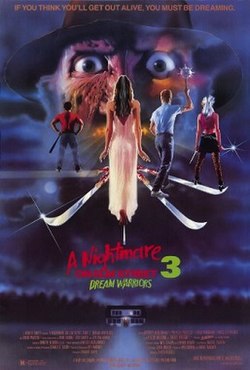
A Nightmare on Elm Street 3: Dream Warriors-1987

A Nightmare on Elm Street 3: Dream Warriors-1987

Director Chuck Russell

Starring Patricia Arquette, Heather Langenkamp, Robert Englund

Scott’s Review #1,028

Reviewed May 29, 2020

Grade: B+

A Nightmare on Elm Street 3: Dream Warriors (1987) is a credible effort to take the, at this point, tired slasher genre in a new direction, using style and special effects to its advantage.

The film is not a work of art and does not stray too far from the norm to risk losing the target audience, but the experiment works, providing the film with a fresh feel.

Thankfully, Freddy Krueger (Robert Englund) is in tow providing wit and humor and rich character history rarely seen in horror.

One year following the events of the previous chapter, Kristen Parker (Patricia Arquette) awakens following a nightmare of being chased by Freddy Krueger, to find him in her bathroom where she is attacked again.

Her mother believes that she is suicidal and sends her to Westin Hills Psychiatric Hospital, where Kristen is placed under the care of Dr. Neil Gordon (Craig Wasson).

The rest of the events of the film mainly take place in this setting. A new intern therapist, Nancy, (Heather Langenkamp) takes an interest in Kristen’s case.

In two clever plot twists, one a bit too coincidental, Nancy reveals to the remaining patients that they are the “last of the Elm Street kids”, the surviving children of the people who banded together and burned Krueger to death many years ago.

The second is more intriguing as a nun named Sister Mary Helena (Nan Martin) provides the history of Freddy’s mother, Amanda Krueger, who turns out to be the same.

This humanizes Freddy a bit and provides layers to his story rather than just another “slice ’em and dice ’em” horror film.

The film has a way of gathering curiosity and delivering the goods with dreams hypnosis and mental synapses, as the kids realize they have dream powers that culminate in a group adventure.

Perfect for the mental hospital setting.

The junkyard sequence that provides the climax with so much muscle is splendid adding creative and colorful bits of junk, littering the entire set with rusty tin trinkets and other nooks and crannies to marvel at.

A feast for the eyes and a perfect backdrop for evil and killings. The set design works tremendously well in this film.

The familiar character Nancy played once again by Langenkamp (the main girl from the first Nightmare) is a nice touch of recognition that will please fans immensely. A returning favorite in a horror franchise is always a smart move.

The casting of esteemed character actress Nan Martin, who can frighten the pants off anyone if given a good part, is a divine decision. The actress even resembles legendary actress Betsy Palmer (familiar to Friday the 13th fans as the dreadful Mrs. Voorhees).

The creepy mommy theme so often works well in horror films and this inclusion is no exception.

The theme song to A Nightmare on Elm Street 3: Dream Warriors is a pop-metal treat written and performed by the heavy metal band Dokken.

This inclusion assuredly brought the teenage girls and the mullet crowd alike to movie theaters across America. The song is catchy and can easily be head-banged as the end credits roll across the screen.

Even more impressive is that the lyrics make sense from a story perspective since dreams are a huge part of the franchise and this specific installment.

Nearly rivaling the original A Nightmare on Elm Street (1984) in originality and plot, A Nightmare on Elm Street 3: Dream Warrior (1987) does a fantastic job bringing energy to a fading genre, one not to be rejuvenated for another nine years when Scream (1996) debuted.

Engaging and brightly lit razzle-dazzle visual sets within dreams are pulse-racing and creative, while a mother story crafts fresh air. This film is the sequel high-point to a series of duds soon to follow.