Category Archives: Chuck Russell

Hell Night-1981

Hell Night-1981

Starring Linda Blair, Peter Barton, Vincent Van Patten

Director Tom DeSimone

Scott’s Review #1,476

Reviewed April 6, 2025

Grade: B

Hell Night (1981) is a slasher/horror film that provides fun late-night entertainment. A creepy, deserted estate where a mass murder event happened amid a night of fraternity hazing offers the appropriate setting for a night of horror.

When four college pledges led by Marti (Linda Blair) are tasked with staying overnight after a costume party as a test of loyalty, what could go wrong?

Director Tom DeSimone knows what ingredients to pepper his film with for the most compelling and effectual result, essentially borrowing from other films. A dark, overnight, attempted pranks, ghosts, screams, good-looking young people, and lots of booze and drug paraphernalia.

He incorporates the standard slasher backstory of a year-old event and a vicious killer still on the loose. This gimmick resembles Friday the 13th (1980) or Halloween (1978).

Folklore tells us that Garth Manor is an abandoned mansion once owned by Raymond Garth, who murdered his wife and three deformed children, Morris, Margaret, and Suzanne.

Garth then hanged himself. While he had a fourth deformed child, Andrew, his body was never found, nor was the body of Morris.

Folklore states that Morris and Andrew still lurk within the mansion, hungrily waiting for prey.

This immediately makes the pledges frightened and happy to get through the six-hour overnight alive. It also builds interest for the audience.

What makes Hell Night particularly unique is its subplot involving social classes. Marti is an intelligent girl from a blue-collar/working-class family who is obviously attending university on a scholarship. At the same time, her love interest, Jeff (Peter Barton), comes from an affluent family.

This makes the audience invest in these characters as they bond with each other. We root for them to find some romance before they are potentially chopped to bits by a maniac.

The other central characters are Denise (Suki Goodwin), a promiscuous party girl from England, and Seth (Vincent Van Patten), a surfer from Southern California. These characters are the film’s comic relief and, indeed, the ones that will ‘get it’.

Van Patten is nice to look at as he frequently parades shirtless, while Denise often forgets his name.

Other stock characters are Peter, May, and Scott, who are responsible for ensuring the pledges don’t escape from the manor and scaring the wits out of them.

Naturally, the fun for the audience lies in knowing that most of the characters will be unceremoniously offed one by one, except for Marti, the film’s hero.

With pleasure, there is a decapitation, a body strung up on the roof, and a horrid scene where a character is hurled out the window.

Reminiscent of Black Christmas (1974), a film that heavily influenced 1980s slasher films, the police are ineffectual and dizzy, believing the pledges’ pleas for help are only part of a fraternity prank and nothing to investigate.

A macabre and terrific scene in which one of the pledges is arranged at a dining room table with the decaying corpses of the Garth family reminds me of Happy Birthday to Me (1981) or The Texas Chain Saw Massacre (1974).

Blair is effective as the ‘final girl’ because she’s smart, sensible, and relatable. With a girl-next-door veneer, she is easy to root for to conquer the fiendish killer (s).

I wanted more explanation of the killers’ motivations. Yes, they were assumed to be abused and mistreated, but why kill helpless college kids? I guess they’d kill anyone who entered the estate, but how would they survive and get food?

There’s also no nudity (male or female) or excessive blood, which gives a softer, tamer feel.

Borrowing heavily from other genre films, Hell Night (1981) is a worthy entry in the slasher genre, mostly because it incorporates an intelligent ‘final girl’ and a bit about social class.


Back to School-1986

Back to School-1986

Director Alan Metter

Starring Rodney Dangerfield, Sally Kellerman

Scott’s Review #1,089

Reviewed December 7, 2020

Grade: B

Back to School (1986) is a formulaic, mid-1980s comedy featuring obnoxiously loud funnyman, Rodney Dangerfield, the comedian you may love to hate.

On paper, this film might have been a train wreck, but some proper pacing and good casting save it from being classified as a drivel. Let’s be clear- it’s not great filmmaking, but it serves a purpose- to amuse and delight.

A vehicle for Dangerfield with a character mirroring his real personality, the film works. With a brisk one hour and thirty-six minutes, the film sticks to the script, not wasting time getting its point across, nor pretending to be some serious film with a clever message.

No, there is little special or inventive about the film, but it’s light, entertaining fun.

The premise, a middle-aged man who returns to college and tries to persevere, is a setup rife with standard situations and comedic moments.

Director Alan Metter, known for gag films, one of his most notable, and the big studio Orion, takes full advantage of the task at hand. They provide a mainstream summer popcorn-flick approach.

Presumably, the story was conjured up by a group tasked with crafting an appropriate story for Dangerfield, and they succeeded.

The film delivers what it sets out to.

This might be a nice, nostalgic watch for parents and soon-to-be college-bound kids to watch together.

Thornton Melon (Dangerfield) is a wealthy corporate tycoon who wants his son, Jason (Keith Gordon), to get the college education that Thornton was unable to receive.

While enrolled in college, Jason is unhappy and ready to quit. Thornton decides to enroll in the same college, determined to achieve his respect.

Jason tries to fit in with his peers, while Thornton falls in love with his literature professor, the sophisticated Dr. Diane Turner (Sally Kellerman), and feuds with the college dean, David Martin (Ned Beatty).

Predictably, Thornton is hardly the college type, so he pays others to write his papers for him, which is all the fuel that the dean needs to ruin him.

He also attends parties and raucous events, preferring these to study groups. Thornton is eventually found out and forced to pass an exam to prove himself.

A more straight-ahead approach would have been to make Thornton an unsuccessful man, thereby making his need to return to school more important and his son’s desire to obtain a college education more powerful, but this might have made Back to School too serious a film.

We can ponder why Thornton joining Jason in college will do anything but alienate the kid, and we can ask ourselves why Jason is bullied by the swim team. He is a nice, likable kid, and students aren’t typically bullied in college- this is more a junior high or high school torture.

There’s also little reason Diane would have a romantic interest in Thornton, and clichéd characters like the dean and Thornton’s bitchy ex-wife, Vanessa (Adrienne Barbeau), surface along the way.

But, Back to School isn’t a film to be overanalyzed either.

On the positive side, the chemistry between Dangerfield and Kellerman is a nice addition, not as forced as it might have been. They flow through their scenes with a light-hearted innocence.

The father-son relationship is a success. Gordon’s brooding nature counterbalances Dangerfield’s over-the-top nature, so they have different personalities.

I’m not sure Back to School (1986) has the legs to be remembered very well. Too similar to other successful comedies of the late 1970s and early 1980s, like Porky’s (1981) or Animal House (1978), it struggles to stand out and is for fans of Dangerfield only.

Perhaps served up as an opening act to the better and much funnier Caddyshack (1980), one of the best genre films of the decade.

A Nightmare on Elm Street 3: Dream Warriors-1987

A Nightmare on Elm Street 3: Dream Warriors-1987

Director Chuck Russell

Starring Patricia Arquette, Robert Englund

Scott’s Review #1,028

Reviewed May 29, 2020

Grade: B+

A Nightmare on Elm Street 3: Dream Warriors (1987) is a credible effort to take the at-this-point tired slasher genre in a new direction, using style and special effects to its advantage.

The film is not a work of art and does not stray far enough from the norm to risk losing its target audience, but the experiment works, giving the film a fresh feel.

Thankfully, Freddy Krueger (Robert Englund) is in tow, providing wit, humor, and a rich character history rarely seen in horror.

One year following the events of the previous chapter, Kristen Parker (Patricia Arquette) awakens following a nightmare of being chased by Freddy Krueger, to find him in her bathroom, where she is attacked again.

Her mother believes that she is suicidal and sends her to Westin Hills Psychiatric Hospital, where Kristen is placed under the care of Dr. Neil Gordon (Craig Wasson).

The rest of the film’s events mainly take place in this setting.

A new intern therapist, Nancy, (Heather Langenkamp) takes an interest in Kristen’s case.

In two clever plot twists, one a bit too coincidental, Nancy reveals to the remaining patients that they are the “last of the Elm Street kids”, the surviving children of the people who banded together and burned Krueger to death many years ago.

The second is more intriguing, as a nun named Sister Mary Helena (Nan Martin) provides the history of Freddy’s mother, Amanda Krueger, who turns out to be the same person.

This humanizes Freddy a bit and provides layers to his story rather than just another “slice ’em and dice ’em” horror film.

The film has a way of gathering curiosity and delivering the goods with dreams, hypnosis, and mental synapses, as the kids realize they have dream powers that culminate in a group adventure.

Perfect for the mental hospital setting.

The junkyard sequence that provides the climax with so much muscle is splendid, adding creative, colorful bits of junk and littering the entire set with rusty tin trinkets and other nooks and crannies to marvel at.

A feast for the eyes and a perfect backdrop for evil and killings. The set design works tremendously well in this film.

The familiar character Nancy, played once again by Langenkamp (the main girl from the first Nightmare), is a nice touch that will please fans immensely. A returning favorite in a horror franchise is always a smart move.

The casting of esteemed character actress Nan Martin, who can frighten the pants off anyone if given a good part, is a divine decision.

The actress even resembles legendary actress Betsy Palmer (familiar to Friday the 13th fans as the dreadful Mrs. Voorhees).

The creepy mommy theme so often works well in horror films, and this inclusion is no exception.

The theme song to A Nightmare on Elm Street 3: Dream Warriors is a pop-metal treat written and performed by the heavy metal band Dokken.

This inclusion assuredly brought the teenage girls and the mullet crowd alike to movie theaters across America. The song is catchy and can easily be head-banged as the end credits roll across the screen.

Even more impressive is that the lyrics make sense from a story perspective since dreams are a huge part of the franchise and this specific installment.

Nearly rivaling the original A Nightmare on Elm Street (1984) in originality and plot, A Nightmare on Elm Street 3: Dream Warriors (1987) does a fantastic job of bringing energy to a fading genre, one that would not be rejuvenated for another 9 years when Scream (1996) debuted.

Engaging, brightly lit razzle-dazzle visual sets within dreams are pulse-racing and creative, while a mother’s story breathes fresh air.

This film is the sequel to a series of duds that will soon follow.

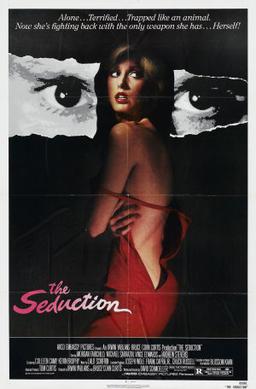
The Seduction-1982

The Seduction-1982

Director David Schmoeller

Starring Morgan Fairchild, Michael Sarrazin

Scott’s Review #749

Reviewed April 27, 2018

Grade: C

The Seduction (1982) is a slick, by-the-numbers voyeuristic thriller that could be a made-for-television Lifetime channel or Hallmark channel production- or something of that ilk.

A woman being stalked by a dangerous admirer is quite formulaic and episodic. Alas, at the time of its release, it was a major motion picture and a perfect vehicle for the upstart young actress of the time, Morgan Fairchild.

She is well cast, and the film has a smoldering,  glossy, sexy appeal, but is quite predictable in the story department, leaving little substance behind after the droll conclusion.

Gorgeous and sexy television news anchorwoman Jaime Douglas (Fairchild) has it all with a handsome beau on her arm (Michael Sarrazin); they swim, bathe, and make love many a steamy night as they reside in the lavish Los Angeles hills.

A photographer approaches Jaime, Derek (Andrew Stevens), eager to take her pictures. He slowly develops an obsession with her as events become more dangerous and sinister for the young woman, until she is finally forced to defend herself against the now-crazed stalker.

Jamie is Morgan Fairchild’s big-screen debut, and, being unaware that any other actresses were in the mix for the part, she is perfectly cast in a role that just “is her”.

In the glitzy and steamy world of Los Angeles media, how adept were the filmmakers at landing the blonde and leggy actress who screams plastic and glamour?

Posing on posters on the walls of millions of teenage boys everywhere in the 1980s, director David Schmoeller wisely incorporates multiple scenes of Jamie swimming naked,  soaping in the bathtub, or in other situations where the actress is semi-nude.

He certainly capitalizes on her looks and popularity with the sensual The Seduction.

The film’s perplexity, though, is clearly on the story front.

The chemistry between Fairchild and Stevens is readily apparent, and while chemistry is crucial between acting leads, it also makes the story far-fetched.

Call me crazy, but I did not get the fear Jaime would experience at the hands of Derek. Dashing and handsome, with much more appeal than her boyfriend, Brandon, I felt that Jamie and Derek should have been dating!

Arguably, the only reason Derek becomes obsessed with Jamie is that she refuses to give him the time of day.

I get that the film wanted a really good-looking male lead, but a homely or even average-looking actor playing Derek would have made more sense from a story perspective.

Stevens is way too handsome to elicit real terror- especially since his only crime is wanting a nice romantic date with Jamie.

The film offers a decent glimpse into the bustling corporate Los Angeles newsroom studios, where the offices exude 1980s glitz and glamour. The entire film is drizzled with sunny California excess, and it makes perfect sense to be set on the West Coast.

The Seduction does well by combining the dark voyeurism of lurking figures in the shadows and the hairspray, lipstick,  and shoulder pads shown under the hot lights of competitive L.A. television cameras.

The Seduction falls victim to being a predictable, poorly acted film, with its inevitable clichés and final scenes. As the police are of no help to her and her boyfriend brandishes a rifle, the audience knows there will be some sort of final stand-off between Jamie and Derek.

The film pulls out all of the possible female-in-peril stops- the nighttime scenes, Jamie being home alone, scantily dressed, and ready to be victimized, Derek continually lurks around (as he does through most of the film), secretly taking photos, sweating, and breathing lustfully.

The climactic conclusion was neither satisfying nor surprising.

A wise cinema friend once coined the term “craptastic” to describe an otherwise atrocious film that somehow contains some morbid appeal- perhaps being so bad it’s good?

I think the 1982 film The Seduction falls perfectly into this category- predictable and trivial, the film is an intended watch for only those seeking something shamelessly awful, that holds little appeal, yet for the gorgeous stars Fairchild and Stevens, who hold the film together while looking great.