Category Archives: Paul L. Smith

Popeye-1980

Popeye-1980

Director Robert Altman

Starring Robin Williams, Shelley Duvall

Scott’s Review #1,474

Reviewed March 31, 2025

Grade: C+

As a loyal fan of the legendary director Robert Altman, I had never seen his 1980 effort, Popeye, which starred his muse, Shelley Duvall, and then rising movie star Robin Williams.

My favorite Altman films, Nashville (1975), Short Cuts (1993), and Gosford Park (2001), are masterpieces sprinkling overlapping dialogue with enormous casts.

Qualities that I adore.

I hoped Popeye would follow the same formula, but strangely and disappointingly, it doesn’t. The end product feels nothing like an Altman film and is a wacky, jagged attempted comedic affair that results in disappointment.

Desperately, it regains some semblance of control during the mid-section when sentimental and touching musical numbers surface, but this cannot save the film from mediocrity.

The entire affair seems rather pointless and overly messy.

When a muscled sailor named Popeye (Williams) journeys to the port town of Sweethaven, looking for the father (Ray Walston) who deserted him as a baby, he befriends an array of bumbling eccentrics.

He falls madly in love with dorky, sweet-natured Olive Oyl (Duvall).

Conflict erupts when it’s revealed that she already has a suitor, the jealous Bluto (Paul L. Smith). Popeye discovers an abandoned baby, Swee’Pea, whom he raises with Olive Oyl’s help, cementing their courtship. But when the spurned Bluto kidnaps Olive and the child, Popeye takes action with the help of his magic spinach.

Williams and Duvall are wonderfully cast and easily the best part of the otherwise ineffectual film.

The chemistry propels an investment in the couple despite the overreaching, zany dialogue. Williams dazzles with a cartoonish performance that befits who the funnyman would play best during his career despite turns towards more dramatic fare.

There is an infectious likeability factor that oozes from the screen. He’s also surprisingly cute.

Duvall nearly upstages Williams and everyone else with a maddingly frenetic and manic, excellent acting job. The actor was born to play Olive, even suffering from the nickname as a child.

Her constant and irritatingly grating ‘oohs’ are irresistible, and I mimicked her well before the credits rolled, much to my husband’s and my amusement.

The best moments occur midway through, with a combination of hits, such as ‘He Needs Me’ and ‘It’s Not Easy Being Me, which are performances by Duvall and Williams, respectively.

Both songs made me fall in love with the characters and made me thirst for more sentimentality over silliness.

You’d think I would have loved the film if for Williams and Duvall alone.

From the opening sequence, though, I found myself unamused and unenamored with the rest of the film.

Meant to be funny, the Taxman (Donald Moffat), Wimpy (Paul Dooley), and Bluto (Paul L. Smith) feel over-the-top and silly. They each lack any warmth or endearment and seem like caricatures of the cartoon.

The finale is meant to be edge-of-your-seat peril, with an octopus added to eat Olive Oyl and Swee’Pea, presumably. This is mixed with an uninspired performance by Ray Walston as Poopdeck Pappy (Popeye’s father).

Waiting for the spinach representation, but this comes too late in the game. Recognizing Popeye’s dislike for spinach, Bluto force-feeds it to him before throwing him into the water. The spinach revitalizes Popeye and boosts his strength, helping him defeat Bluto and Salty Sam.

Popeye celebrates his victory and his newfound appreciation of spinach.

If I made a list of Robert Altman films, I would rank Popeye (1980) toward the bottom. Reviled by critics at the time of release, the film has grown some appreciation over the years, but I’m not sure why.
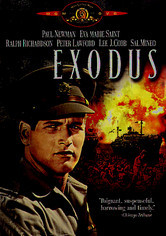
Exodus-1960

Exodus-1960

Director Otto Preminger

Starring Paul Newman, Eva Marie Saint

Scott’s Review #1,005

Reviewed March 30, 2020

Grade: A-

Creating a monumental epic about the modern state of Israel, director Otto Preminger’s vast project Exodus (1960) is a bold adaptation of the Leon Uris novel from 1958.

Starring stars of the day for added Hollywood spice and a romantic element, the result is a sprawling war drama with robust proportions and a hefty running time.

The film sometimes lags or even drags, but the message’s enormous importance and influence on stimulating Zionism should never be forgotten.

With the treacherous World War II barely in the rear-view mirror, Israeli resistance fighter, Ari Ben Canaan (Paul Newman), attempts to bring six hundred European Jewish Holocaust survivors from British-blockaded Cyprus into newly developed Palestine.

At the camp, he meets Kitty Fremont (Eva Marie Saint), an American volunteer nurse. The pair teams up with others to attempt to liberate the survivors.

The action eventually switches to Palestine, where other characters and motives come into play in a complex story. During this time, opposition to the partition of Palestine into Arab and Jewish states was heating up, leading to tension, bombs, and death among similar types of people.

Central to the main plot is a young love story involving spirited Dov Landau (Sal Mineo), a radical Zionist resistance group member, and Karen Hansen Clement (Jill Haworth), a young Danish-Jewish girl searching for the father from whom she was separated during the war.

Exodus has so much story going on and multiple plots to follow.

Besides the tense story, the main draw is the two love stories told amid the political turmoil.

Newman and Saint have marginal chemistry; he is an eye candy who electrifies the screen, and she seems too old for him and does not photograph well. Kitty, a widow, hedges on her romantic feelings for Ari, but they ultimately unite.

A gorgeous sequence occurs when the two share a delicious meal of fish and martinis amid a rooftop restaurant overlooking the dazzling landscape. She later dines with his parents and his mother, a classic Jewish mother who, in stereotypical fashion, cooks and fusses.

The fresh-faced pairing of Dov and Karen is reminiscent of Tony and Maria from West Side Story. Doomed from the start, the youngsters are opposites in many ways: hot-headed, sensible, and resilient. He is bronze and swarthy; she is blonde and blue-eyed.

I fell in love with the couple more than Ari and Kitty and rooted for their happily-ever-after moment, which sadly never occurred.

At nearly four hours, the film is best watched in segments, perhaps even four, to let the action marinate overnight. The sweeping cinematic photography and the lush exterior sequences aid the complex drama.

A drawback was not seeing the film on the big screen, which was almost a must in hindsight and limited by the DVD quality over Blu-Ray.

Nonetheless, the film is delicious in nearly every way. When tedium is about to occur, an event snaps the viewer back to immediate attention.

A notable fun fact is that Preminger boldly hired blacklisted screenwriter Dalton Trumbo, on the dreaded Hollywood blacklist for over a decade for communist leanings, to write the script.

Together with Spartacus (1960), made the same year, Exodus is credited with ending the practice of Blacklisting in the motion picture industry. The importance of what is written on the blank page is arguably surpassed by the man who wrote those pages.

Exodus (1960) nearly rivals the epic of all epics, Lawrence of Arabia (1962), in its cinematography of exotic and sacred landscapes in daring and forbidding lands.

Perhaps twenty minutes could be carved out when the action loses momentum. Still, with great direction, a top-tier cast, and a history lesson in the harshness of war and generations of conflict, the film resonates with the realism of the subject matter.

Oscar Nominations: 1 win-Best Supporting Actor-Sal Mineo, Best Music Score of a Dramatic or Comedy Picture (won), Best Cinematography, Color