Tag Archives: Ethan Hawke

Strange Way of Life-2023

Strange Way of Life-2023

Director Pedro Almodóvar

Starring Ethan Hawke, Pedro Pascal

Scott’s Review #1,425

Reviewed April 22, 2024

Grade: A-

Pedro Almodóvar is a unique film director. Spanish, his films are flavorful, saucy, and unpredictable. He tends to mix melodrama, wacky humor, and a colorful landscape frequently sprinkling LGBTQ+ elements even if they are not classified with that specific genre.

I adore his films though they frequently blur together for me.

Though a Spanish film, Strange Way of Life (2023) is only Almodóvar’s second English language film and to my knowledge his first short feature film.

Watching the brief thirty-one-minute offering I fantasized about a full-length feature or even a television series based on the story and characters.

Since it’s short we get right down to business quickly.

One day Silva (Pedro Pascal) rides a horse across the desert to Bitter Creek to visit Sheriff Jake (Ethan Hawke). It is quickly revealed that twenty-five years earlier, the sheriff and Silva, worked together as hired gunmen.

They fell in love during a passionate encounter with three whores and barrels of wine who ditched the men when they realized they were not valued.

Silva provides Jake with the excuse that the reason for his trip is not to go down the memory lane of their old friendship but rather to rescue his son Joe (George Steane) from persecution for being suspected of killing Jake’s late brother’s wife, also a whore.

After Jake and Silva sip wine and enjoy a lovely meal they quickly engage in animalistic sex and reignite their long-dormant passion.

While Silva is gung-ho about reuniting Jake has reservations.

Pascal, who is everywhere due to the success of his television series The Last of Us is fabulous to watch. His sexy machismo pairs well with his passion for his soulmate. Because his character of Silva intends for him and Jake to live out their days running a ranch he is a more inspiring character than Jake.

This point is a nod to the groundbreaking Brokeback Mountain (2006) whose characters also flirted with running a ranch together during a time when any gay relations were forbidden territory.

Hawke is quite good too though I’m partial to Pascal. Buttoned up and law-abiding he rebuffs Silva’s advances, at first.

It’s nice to see Hawke in a gay role. Both characters are masculine thereby dismissing silly LGBTQ+ stereotypes that too often appear in cinema.

It also doesn’t hurt to get a glimpse of Pascal’s bare butt or Hawke’s buff physique as they while away time in the bedroom.

I love the sweaty and muscular Western genre being the backdrop of an LGBTQ+ film and tipped upside down. Not to reduce it to a tepid John Wayne film cliche there exists a gorgeous and melodic fado singer throughout the film.

It is performed by Manu Ríos.

This counterbalances the Quentin Tarantino-ish blood and violence with lovely music.

The film is titled after a 1960s Portuguese fado song by Amália Rodrigues

Since Strange Way of Life is a brief experience many facets could have been explored. Why did Silva leave Jake in the first place? What made him suddenly have a realization after twenty-five years? Were there other men at that time?

Being critical that the film is short and deserves full-length feature status it nonetheless deserves to be towards the top of Almodóvar’s catalog a testament to its power.

Strange Way of Life (2023) successfully takes a macho genre like the Western and lights it on fire proving that two men can be tough and tenderly love each other.

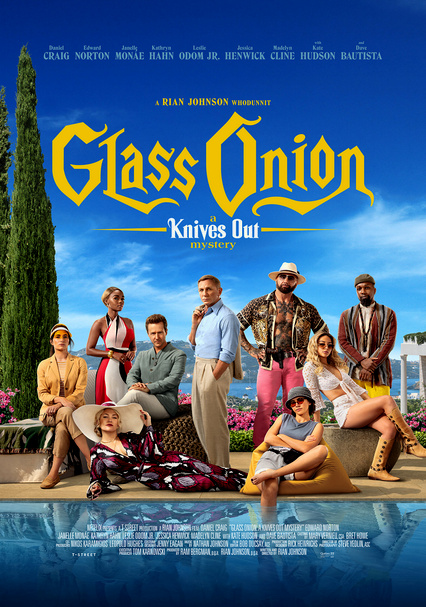
Glass Onion: A Knives Out Mystery-2022

Glass Onion: A Knives Out Mystery-2022

Director Rian Johnson

Starring Daniel Craig, Edward Norton, Janelle Monáe

Scott’s Review #1,331

Reviewed January 5, 2023

Grade: B

I teetered over grading Glass Onion: A Knives Out Mystery (2022), referred to as Glass Onion, a B+ or a B, but the hardline critic in me won out on this day.

If I hadn’t compared it so much to the deliciously witty and inventive Knives Out from 2019, I might have given it a generous B+ rating. Still, it’s also impossible not to compare the two, since the setups and similarities are too apparent.

Rian Johnson, who returns to the fold as director, writer, and co-producer, pays tribute to the fabulous Agatha Christie murder mystery whodunits and the Hercule Poirot detective inclusion with the delightful Daniel Craig as the lead, reprising his role as master detective Benoit Blanc, as he takes on an exciting new case.

A Greek island owned by ultra-billionaire Miles Bron (Edward Norton) serves as the setting for the Southern detective’s latest adventure, which unfolds as a group of the tech giant’s friends gather for a murder mystery party that quickly turns deadly.

I couldn’t watch Miles without thinking of Elon Musk, the current controversial social media Twitter chief executive officer, in all his juvenile buffoonery.

Appearances by top stars Janelle Monáe, Kate Hudson, Kathryn Hahn, and Leslie Odom Jr., and a surprise cameo by Hugh Grant round out the cast. Along with Craig and Norton, this brings enough star power to create buzz.

It’s also appealing that Benoit, a clear ode to Poirot, is the only character who is the same from the first Knives Out story. His character is immediately developed when we see him soaking in a bathtub in his Manhattan apartment, conversing with a male voice offscreen.

He refuses to leave the tub during the very topical COVID pandemic, making the entire film feel incredibly timely and relevant.

Let’s see what happens when the film ages ten years.

We later learn that his husband, Phillip (Hugh Grant), lives with him, and Blanc is gay. How wonderful to incorporate an LGBTQ+ presence into a main character, and icing on the cake is that the studly James Bond actor is all in.

With Blanc’s vague sexuality revealed, the exciting mystery commences with many twists and turns among the characters, led by a fantastic dual performance by Monáe. She plays sophisticated New Yorker Andi and her southern sister Helen Brand.

The other characters are a mixed bag with Hudson and Hahn playing ridiculous, over-the-top roles as a washed-up fashion designer and an aspiring governor, respectively.

But the cartoon character award goes to former WWE professional wrestler David Bautista as the weird, buff guy, Duke Cody, who barely keeps his clothes on.

Still, the characters are a hoot, and the anticipation of how they all connect, who has screwed over whom, and why, is slowly revealed in fun form.

Not to be outdone, there are even revelations of who is screwing whom in the bedroom.

The story isn’t as interesting as the one in Knives Out. The ingenious script is lost, and by the end, it’s a case of who cares? All we want to know is who’s dead and who’s alive, and what does the Mona Lisa have to do with anything?

The cast undoubtedly had a ball making Glass Onion, and the sunny Greek Island locale is a great choice. As the players bask in the sun and saunter around in bikinis, sipping a cocktail or three amid peril, it is great fun for the cast and viewers alike.

It’s unclear if Johnson will create another installment of the Knives Out collection, but I’m on board if he does. I’ve been fascinated by the whodunit genre for as long as I can remember.

Glass Onion: A Knives Out Mystery (2022) isn’t quite as riveting or satisfying as Knives Out (2019), but the film is still enjoyable, thanks to its superior, glossy production values and a great cast.

Oscar Nominations: Best Adapted Screenplay

The Black Phone-2022

The Black Phone-2022

Director Scott Derrickson

Starring Mason Thames, Madeleine McGraw, Ethan Hawke

Scott’s Review #1,296

Reviewed September 7, 2022

Grade: B+

The Black Phone (2022) is a compelling horror offering that delivers some effective frights and jumps. It merges classic horror with a supernatural element that walks the line very well, never straying too far into either territory.

It doesn’t redefine the genre, but nor does it feel stale or like a tired retread of other modern films. This is because of merging other genres into the action.

Some question marks surface, but the movie is an above-average effort by director Scott Derrickson, who is surprisingly most known for the superhero vehicle Doctor Strange (2016).

The 1978 cloudy suburban blue-collar United States setting works remarkably well, and Ethan Hawke is delicious as the evil ‘Grabber’, a demented masked man who snatches neighborhood boys and hides them in a dank basement.

And I’d be remiss if I didn’t mention the brilliant inclusion of the Pink Floyd song ‘On the Run’ during the final sequence.

Wonderful is how snippets of The Silence of the Lambs (1991) peek in now and then, without ever feeling like a carbon copy or even a source material.

The Black Phone feels quite like a coming-of-age story, as it revolves around a conflicted teenage boy and his numerous insecurities, from bullying to blossoming romance.

Finney, played by newcomer Mason Thames, is a shy but clever thirteen-year-old boy. He and his younger sister, Gwen (Madeleine McGraw), live with their alcoholic father and take turns looking after him.

Neighborhood boys bully Finney, but also has a protector in his friend Robin, until Robin goes missing.

Eventually, Finney is abducted and finds himself trapped in a soundproof basement where screaming is of little use. When an old disconnected black phone on the wall begins to ring, Finney discovers he can hear the voices of the killer’s previous victims.

The Black Phone was adapted from a 2004 short story of the same name and has a similar feel. Events flow quickly, and the film doesn’t drag, though I was ready for it to end when it did.

Since the film was a commercial success, rumors of a sequel or prequel are swirling. I vote for a prequel because there is a lot left to tell regarding the Grabber. The character’s backstory is barely touched, leaving many questions unanswered.

He only kidnaps and kills teenage boys, the suggestion being that the Grabber is gay. At one point, he announces that he wants to look at Finney. The suggestion is uneven, though, because it’s never revealed if he rapes the boys before killing them or what his motive even is.

The Grabber has a brother, who plays a key role in the story, but their relationship is not explored in detail. What about parents, kids, or jobs?

In a nutshell, I wanted to know more about the killer, and I was left unsatisfied.

Speaking of the Grabber, here’s where the Silence of the Lambs comparison comes into play. The villains are similar since both are presumably gay and disguise themselves in one way or another, either by creating a ‘women’s suit’ or donning a creepy mask.

Both lure their victims into a grimy van and keep them tucked away underground before killing them.

But Buffalo Bill beats the Grabber by a landslide. The line ‘it rubs the lotion on its skin- it does this whenever it is told’ will forever give me a chills.

I’ve droned on long enough about the Grabber, but only because he is a fabulous villain and I am intrigued beyond measure at the possibilities.

The editing and continuity are a win, especially in the final twenty minutes. The rescue/escape scenes are powerful and emotional without being hokey or overly predictable.

The psychic dreams are pretty good, and McGraw is a superb child actor, but those sequences didn’t enamor me as much as the scenes with Finney and the Grabber or the voices on the telephone.

I’ll bet casting Ethan Hawke against type in The Black Phone (2022) supercharged audiences into seeing the film. The independent film style and edge-of-your-seat pacing ultimately make the film a winner, even if I was left with tons of questions.

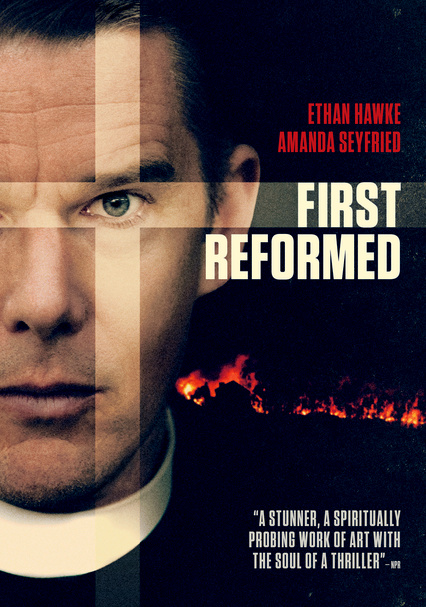
First Reformed-2018

First Reformed-2018

Director Paul Schrader

Starring Ethan Hawke, Amanda Seyfried

Scott’s Review #870

Reviewed February 22, 2019

Grade: B+

First Reformed (2018) is a dark, independent film that has received a great deal of buzz for the raw and daring risks it takes and the brave performance by its star, Ethan Hawke.

Directed by the same man who wrote the screenplay for Taxi Driver (1976), Paul Schrader, the film is a character study of one man’s efforts for benevolence and normalcy after experiencing insurmountable tragedy. He wrestles with his demons and questions his faith in the church.

The film is a heavy, raw drama, and not for those looking for a feel-good experience.

Reverend Ernst Toller (Hawke) is an alcoholic, residing in bleak and barren upstate New York, presumably near Buffalo. He serves as a Protestant minister at a historically significant yet sparsely populated church.

Another, more modern congregation takes over the establishment with a large following. Ernst has recently been dealt a significant blow with the death of his son in the Iraq War after encouraging him to enlist.

When Mary (Amanda Seyfried), a young pregnant woman, asks Ernst to guide her radical and troubled husband, Ernst’s life spirals out of control.

Ernst is determined to keep a journal for precisely one year and then subsequently burn it. He chronicles his feelings, thoughts, and doubts as narrated by Hawke. Schrader, who directed and wrote First Reformed, succeeds at making the film feel personal and conflicted.

He creates a quiet experience, masked by underlying turmoil and even a suffocating existence. Ernst’s angry protege is an environmentalist determined to change the minister’s views and succeeds in pointing out life’s hypocrisy.

The season is winter, and the elements are cold and depressing in First Reformed. From the crisp air and the clutching small-town grasp, Schrader makes the audience feel stifled, so we relate to Ernst, even though we may not share his views or beliefs.

He is a kind man, helpful, and even-keeled, but wrestles with constant demons.  Despite his role as a minister, what the film does well is resist carving a traditional tale of religious conflict or even questioning Ernst’s sexuality.

The film is set in a much darker context and doesn’t focus on a single theme.

Where Schrader loses me is with Ernst’s questionable actions, which sometimes come out of left field. The conclusion is both perplexing and unsatisfying.

As the character prepares for a desperate act of brutality, indeed a shock for the audience who has him figured out, he suddenly changes course due to the appearance of Mary. They embrace, and the film ends, but what are his intentions towards Mary? He is fond of her, but are his feelings pure friendship or something more emotional?

Sadly, we never find out, nor do we know, where he channels all of his feelings from.

Hawke’s dynamic portrayal of Ernst is never better. The supporting characters lack much appeal or interest. Mary is nice enough but is a tad clingy, and her numerous requests to talk or have Ernst come by to visit get tedious.

Seyfried does what she can with the role, but is the second banana.

Cedric the Entertainer as Pastor Joel Jeffers lacks appeal, and the dowdy character of Esther, meant to be a potential love interest for Ernst, is instead bothersome and portrayed as a pest.

First Reformed (2018) has shades of appeal, and the main character is well-substantiated and deep, but ultimately, the film does not come together as well as it might have.

The finale underwhelms, and after the significant buildup to the character’s changing thoughts and motivations, too much was left unclear. Schrader deserves props for attempting to create an edgy experience with a unique and daring character, but could have wrapped the film up in a tidier way.

This would have served the film better.

Oscar Nominations: Best Original Screenplay

Independent Spirit Award Nominations: Best Feature, Best Director-Paul Schrader, Best Male Lead-Ethan Hawke (won), Best Screenplay

Boyhood-2014

Boyhood-2014

Director Richard Linklater

Starring Ellar Coltrane, Ethan Hawke

Scott’s Review #217

70301281

Reviewed January 19, 2015

Grade: A

Boyhood (2014) is a family drama directed by Richard Linklater that tells the story of a family’s trials and tribulations over twelve years, ranging from approximately 2002-2013.

The film uses the same actors over the entire period, enabling the viewer to see the characters change. What a novel idea! In this day and age of special effects, superheroes, and animated animals, how refreshing to see a simple tale of a family told over a while.

The film’s main character is Mason Evans, Jr. played by Ellar Coltrane.

We are introduced to Mason when he is six years old and in the first grade. He lives with his older sister Samantha, played by the director’s daughter Lorelei Linklater, and his mother Olivia, played by Patricia Arquette, in Texas.

Ethan Hawke, divorced from Olivia plays Mason’s father (Mason Sr.).

As the years go by we see situations arise and the characters grow and develop like real life.

After the film, Mason Jr. is headed off to college following years of life experience including his first relationship. The other characters develop and we see Olivia and Mason Sr. delve into relationships with partners, some successful, others less successful.

Boyhood succeeds because it is a film about real life that feels like a slice of Americana.

It’s a wonderful film.

The audience invests in the characters because we grow to love and care about their lives. It is comparable to seeing cousins or friends once a year and seeing what becomes of their lives over time.

This film fascinates me because it is so basic and real that it does not need contrived dramatic situations to warrant attention. It is simply authentic and that is what makes a great film.

The film is left-leaning politically speaking and I love that current events are brought up throughout the years by the family members.

As the film progresses we are treated to Mason Sr. commenting on his distaste of the Iraq war, the children’s anticipation of the new Harry Potter film, Mason Sr. taking the kids to a Houston Astros game, and The Beatles and Star Wars are mentioned.

Another scene sadly focuses on a returning soldier from Iraq who suffers from Post-traumatic stress disorder. These nuances make the film seem so authentic and rich.

As wonderful a job as Patricia Arquette and Ethan Hawke did neither of them had a huge, bombastic, emotional scene which would have been splendid given the talents of each, but this is a small criticism.

Both are superb as struggling parents trying to do the right thing for their children and carve out a life for themselves.

Boyhood redefines realism in the film as we see a family unit hope, struggle, and dream as it’s played out before our eyes.

The film does not need overwrought dramatics as it is simply a slice of the life of a group of people we come to know and love.

Everyone can relate to Boyhood (2014).

Oscar Nominations: 1 win-Best Picture, Best Director-Richard Linklater, Best Supporting Actor-Ethan Hawke, Best Supporting Actress-Patricia Arquette (won), Best Original Screenplay, Best Film Editing

Independent Spirit Award Nominations: 2 wins-Best Feature, Best Director-Richard Linklater (won), Best Supporting Male-Ethan Hawke, Best Supporting Female-Patricia Arquette (won), Best Editing

The Purge-2013

The Purge-2013

Director James DeMonaco

Starring Ethan Hawke, Lena Headey

Scott’s Review #128

70265234

Reviewed July 23, 2014

Grade: A-

On paper, the premise of the film The Purge (2013) is very intriguing. It immediately caught my attention and I was compelled to see it.

The government, fed up with the overwhelming crime and prison overcrowding, decides to initiate a once-a-year purge, where anything goes.

It’s like Christmas for the criminals and the insane.

All emergency and police will shut down on this night and citizens are left to their own devices as a way to purge the violent and aggressive instincts from human systems.

An affluent family, led by a security systems genius (Ethan Hawke), nestles in their lavish home.

Of course, events go awry and chaos ensues.

The film contains suspense, thrills, frights, and a bit of humor, containing questions of class distinction and raises societal questions- Why are the wealthy better off than the poor? Do they deserve to be?

I enjoyed the setting of the wealthy, gated Los Angeles community and the eerily Stepford wife-like atmosphere of the neighborhood where housewives delivered casseroles and other dishes to each other for the big night.

Throughout this sunny environment, the viewer could sense a too-good-to-be-true cheerfulness and the darkness to follow anticipated as sunset emerged.

I found this film to be unpredictable and the edge of your seat and the film delved into a home invasion thriller, which was effective.

I could not predict what might happen next and that is incredibly entertaining.

I am unsure if some of the humor in the film was intentional or not- some of the kills were over the top and contained one-liners, but The Purge (2013) is a crisp, fun, summer popcorn horror film.