Category Archives: Jeremy Davies

The Black Phone-2022

The Black Phone-2022

Director Scott Derrickson

Starring Mason Thames, Madeleine McGraw, Ethan Hawke

Scott’s Review #1,296

Reviewed September 7, 2022

Grade: B+

The Black Phone (2022) is a compelling horror offering that delivers some effective frights and jumps. It merges classic horror with a supernatural element that walks the line very well, never straying too far into either territory.

It doesn’t redefine the genre, but nor does it feel stale or like a tired retread of other modern films. This is because of merging other genres into the action.

Some question marks surface, but the movie is an above-average effort by director Scott Derrickson, who is surprisingly most known for the superhero vehicle Doctor Strange (2016).

The 1978 cloudy suburban blue-collar United States setting works remarkably well, and Ethan Hawke is delicious as the evil ‘Grabber’, a demented masked man who snatches neighborhood boys and hides them in a dank basement.

And I’d be remiss if I didn’t mention the brilliant inclusion of the Pink Floyd song ‘On the Run’ during the final sequence.

Wonderful is how snippets of The Silence of the Lambs (1991) peek in now and then, without ever feeling like a carbon copy or even a source material.

The Black Phone feels quite like a coming-of-age story, as it revolves around a conflicted teenage boy and his numerous insecurities, from bullying to blossoming romance.

Finney, played by newcomer Mason Thames, is a shy but clever thirteen-year-old boy. He and his younger sister, Gwen (Madeleine McGraw), live with their alcoholic father and take turns looking after him.

Neighborhood boys bully Finney, but also has a protector in his friend Robin, until Robin goes missing.

Eventually, Finney is abducted and finds himself trapped in a soundproof basement where screaming is of little use. When an old disconnected black phone on the wall begins to ring, Finney discovers he can hear the voices of the killer’s previous victims.

The Black Phone was adapted from a 2004 short story of the same name and has a similar feel. Events flow quickly, and the film doesn’t drag, though I was ready for it to end when it did.

Since the film was a commercial success, rumors of a sequel or prequel are swirling. I vote for a prequel because there is a lot left to tell regarding the Grabber. The character’s backstory is barely touched, leaving many questions unanswered.

He only kidnaps and kills teenage boys, the suggestion being that the Grabber is gay. At one point, he announces that he wants to look at Finney. The suggestion is uneven, though, because it’s never revealed if he rapes the boys before killing them or what his motive even is.

The Grabber has a brother, who plays a key role in the story, but their relationship is not explored in detail. What about parents, kids, or jobs?

In a nutshell, I wanted to know more about the killer, and I was left unsatisfied.

Speaking of the Grabber, here’s where the Silence of the Lambs comparison comes into play. The villains are similar since both are presumably gay and disguise themselves in one way or another, either by creating a ‘women’s suit’ or donning a creepy mask.

Both lure their victims into a grimy van and keep them tucked away underground before killing them.

But Buffalo Bill beats the Grabber by a landslide. The line ‘it rubs the lotion on its skin- it does this whenever it is told’ will forever give me a chills.

I’ve droned on long enough about the Grabber, but only because he is a fabulous villain and I am intrigued beyond measure at the possibilities.

The editing and continuity are a win, especially in the final twenty minutes. The rescue/escape scenes are powerful and emotional without being hokey or overly predictable.

The psychic dreams are pretty good, and McGraw is a superb child actor, but those sequences didn’t enamor me as much as the scenes with Finney and the Grabber or the voices on the telephone.

I’ll bet casting Ethan Hawke against type in The Black Phone (2022) supercharged audiences into seeing the film. The independent film style and edge-of-your-seat pacing ultimately make the film a winner, even if I was left with tons of questions.
Saving Private Ryan-1998

Saving Private Ryan-1998

Director Steven Spielberg

Starring Tom Hanks, Tom Sizemore

Scott’s Review #778

Reviewed June 26, 2018

Grade: A

Famed director Steven Spielberg does not always get his due respect. This is usually because, for better or worse, he has become synonymous with the “blockbuster” film, drawing comparisons to either lightweight fare or films of “lesser” artistic merit.

His 1980’s works- Raiders of the Lost Ark (1981), E.T. the Extra-Terrestrial (1982), and Indiana Jones and the Temple of Doom (1984), were enormous commercial successes, though I enjoyed all of the films.

During the 1990s Spielberg continued to direct “popcorn flicks” such as Hook (1991) and Jurassic Park (1993), with large studio budgets, but with somewhat less critical acclaim.

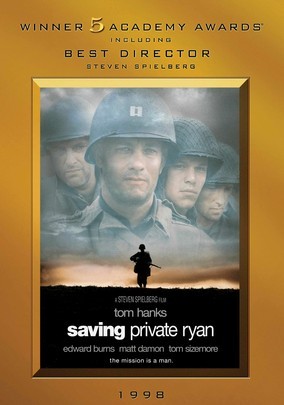
Finally, he was able to change many opinions with 1993’s Schindler’s List and the war film to end all war films, Saving Private Ryan (1998), an epic, profound experience.

Both received numerous Oscar nominations and success at the box office.

The film is a tremendous treat for nothing other than the riveting opening sequence alone (more about that later). If that is not enough to impress, Saving Private Ryan is known for infusing a very graphic element into the war film- with no letting up from the brutality.

Spielberg does not water down this picture, instead shows the pain and angst of war. The film is helped tremendously by the casting of Hollywood superstar Tom Hanks, who leads an enormous cast of mainly young men.

Saving Private Ryan opens with a prologue- in present times a veteran brings his family to visit an American cemetery at Normandy. Flashbacks then take the audience back to the Omaha Beach debacle in 1944, where American troops faced deadly German artillery attacks in France.

After the horrific three-day D-Day, it is learned that three of the four Ryan sons have died in the events. Captain Miller (Hanks) is ordered to bring a team of men to Normandy and bring the fourth Ryan son (Matt Damon) to safety.

Spielberg’s opening D-day sequence is just astounding and propels the film to unforgettable status. With a running time of twenty-four minutes, the riveting and horrific slaughter of American soldiers is intensely brought to the screen.

Audiences undoubtedly sat open-mouthed (I know I did!) as bullets riddled the beach and left soldiers killed or with limbs torn off. The camera-work is brilliant as the use of a shaky technique, almost documentary style is used for effect.

Successful is this sequence at promoting an anti-war sentiment while not glorifying the combat at all. The scene will stay with its audience for years to come.

Saving Private Ryan can be compared to the decades later Dunkirk (2017) in that each film took the war genre and turned it upside down.  The similarities between the films start with the obvious- the main events in both films are during World War II, the same week, and the French beach settings making the films perfect companion pieces.

Both films feature a gray, rainy setting with many horrific moments of death and suffering. The war film is a common genre that has historically teetered on predictability and over-saturation, but both films do something completely different and unexpected, yet mirror each other in style.

To counter-balance the violence in the opening sequence, a quiet scene is created and remains one of my favorites. The scene contains almost no dialogue throughout the seven-minute duration and is pivotal to the entire film.

As a typist realizes that three letters of death are to be delivered to the same family, a woman on a mid-west farm quietly washes dishes and is calmly horrified when she sees a government car approaching.

What else can this mean but that one of her sons is dead? The poor Mrs. Ryan will be told that she has lost not one, but three sons.

How utterly unimaginable and the scene is incredibly touching!

The best part of Saving Private Ryan is that Spielberg provides a deep level of sentimental vision combined with the terrible atrocities of war. He portrays not only the violent effects of the battles on the soldiers but also the surviving families.

This is not always done in war films, at least not to the level that Spielberg chooses to.

With such a film as the startling Saving Private Ryan, Spielberg turned the war film genre inside out. Breaking barriers with a no-holds gusto, Spielberg influenced war films for years to come- Black Hawk Down and Enemy at the Gates (2001) are prime examples, and received acclaim from fellow directors for his interesting techniques.

Saving Private Ryan (1998) was an enormous financial winner at the box office, proving that great films don’t have to be watered down to find an audience.

Oscar Nominations: 5 wins-Best Picture, Best Director-Steven Spielberg (won), Best Actor-Tom Hanks, Best Screenplay Written Directly for the Screen, Best Original Dramatic Score, Best Sound Effects Editing (won), Best Sound (won), Best Art Direction, Best Cinematography (won), Best Makeup, Best Film Editing (won)

Twister-1996

Twister-1996

Director Jan de Bont

Starring Bill Pullman, Helen Hunt

Scott’s Review #763

Reviewed May 25, 2018

Grade: B+

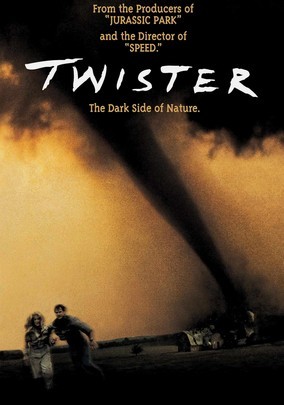
Twister (1996) is a film that contains amazing and groundbreaking special effects- that blew people away (pun intended!) when released to the masses over twenty years ago.

Moviegoers flocked to theaters everywhere to partake in the escapist summer feel-good hit starring popular movie stars of the time.

The film spawned amusement park rides and lots of other fun things during its run.

The visuals are what truly are to be enjoyed here and not the generic, tried, and true subplots of romance, childhood trauma, and corporate greed that are mixed in.

The film does not hold up well in present times as the dazzling effects now look rather dated when lined up against modern blockbusters. This results in Twister being reduced to “one of those 1990’s films”.

Bill Paxton and Helen Hunt star as American storm chasers, Bill and Jo, obsessed with their craft of tracking tornadoes throughout the United States mid-western region. Adding drama to the plot is that Bill and Jo are an estranged married couple amid a divorce.

Bill brings his new fiancee Melissa (Jami Gertz) along as numerous meteorologists converge to track storms using newly invented devices.

Predictably, a series of vicious storms commence while Bill, Jo, and Melissa play out a love triangle.

Twister gets off to a fantastic start as a wicked storm kills the five-year-old Jo’s father, prompting her to pursue her career of choice. Jo has never gotten over her father’s death becoming fascinated by deadly storms.

The effects of this initial storm are very well done as Jo’s father’s death scene is riveting- the poor man being sucked into the deadly cyclone is memorable. Regardless, this scene sets the tone for the ample effects to follow- most notably the terrifying sound of the swirling storm as farm tools and animals fly around onscreen.

After the initial introduction, the rest of the film is mainly of the group driving around and encountering storms, with Bill and Jo taking center stage.

As a child having spent many summers in the mid-west, sans tornadoes thankfully, I felt a sense of nostalgia watching the film.

Assumptions are being made that Twister was indeed filmed on location (with studio help), but the authenticity is apparent. From the vastness of the plains to the dusty roads, cornfields, and the small-town U.S.A. I enjoyed the down-home, slice-of-life feel.

The action and effects are lightning-quick and quite realistic. As mentioned the sound effects are as strong as the visual effects and I never doubted for a second that the twisters had a realism to them.

This successfully merges into the summer blockbuster that Twister’s producers undoubtedly were going for. Making a ton of money, the result was successful and inspired by Hollywood.

Despite the superlative special effects, though, this is the only reason to watch Twister, and seeing the film once is enough excitement.

The writers (Michael Crichton and Anne-Marie Martin) attempt to incorporate a romance into the story and this does nobody any good. This negative aspect is even more apparent since the chemistry between Paxton and Hunt is non-existent and Gertz’s Melissa is meant to be the odd woman out all along.

A large amount of suspension of disbelief is necessary to “buy” various scenes. Ludicrous are countless scenes where characters either outrun the monstrous twisters or somehow the storms encircle them, but miraculously never touch them.

When Jo, Bill, and Melissa’s truck are captured inside the funnel cloud the vehicle and its passengers somehow remain unharmed.  Tornadoes do not simply come out of nowhere to attack without any indication on the radar.

But alas this is a disaster film and liberties must be taken.

The famous “cow scene”, notoriously used twice in the film seemed groundbreaking and cutting edge in 1996, but in 2018 now seems hokey and unnecessary.

Times sure do change in cinema, especially with technical effects and CGI growing each year.

Admittedly, the film does contain a good, all-American rockin’ summer tune by Van Halen named “Humans Being”, which always makes me think of summertime when I hear it. The entire Twister soundtrack was an enormous success with radio airplay given and led to further successes for the film.

Perhaps now watched as a blast from the past or a revisit to some sort of nostalgic time for folks, Twister (1996) is a great example of a once-popular popcorn movie falling into semi-obscurity. Given another twenty years, the film will undoubtedly fall all the way.

A nice film for the time it was, but not much more.

Oscar Nominations: Best Sound, Best Visual Effects