Category Archives: Patrick Kennedy

Blue Moon-2025

Blue Moon-2025

Director Richard Linklater

Starring Ethan Hawke, Margaret Qualley

Scott’s Review #1,514

Reviewed January 26, 2026

Grade: B+

Blue Moon (2025) is a character-driven look at a talented writer on the brink of breakdown. Over the course of one boozy night, the audience is introduced to the troubled man and comes to envelop him and his sometimes off-putting ideas.

The movie succeeds through a combination of crisp, sardonic, well-written dialogue and Ethan Hawke’s inspired performance as Lorenz Hart, an American lyricist living in the 1940s.

A film every Old Broadway New Yorker ought to love, the setting is the famous theatre district eatery, Sardi’s, where many a piano song has been sung, and drink has been drunk by both popular and struggling players in the Broadway game.

The plot centers on the night of March 31, 1943, as World War II rages.

Hart reflects on himself following the opening night of Oklahoma!, a new musical created by his former colleague Richard Rodgers (Andrew Scott), where a celebration is planned to gush over its overwhelming success. He despises the corny, overly wholesome lyrics and is dismayed by the production’s popularity.

The talkative, cynical, and newly sober Hart visits with bartender Eddie (Bobby Cannavale), who tries unsuccessfully not to serve him liquor, and enlisted sergeant piano player Morty (Jonah Lees), who is on leave.

Hart also commiserates with writer E.B. White (Patrick Kennedy), soon to become famous for stories like Stuart Little and Charlotte’s Web, the former of which he gets from Hart.

While not the flashiest film, director Richard Linklater draws an excellent performance from Hawke and miraculously and flawlessly makes Hawke’s character appear physically very short in stature.

This is more difficult than it sounds from a cinematography perspective, and it also deserves props for creating a unique-looking restaurant-and-bar shape.

Hawke came into his own with 1989’s Dead Poets Society and has continued to deliver more sophisticated performances as he has aged.

Except for a brief opening sequence where Hart’s ultimate fate is revealed, the entire film takes place in the dark restaurant/bar.

Hart spends time chatting with Elizabeth Weiland, an unrequited love interest of his, who ruminates on her own unsuccessful love life.

Over the course of the film, it’s sad to see Hart’s life unravel. Fans will know that Rogers and Hammerstein were a tremendously successful musical duo and not Rogers and Hart. As Hart spends time pitching ideas to Rogers, we realize their partnership will go no further than it already has.

Hawke is superb at delivering a massive amount of lines, showcasing Hart’s sometimes rambling and fragmented ideas. The handsome actor adopts a more homely persona in Hart, suffering rejection after rejection throughout the evening.

The glitz of Broadway is enshrouded within the walls of Sardi’s, famous for showcasing caricatures of Broadway celebrities. In satisfying form, a close-up of a caricature of Hart clings to the wall as Blue Moon ends, presumably long after his death.

Briefly skated over is Hart’s sexuality, said to lean more toward homosexuality than is ever more than alluded to, which is a disappointment. The closest the film comes to any dissection of this nature is when Hart invites a delivery boy to an afterparty and has a a conversation with Morty in the men’s room.

Both story points go nowhere. Instead, Hart mostly pines over Elizabeth.

The winning formula is the dialogue, sometimes teetering off course when Hart goes off on tangents. Still, the central concept of a misunderstood and underappreciated creative genius is received loud and clear.

While good, Qualley and Cannavale are never given great moments to show off their acting chops. The best supporting player is Andrew Scott, who provides entertaining banter while playing opposite Hawke.

Linklater offers up a talkative, cerebral film about the celebrations and heartbreaks of life through art. Through enriching conversations, Blue Moon (2025) delivers a thought-provoking dialogue-heavy cinema that is an intelligent, confined experience.

Oscar Nominations: Best Actor-Ethan Hawke, Best Original Screenplay
London Has Fallen-2016

London Has Fallen-2016

Director Babak Najafi

Starring Gerard Butler, Aaron Eckhart

Scott’s Review #608

Reviewed January 13, 2017

Grade: D

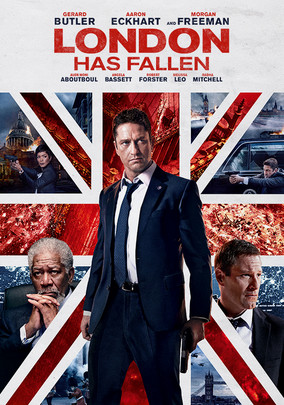
Save for many enjoyable, incredible London shots of mostly aerial views, London Has Fallen (2016) is a complete drivel of an experience.

The film’s attempt at being a red-blooded, patriotic film comes across as insulting and racist, with a machismo that is cringe-worthy.

The dialogue is terrible, and the “us against them” mantra has been done to death in film, mainly in the 1980s and 1990s. To quote one reviewer, “London Has Fallen is Donald Trump in film form.”

I don’t understand how the film convinced such a talented cast to appear (it must have been money), and several parts are so small (Robert Forster, Melissa Leo, Jackie Earle Haley) that they are nearly glorified extras.

The plot is painfully contrived, to say nothing of the ludicrous nature of the entire story.

To retaliate against a drone strike killing a Pakistani leader, terrorists take advantage of the death of the UK Prime Minister to assassinate several world leaders who have gravitated to London to attend funeral services.

The President of the United States (played by Aaron Eckhart) is naturally in attendance, and his murder is thwarted by top Secret Service official Mike Banning (Gerard Butler), our film’s hero.

The rest of the film involves the President and Mike running throughout London, attempting to catch the terrorists and bring them to justice while avoiding death.

The London locales are superb, but sadly, they mainly appear at the film’s beginning and end. The London Eye, the Thames River, the Underground, and various metro stations are featured.

The numerous London bridges also get some exposure.

The best part is how the film showcases London’s vastness, not just the up-close shots of historic places like Westminster Abbey or Buckingham Palace.

Undoubtedly, London is known for those gems, but the aerial views give the viewer an appreciation of all London offers.

I loved only this aspect of the film.

The supporting roles are abysmal, and given the more artistic parts they’ve received in the past; one imagines the actors cringing as they read the scripts for some of them.

I hesitate to think what possessed Leo, Forster, and Haley to accept meaningless roles save for a hefty paycheck. Each played a member of the President’s staff and was reduced mainly to reactionary shots.

As an ill-fated Secret Service Director, Angela Bassett and Radha Mitchell, as Banning’s weary-looking, pregnant wife, get more screen time but are treated to equally uninteresting roles.

Overall, the performances are forgettable. Respectable actors Butler and Eckhart merely phone in their vapid, dull lines, failing to make any of them believable.

The film never bothers with character development or anything beyond fundamental good and evil roles. Every character is either 100% good or 100% bad.

It is made crystal clear that the Americans are the good guys, and the foreigners (all Middle Eastern or Asian actors, of course) are simply the bad guys.

The motivations of the “bad guys” are never explained, and one cheesy line after another is written for the “good guys.”

During the finale, Banning professes that “we have been here for thousands of years and always will be” as he beats a lousy guy senselessly. Good grief. I’ve seen better dialogue on a network television drama.

And there is never any doubt about how the film will end. There is an American mole who has used his power to enable all of the assassinations, but when the mole is revealed, it is a character we have never seen before, so who cares?

Indeed, the film will soon be forgotten for its poor story, cliche-ridden script, and numerous stereotypes, but the fantastic London shots were inspiring and lovely.

I would have been happy with one hour and forty minutes of those.

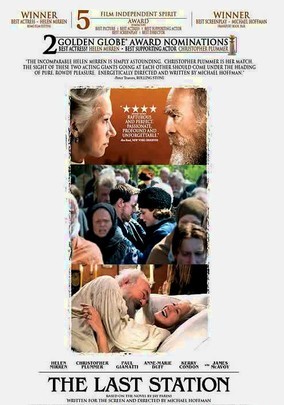
The Last Station-2009

The Last Station-2009

Director Michael Hoffman

Starring Christopher Plummer, Helen Mirren

Scott’s Review #569

Reviewed December 28, 2016

Grade: A-

The Last Station (2009) is a wonderful film.

It contains many worthwhile elements- history, culture, good drama, and great acting. Starring seasoned veterans such as Christopher Plummer and Helen Mirren, the fantastic acting is as good as it gets.

The film tells the story of the final year in the life of famous Russian author Tolstoy and the relationship he has with his family- specifically his wife, Sofya, and his disciples.

The year is 1910 and Tolstoy is ailing. He has had a stormy yet passionate relationship with his wife for decades, which is explored in the film.

The film’s main point is greed and in-fighting for control of a great literary figure’s legacy and money.

The main strong point of The Last Station is the relationship between Tolstoy and Sofya- both characters are headstrong and opinionated, but also madly in love, which leads to many sessions of battle.

This is a film of substance.

Director Michael Hoffman also mixes some humor with the heavy drama.

In conclusion, you might need to use some hankies.

Oscar Nominations: Best Actress-Helen Mirren, Best Supporting Actor-Christopher Plummer

Independent Spirit Award Nominations: Best Feature, Best Director-Michael Hoffman, Best Female Lead-Helen Mirren, Best Supporting Male-Christopher Plummer, Best Screenplay