Category Archives: Don Gordon

The Towering Inferno-1974

The Towering Inferno-1974

Director John Guillermin

Starring Paul Newman, Steve McQueen, Faye Dunaway

Top 250 Films #41

Scott’s Review #194

1059232

Reviewed November 15, 2014

Grade: A

The Towering Inferno (1974) epitomizes the disaster film craze heaped on audiences throughout the 1970s (Airport, Airport ‘75 and ‘77, The Poseidon Adventure (1972), and Earthquake (1974) to name a few).

I am (guilt-free) a huge fan of this 1970s movie genre, though some certainly look down on it, I am not one of them and feel The Towering Inferno is one of the greatest.

The film is enormous and has such a sense of adventure and danger.

The grand film tells of the trials and tribulations of an enormous cast of characters trapped inside an inferno-flamed skyscraper – led by Paul Newman and Steve McQueen (fun fact- the two actors reportedly despised each other).

An incredible skyscraper is erected in San Francisco, at one hundred and thirty-eight floors it is professed to be the tallest building in the world and incredibly state-of-the-art. At the ribbon-cutting ceremony, an elaborate party is held atop the building overlooking the gorgeous Pacific Ocean.

Due to faulty electrical wiring, the building catches fire and the cast of characters faces one challenge after another to escape the grips of death.

The stellar cast features stars like William Holden, Faye Dunaway, Fred Astaire, Robert Wagner, Jennifer Jones, and O.J. Simpson in addition to Newman and McQueen.

The film is quite a soap opera style- numerous characters are introduced, many having affairs with each other or suffering some sort of conflict.

Wagner having a torrid office romance with his secretary played by then up-and-coming star Susan Flannery is deliciously sexy and I yearned to know more about both characters.

Holden’s son-in-law is responsible for the faulty electrical system yet blames his father-in-law for cutting budgets.

Another subplot involves Astaire’s character attempting to swindle Jones’s character but then falling in love with her. The plots are so melodramatic that, given the period of the film, it has a definite primetime television soap opera style to it- think Dallas or Dynasty in a state of peril.

I enjoyed the enormous cast and trying to guess who will be killed off next and in what elaborate way the film will burn them to death is a joy to watch- several victims fall or jump to their deaths, which eerily (and sadly) bring back morbid images of jumpers from the World Trade towers on 9/11.

The beginning of the film shows a dedication to firemen everywhere and the film has a definite moral and heroical quality to the firemen sent to rescue the people in the building. They are portrayed as heroes and intended not to be forgotten amid all the drama encompassing the story. This is admirable.

The special effects are elaborate and quite impressive- the glass elevator rescue scene is amazing! The beautiful set designs are a treat to watch as each lobby, apartment, or lounge in the skyscraper is exquisitely designed at the height of the 1970s style.

Every sofa or carpet featured is plush, colorful, and sophisticated. The skyscraper, made of glass, is an amazing element of the film, and the aerial views of the building, especially while ablaze are impressive, to say the least- remember- 1974 was long before CGI. I am assuming small replicas of the building were used, but what an achievement from a visual perspective.

The effects certainly champion the syrupy story elements.

My only small gripe with The Towering Inferno is, assumed to be 138 stories high, the action taking place at the top of the tower- the rooftop as well as the party scenes on the top floor- do not feel that high- The scenic outlook overlooking the water and some land feel about twenty-five stories high, not one hundred and thirty-eight.

Some find The Towering Inferno (1974) to be nothing more than schmaltzy drama- I say schmaltz was never done better.

Enjoy this feast of a big film.

Oscar Nominations: 3 wins-Best Picture, Best Supporting Actor-Fred Astaire, Best Original Dramatic Score, Best Song-“We May Never Love Like This Again” (won), Best Sound, Best Art Direction, Best Cinematography (won), Best Film Editing (won)
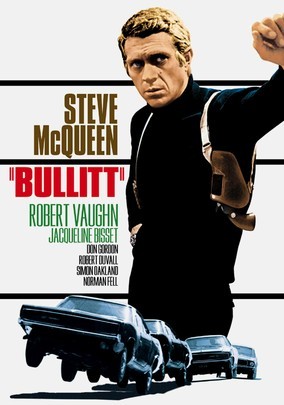
Bullitt-1968

Bullitt-1968

Director Peter Yates

Starring Steve McQueen, Robert Vaughn, Jacqueline Bisset

Scott’s Review #660

Reviewed July 7, 2017

Grade: B+

Bullitt (1968) is one of the ultimate “guy movies”, hardly a stretch considering it stars the “regular guy” hero of the time, Steve McQueen.

With his macho, tough-guy persona and his cool, confident swagger, he was a marquee hero during the late 1960s and into the 1970s.

While the film is rife with machismo stereotypes and is not precisely a women ‘s-lib film, it is also a good old-fashioned action thriller with plenty of chase and fight scenes to make most guys (and some girls) happy.

The story is not particularly thought-provoking, but the film works as escapist fare and is an example of good late-1960s cinema.

Set in San Francisco, Lieutenant Frank Bullitt (Steve McQueen) is assigned to watch a Chicago gangster, Johnny Ross, over a long weekend, before the criminal is set to testify against his brother on Monday morning.

Robert Vaughn plays ambitious politician, Walter Chalmers, who is determined to see the case go off without a hitch and see convictions in the organized crime syndicate.

Predictably, the weekend does not go as planned, and hitmen attack Ross. This, in turn,  sets off a cat-and-mouse game of deception and intrigue. As expected, the action is virtually non-stop with many action sequences lighting up the screen.

The plot of Bullitt does not matter, and one does not need to completely understand what is going on to enjoy the film for what it is. The intent of a movie like Bullitt is not good storytelling, but rather good action.

This is not meant as a put-down, but rather good, honest critiquing. One can sit back, relax, and enjoy the testosterone-laden affair.

Bullitt contains some riveting scenes that raise it above an average, middling action flick. The muscle car chase involving a then-state-of-the-art, flashy Ford Mustang and a Dodge Charger is fantastic and one of the film’s high points.

The quick, edgy camera angles as the cars zip down the windy, narrow San Francisco roads build compelling tension.

Will one of the cars careen off the side of the road or blow up? Since one of the cars holds Frank Bullitt and the other car is the bad guy, it is not tough to guess how the sequence will end.

But it’s good fun all the same, and well filmed.

The other spectacular sequence is the finale: as Frank and company overtake a busy San Francisco airport in pursuit of a baddie about to board a transcontinental flight, the chase leads them throughout the airport, onto a taxiing plane, and finally onto the runway as a plane is about to take off.

It is action at its finest and a treat for the viewer, bringing us back to airport days, pre-9/11, when airports were just different—the luxurious flight crew, the innocence, and the glamour- all a distant memory.

The scene is such that it shows all of the airport elements- the people, the employees, the airport, and the planes, giving it a slice-of-life feel, circa late 1960s airport days.

Appealing is the period in which the film is made. 1968 was an excellent year for cinema; Bullitt capitalized on the newly liberal use of blood in films, making it an influential action film.

Dozens of imitators (some admittedly with superior writing) followed, including classics Dirty Harry and The French Connection (both 1971). These contain the exact basic blueprint that Bullitt has.

A negative of Bullitt is the trite way women are portrayed. Female characters are written as dutiful nurses, gasping in fear and helplessly running away when an assailant runs rampant in the hospital, praying for a man to save the day.

Or, they are written, in the case of Bullitt’s girlfriend, as a gorgeous yet insignificant character, given a laughable scene in which she questions whether or not she knows Frank after witnessing the violence in his job- hello?

He is in the San Francisco Police Department after all.

Bullitt is a meat-and-potatoes kind of filmmaking. An early entry into what would become the raw 1970s and the slick formulaic 1980s action genre, the film deserves credit for being at the front of the pack in style and influence.

The story and character development are secondary to other aspects of the film, and Bullitt (1968) is just OK as escapism fare.

Oscar Nominations: 1 win-Best Sound, Best Film Editing (won)