Tag Archives: Stefania Sandrelli

The Conformist-1970

The Conformist-1970

Director Bernardo Bertolucci

Starring Jean-Louis Trintignant, Stefania Sandrelli, Dominique Sanda

Top 250 Films #34

Scott’s Review #212

70054715

Reviewed January 10, 2015

Grade: A

The Conformist, directed by Italian director Bernardo Bertolucci and based on the 1950s novel by Alberto Moravia, is a complex film that tells the story of one man’s complicated life during the Italian Fascist era (1922-1943).

Due to a traumatic childhood event, he is troubled and strives to “conform” to a “normal”, traditional lifestyle despite his underlying wounds and desires, which he struggles to repress.

The character in question is Marcello Clerici, played by Jean-Louis Trintignant, who works for the secret police in support of the Fascist government.

Marcello yearns for a quiet life that everyone else seems to have. He is set up with a beautiful new wife and is ordered to assassinate his college professor, who is a leader of an anti-Fascist party.

Throughout the story, Marcello is tormented by his troubled childhood in flashbacks, and the film delivers a marvelous, creative use of camera angles, style, and design.

It is a dreamlike film that makes full use of the protagonist’s childhood memories.

The film is a character study in the highest regard, yet it is also beautiful to look at, making it very multifaceted. Marcello is troubled, as evidenced by his backstory. In many ways, he is weak, refusing to accept who he is or admit his deepest desires.

Mixed in with the complexity of his character is a unique character named Anna (Dominique Sanda), the college professor’s gorgeous blonde wife, who appears to be bisexual, enticing both Marcello and his wife, Giulia, played by Stefania Sandrelli.

Marcello, in particular, becomes transfixed and obsessed with Anna.

A truly heartbreaking moment arrives later in the film and is my favorite scene in The Conformist. As the assassination attempt is made on a lonely and secluded, yet picturesque country road, the result is murder, betrayal, and surprise.

When one character nonverbally speaks to another, mainly through facial expressions, and emotionally and pathetically pleads for their life through a car window, it is as tragic as it is poetic.

The scene is wrought with drama and sadness.

Additionally, Marcello’s troubled childhood involving a homosexual experience with a chauffeur named Lino resurfaces years later in an unlikely way and leads to the shocking conclusion of the film.

The very last frame of the film leaves the viewer pondering what is to become of Marcello next.

Marcello’s mother and father add mysterious layers to the film. His father is securely an inmate in a mental hospital, while his mother is a boozy older woman who sleeps until noon.

While these characters are not explored as thoroughly as they might have been, this exploration does lead one to ponder why Marcello is the way he is and whether his parents have any bearing on his persona.

In a particularly fascinating scene, Anna seductively dances with Marcello’s wife at a crowded dancehall; they do the tango, even as, amid her affair with Marcello, she is clearly in love with his wife, making the dynamic confusing yet fascinating to view.

The Conformist heavily influenced storied directors such as Frances Ford Coppola, Martin Scorsese, and Steven Spielberg. A beautiful scene of leaves blowing in the wind almost mirrors a similar scene contained in Coppola’s The Godfather: Part II (1974).

A film as captivating as it is influential, The Conformist is an interesting watch for its style and the mystique that surrounds it.

Oscar Nominations: Best Screenplay Based on Material from Another Medium

1900 (Novecento)-1977

1900 (Novecento)-1977

Director Bernardo Bertolucci

Starring Robert De Niro, Gerard Depardieu

Top 250 Films #201

Scott’s Review #984

Reviewed January 28, 2020

Grade: A

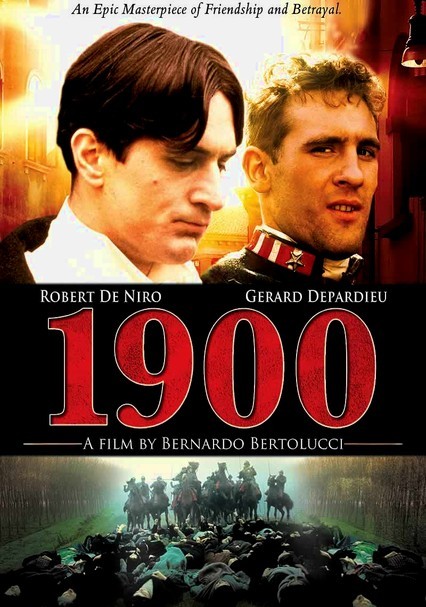
An epic to rival all epics, 1900 (Novecento) (1977) is a grandiose offering of monumental proportions featuring legendary actors and created by a brilliant director.

With a running time of a whopping three-hundred and seventeen minutes in its original version, 1900 is known for being one of the longest commercially released films ever made.

The cinematography is breathtaking, and the historical values, like friendship, class distinction, and rivalry are outlined and explored in depth.

The key is to let the experience marinate and blossom with a slow and patient build.

Brilliant director Bernardo Bertolucci’s tale follows the lives of two Italian men, a peasant named Olmo (Gerard Depardieu) and landowner Alfredo, (Robert De Niro), both ironically born on January 1, 1900.

Inseparable as children, the two become estranged as their differing social status pulls them apart. Their conflicts mirror the political events in Italy, as both fascism and socialism gained prominence in the country.

Here is a bit of background on the film.

Due to its length, the film was presented in two parts when originally released in many countries, including Italy, East, and West Germany, Denmark, Belgium, Norway, Sweden, Colombia, Pakistan, and Japan.

In other countries, such as the United States, a single edited-down version of the film was released.

The latter is not the way to watch this film. I do not like severely edited films, especially in an epic such as 1900, so the full-length version is highly recommended.

The film opens on April 25, 1945, the day Italy is liberated from the fascists, and this is key to the political message Bertolucci crafts. As peasants revolt against the owner of the land, Alfredo (De Niro), and female laborers wield deadly pitchforks, the resulting ambiance is one of chaos.

We know nothing of Alfredo yet but know enough to realize he is rich and perceived as a tyrant. The natural reaction is to sympathize with them because they are oppressed.

As the film backtracks to the turn of the century, a more elegant scene emerges with the birth of two infants, Alfredo and Olmo. The sequence is sweet, both babies are bright and filled with promise.

Sadly, this is not meant to be.

A railway track is an important addition to the film and one that culminates in the climactic finale.

The most interesting aspect of the film is the dynamic development of Alfredo and Olmo as they grow. Alfredo resents his family’s wealth and sides with Olmo, a socialist. Alfredo sees his family as false and Olmo and his family as genuine.

This aspect is timeless and can be related to by any viewer with any intelligent sense of the world today. The obvious analogy of the haves and have-nots cannot be clearer in this film. Frightening, is that some have-nots are convinced they will one day become the haves.

The messages and feelings that 1900 elicited are emotional and strong. Aren’t all men created equal? On the surface they are, but Alfredo and Olmo are not equal. As the birth scene reveals and as Bertolucci makes clear, they are born with advantages and disadvantages.

These characteristics simply are what they are, and as human beings grow and learn social norms the financial differences become more robust and the humanistic connections weaker.

If the social aspects of the film or the brilliant cinematography are not enough to please a viewer, the historical lessons presented are second to none. One can revel in the political and historical excitement that existed in Europe throughout the forty-five years in which the film is set.

I wish Hollywood made more films like this.

1900 (Novecento) (1977) can be enjoyed as both a grandiose dramatic period piece, revered for its majestic and flourishing design style, or as a thought-provoking message film, about the unresolved social class distinctions that exist in the world.

I found the film a treasure that works on all levels and showcases just how good a director Bertolucci is.

This film is not his best-known work, but for fans of cinema as an art form, this is a must-see.