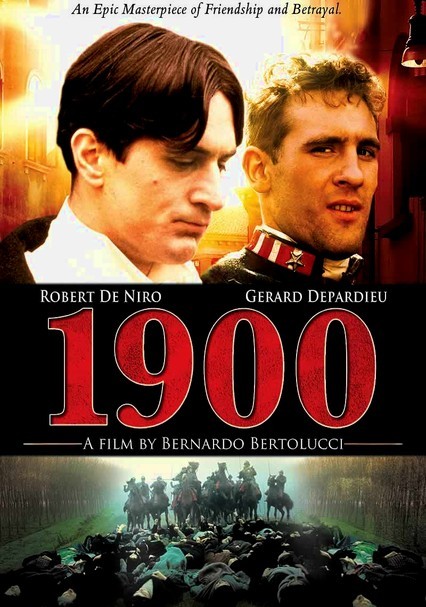
1900 (Novecento)-1977
Director Bernardo Bertolucci
Starring Robert De Niro, Gerard Depardieu, Dominique Sanda
Top 250 Films #201
Scott’s Review #984
Reviewed January 28, 2020
Grade: A
An epic to rival all epics, 1900 (Novecento) (1977) is a grandiose offering of monumental proportions featuring legendary actors and created by a brilliant director.
With a running time of a whopping 317 minutes in its original version, 1900 is known as one of the longest commercially released films ever made.
The cinematography is breathtaking, and the historical themes, such as friendship, class distinctions, and rivalry, are explored in depth.
The key is to let the experience marinate and blossom through a slow, patient build.
Brilliant director Bernardo Bertolucci’s tale follows the lives of two Italian men, a peasant named Olmo (Gerard Depardieu) and landowner Alfredo (Robert De Niro), both ironically born on January 1, 1900.
Inseparable as children, the two become estranged as their differing social statuses pull them apart. Their conflicts mirror the political events in Italy, as both fascism and socialism gained prominence there.
Here is a bit of background on the film.
Due to its length, the film was presented in two parts when originally released in many countries, including Italy, East and West Germany, Denmark, Belgium, Norway, Sweden, Colombia, Pakistan, and Japan.
In other countries, such as the United States, a single edited-down version of the film was released.
The latter is not the way to watch this film. I do not like heavily edited films, especially in an epic like 1900, so the full-length version is highly recommended.
The film opens on April 25, 1945, the day Italy is liberated from the fascists, and this is key to the political message Bertolucci crafts. As peasants revolt against the landowner, Alfredo (De Niro) and female laborers wield deadly pitchforks, creating an atmosphere of chaos.
We know nothing of Alfredo yet, but we know enough to realize he is rich and perceived as a tyrant. The natural reaction is to sympathize with them because they are oppressed.
As the film backtracks to the turn of the century, a more elegant scene emerges: the births of two infants, Alfredo and Olmo. The sequence is sweet, and both babies are bright and filled with promise.
Sadly, this is not meant to be.
A railway track is an important addition to the film, culminating in the finale.
The most interesting aspect of the film is the dynamic development of Alfredo and Olmo as they grow. Alfredo resents his family’s wealth and sides with Olmo, a socialist. Alfredo sees his family as false and Olmo and his family as genuine.
This aspect is timeless and can be related to by any viewer with any intelligent sense of the world today. The obvious analogy between the haves and have-nots is clearer than ever in this film. Frightening is that some have-nots are convinced they will one day become the haves.
The messages and feelings elicited in 1900 are strong and emotional. Aren’t all men created equal? On the surface, they are, but Alfredo and Olmo are not equal. As the birth scene reveals and as Bertolucci makes clear, they are born with advantages and disadvantages.
These characteristics are what they are, and as human beings grow and learn social norms, financial differences become more pronounced and humanistic connections weaker.
If the social aspects of the film or the brilliant cinematography are not enough to please a viewer, the historical lessons presented are second to none. One can revel in the political and historical excitement that characterized Europe throughout the forty-five years the film is set.
I wish Hollywood made more films like this.
1900 (Novecento) (1977) can be enjoyed as both a grandiose, dramatic period piece, revered for its majestic and flourishing design, and as a thought-provoking film about unresolved social class distinctions in the world.
I found the film a treasure that works on all levels and showcases just how good a director Bertolucci is.
This film is not his best-known work, but for fans of cinema as an art form, this is a must-see.