Une chambre en ville-1982
Director Jacques Demy
Starring Dominique Sanda, Richard Berry
Scott’s Review #1,397
Reviewed September 10, 2023
Grade: A
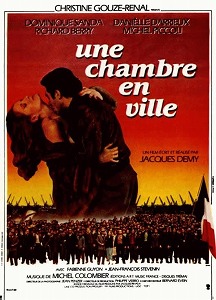
Une chambre en ville (also known as A Room in Town) is a 1982 French musical drama film written and directed by Jacques Demy, with music by Michel Colombier, and starring Dominique Sanda, Danielle Darrieux, and Michel Piccoli.
Those familiar with Demy’s other works, such as The Umbrellas of Cherbourg (1964) and The Young Girls of Rochefort (1967), will be aware that his preferred genre is musical drama. In Une Chambre en Ville, the dialogue is entirely sung.
And those unfamiliar with his work are recommended to give his films a chance. They are flavorful and offer exceptional production design, to say nothing of other ingredients.
I liken the film most to The Umbrellas of Cherbourg because the story involves two people destined to be together, but who are thwarted by many obstacles that threaten to ruin their happiness.
Demy creates a distinct Shakespearean Romeo and Juliet final ending in the best possible way.
The story is set during a workers’ strike in Nantes, France, in 1955. A steelworker named Francois (Richard Berry) has a fling with the married daughter, Edith (Dominique Sanda), of his widowed landlady, Margo (Danielle Darrieux).
His girlfriend Violette (Fabienne Guyon), who works in a shop and lives with her mother, wants to get married, but he is unwilling, partly because they have no money and nowhere to live.
Oh, and he has also met Edith.
On the street, François is accosted by Edith, a beautiful woman who wears only a fur coat and has decided to take up part-time prostitution to pay bills. Her husband owns a struggling television shop.
The two have a blissful night together in a cheap hotel and fall madly in love.
Une Chambre en Ville is at first jarring because the dialogue is in the form of a song. But after merely a few minutes, I became invested and enamored with the characters. This occurs when Francois and Margo discuss the strike, and although she is upper class, she supports the workers.
They quickly bond.
Before this, though, the tone is set with black-and-white cinematography of the workers’ strike that quickly turns to color. My hunch is that Demy wanted to promote the seriousness of the situation and alert the audience that they were not watching a rosy musical with tap-along tunes.
There’s a message of pain, struggle, and depression, which doesn’t make the film a downer either.
As with Demy’s other films, the art direction and set designs are gorgeous. The director has a talent for introducing the most fragrant colors like red, yellow, blue, and green, which are powerful and enshroud the characters in pizazz and vibrancy.
The highlights are Margo’s apartment, drizzling with red color and contemporary patterns and furniture, and Edith’s husband’s television shop. The greenish hue reveals a tacky yet sophisticated French style. These and other sets are superior efforts.
The main attraction is Francois and Edith, and I was smitten with them almost immediately. Some may think this is odd because basically, Francois dumps his nice girlfriend for a sexy prostitute who flashes her naked body to him and then beds him.
Nonetheless, I became enraptured. They make ‘love at first sight’ seem believable and possible. The thing to remember is that they are both wounded by their circumstances and are reaching for their desires out of desperation.
The finale of Une chambre en ville is dazzling but painful to watch. I alluded to a Romeo and Juliet catastrophe, and this is no joke, as the star-crossed lovers meet a dire ending.
I won’t spoil the fun by revealing what happens.
Jacques Demy creates a film made in 1982 that feels nothing like a 1982 film, as we are believably transported to 1955.
Une chambre en ville holds up as well as Demy’s films made two decades earlier, and he proves none of his creativity and romantic dramatics have waned.