Category Archives: John Vernon

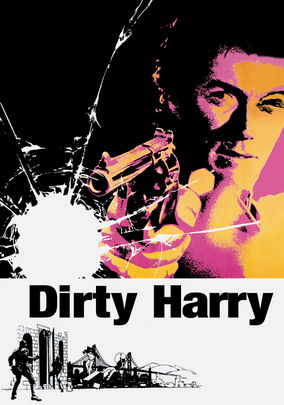
Dirty Harry-1971

Dirty Harry-1971

Director Don Siegel

Starring Clint Eastwood, Harry Guardino

Top 250 Films #42

Scott’s Review #443

445522

Reviewed July 4, 2016

Grade: A

Dirty Harry (1971) is a classic crime drama that became a signature role for Clint Eastwood as the title character, a role he has played four more times.

Dirty Harry set the tone for the plethora of crime thrillers and police action films that filled theaters throughout the 1970s and 1980s. This film still holds up very well and is a masterpiece of the cat-and-mouse/detective genre.

Quiet and controlled, but filled with anger below the surface (we learn a drunk driver killed his wife), Harry Callahan is a tough cop in San Francisco who has seen it all. He is a red-blooded American good guy, though he is brooding and has a mind of his own, oftentimes disagreeing with his superiors and their rules.

He epitomizes good versus evil.

A vicious killer named Scorpio (based on the real-life Zodiac killer) is on the loose, having killed two people already. His motives are unclear, but that is rather unimportant. What is important is that he threatens to kill one person per day unless his demands of $100,000 are met.

Harry is immediately assigned to the case despite his reputation for being difficult and violent. This leads to a cat-and-mouse game between Harry and Scorpio in Harry’s pursuit of the criminal.

Scorpio is played by Andy Robinson, who is a fantastic villain- perhaps one of the most frightening in film history. His dirty blonde locks, yet angelic face, combined with maniacal facial expressions make his portrayal quite frightening.

He is a sniper so he is continually perched on rooftops seeking his next victim. As he watches a couple eating ice cream in the park or a woman swimming in a rooftop pool, we feel a sense of voyeurism and dread.

His disturbing sense of humor and sadistic personality make him quite scary.

The film succeeds in large part because of its grit and violence.  And it is a very masculine film. Harry is a take-no-prisoners kind of guy and he is hell-bent on stopping Scorpio from killing- no matter what.

In a very effective scene, Harry chases Scorpio to a vast football field and uses torture to elicit a confession from Scorpio. It is a bloody and intense scene, but quite necessary to who Harry is.

Of course, this tactic backfires as Scorpio is released from the hospital and set free. This leads to a further feud between the two men.

A bonus of Dirty Harry, and one aspect that gives so much authenticity, is the on-location setting of San Francisco. From the Golden Gate bridge to the illustrious mountains outside of the city and the Pacific Ocean, these elements give a dash of realism to an already gritty film. Chinatown and Dolores Park are also featured.

Highlighting all of this is a sequence where Scorpio forces Harry to go from locale to locale on foot in part of a wicked game to save a victim.

Harry’s famous lines as he points his gun at the perpetrators and mocks them by asking them if five or six bullets in his gun are now legendary as is his “Do I feel lucky? Well, do you, punk?”

On the surface a bit silly and gimmicky, these catchphrases somehow still work.

The school bus finale as Harry and Scorpio once again square off is great. As Scorpio hijacks a bus filled with grammar school students, he tricks the students, unaware of his intentions, by engaging them in children’s song sing-alongs as the harried bus driver drives out of the city.

When one child catches wind of the situation, Scorpio turns nasty, scaring the children into a frenzy.

Dirty Harry (1971) is a classic cop film that I never tire of watching. For the genre, it is as good as it gets and holds up well. After all of these years, it is tough to disassociate Clint Eastwood from the role of “Dirty Harry”.

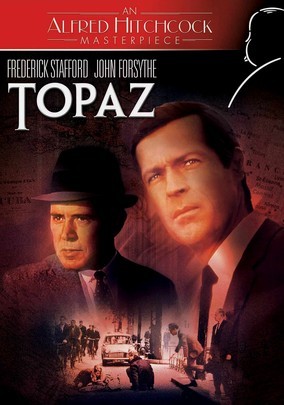
Topaz-1969

Topaz-1969

Director Alfred Hitchcock

Starring Frederick Stafford, Karin Dor

Top 250 Films #163

Scott’s Review #108

60020562

Reviewed July 12, 2014

Grade: A-

Topaz is an intriguing, suspenseful 1969 latter-day Alfred Hitchcock film.

In the political thriller vein, the film typically suffers from being both overlooked and under-appreciated, yet receives admiration from film buffs. It is certainly not one of his better-known films, and that is quite a shame.

As with many great films, it is complex and layered, requiring close attention and even multiple viewings.

The issue with Topaz is that the film suffers from a lack of recognizable stars- a trademark of Hitchcock films in his heyday. Frederick Stafford (Andre) and Karin Dor (Juanita) are the featured romantic couple.

Despite his being married to another woman, Andre and Juanita are the couple the audience is intended to root for.

The story involves competing spies from France, the United States, and Cuba, all vying for government secrets concerning the Cuban Missile Crisis in the 1960s.

Each spy does their best to obtain the secrets, some in a sinister fashion.

The French accents, especially, can be tough to understand, but it is a thrilling film that traverses New York City, Cuba, and France. The main protagonist is Andre, and Stafford has a high level of charisma and a suave manner.

The character is quite similar to James Bond. The film itself plays out like a Bond film, with exotic locales, beautiful women, and political intrigue.

As with most Hitchcock films, the set pieces and art direction are beautiful and perfect. One highlight is a particular character’s death scene in Cuba. Throughout the film, the love story is involved, and the death is tragic yet heartfelt and shocking.

Topaz, sadly, was unsuccessful at the box office due to the lack of Hollywood names attached and limited promotion, although it made several top-ten critics’ lists in 1969.

Topaz is undoubtedly one of the more obscure of Hitchcock’s films, but an excellent one to discover and revere.

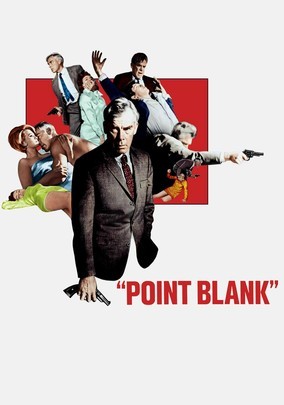
Point Blank-1967

Point Blank-1967

Director John Boorman

Starring Lee Marvin, Angie Dickinson

Scott’s Review #263

70033963

Reviewed August 8, 2015

Grade: B+

Directed by John Boorman, (later made famous for the masterpiece Deliverance in 1972), and based on the novel The Hunter, by Donald E. Westlake, Point Blank (1967) is a tense crime drama starring Lee Marvin as a man seeking revenge on those who have wronged him.

A criminal himself and involved in the mob world of deals and drugs, he is double-crossed by his partner, who takes off with his wife.

A relatively obscure film, Point Blank features obvious influences from the classics it preceded (The Getaway, 1972; Chinatown, 1974; The French Connection, 1971; and Dirty Harry, 1971) and contains some dynamic camera work and art direction.

In its day, it must have been quite a groundbreaking film.

The film begins muddled a confusing, catching the viewer off guard. We know nothing about any of the characters, who are suddenly introduced via flashbacks, interlaced with present and future scenes, so that chaos and tension fill the story immediately.

We know that someone has stabbed someone in the back, but we do not understand why or who the players are.

The film is set partly on deserted Alcatraz Island (the meeting point for a money drop, which we later learn), then moves to Los Angeles. Early on, we realize that Marvin’s character (Walker) has been tricked, shot, and left for dead by his partner Mal (John Vernon), who takes off with Walker’s share of cash…and his troubled wife Lynne.

Hell-bent on seeking revenge (and his money) on Mal and his wife (Lynne), he attempts to track the duo down using any means necessary, leading to the introduction of pivotal and mysterious characters such as Lynne’s sister Chris (played by Angie Dickinson), and Crime Organization leaders Carter and Brewster (played by Lloyd Bochner and Carroll O’Connor, respectively).

With little blood or overt violence, the film instead uses tense action scenes and a great style, and is told in a non-linear way.

One favorite scene involves Walker taking a new car for a test drive and interrogating the salesman for information. As he terrorizes the salesman, he repeatedly slams the vehicle into a pole using the car’s reverse and drive gears, increasing in intensity with each attempt by the salesman to avoid answering Walker’s questions.

Two other scenes that stand out and deserve mention are as follows: when a naked villain is nonchalantly tossed from a penthouse apartment to his death on the street, and subsequently becomes wedged under a passing car, the scene is as startling as it is well shot, especially considering the year was 1967.

In another scene, Lynne is at the beauty salon having her makeup and hair done by a stylist. Her face is captured in the mirror, and the camera shows a dozen or so images of the mirror layered on top of one another.

This looks great, inventive, and is a good example of some superlative camera shots that occur throughout the film.

A few interesting tidbits that I pondered following the film. Was the elevator scene containing Angie Dickinson (almost meaningless to Point Blank) the inspiration for the famous elevator scene from the 1980s Dressed to Kill?

Only Dressed to Kill’s director, Brian De Palma, would know the answer to that question.

How interesting to see Carroll O’Connor (later universally famous for portraying TV’s “Archie Bunker”) as a crime lord. Even though Point Blank was made before All in the Family premiered, it was tough to find him believable in this role.

Finally, I loved the scenes set high atop Los Angeles, in a gorgeous high-rise apartment- the sophisticated living room furniture arrangement and colors are great visual treats.

Taut, intense, and engaging, though admittedly a plot not always made crystal clear nor easy to follow, the film came along at a time when edgier, more experimental films were beginning to be released, which makes Point Blank (1967) a groundbreaking and influential film that undoubtedly helped bring about other crime dramas to follow.