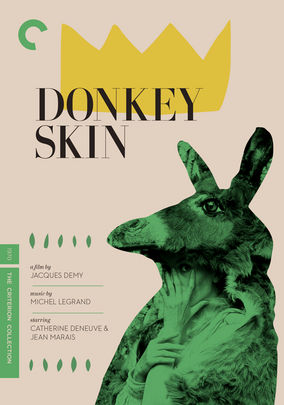
Peau d’Ane (Donkey Skin)-1970
Director Jacques Demy
Starring Catherine Deneuve, Jacques Perrin
Scott’s Review #227
Reviewed March 11, 2015
Grade: B
Peau d’Ane (English: Donkey Skin) is a 1970 French musical film that is a fairy tale for adults- seemingly happy, but very dark beneath the surface.
To say this film is bizarre would be an understatement. The film is a strange retelling of the classic Cinderella story.
The film is set in a peculiar medieval world and centers on a dying Queen (Catherine Deneuve), her husband, the King (Jean Marais), and the heroine, the beautiful Princess (also Catherine Deneuve).
The Queen is dying. Her last wish is for the King to marry the most beautiful woman in the land. Coincidentally, that is their daughter, The Princess! Eager to produce an heir to the throne, he is determined to marry and reproduce with his daughter.
The Princess, wanting none of it, turns herself into an ugly creature by wearing the skin of a donkey and moves to a neighboring kingdom to exist in a life of exclusion and revulsion, farming pigs and being berated by those around her.
A handsome Prince decides to pursue the woman who has baked him a delicious cake, but knows not who she is. Ironically enough, it is the Princess.
I found the film to be quite interesting, albeit in a warped way. Unusual and challenging to analyze, one must watch with an open mind.
Certainly, Donkey Skin delves headfirst into the icky world of incest. It makes no apologies for its controversial nature, all the while interspersing the film with cheery tunes, singing roses, and hatching chicks.
The donkey skin that the Princess wears is fake and unbelievably laughable, and how nobody is aware that there is a beautiful Princess underneath is silly.
And yet the film somehow works. I was transported into a magical world where nothing is normal, and one surprise after another ensues.
A couple of oddities worth mentioning: some of the film’s music a contemporary and upbeat. Also, strangely, the final scene involves a helicopter, which is completely implausible given the period.
I get the sense that this film is going for absurd and unique and succeeds on both counts.
Visually, the film is gorgeous- bright and cheerful with loads of colors. The film has awe-inspiring art direction, with the castle’s set pieces odd, engaging, and colorful. I especially enjoyed the Prince’s bedroom set.
As eccentric and seemingly dark as the film is, often a character will burst into a cheerful song, as evidenced by the Princess singing a happy tune while making a meal, all the while dressed in her donkey skin, almost like a scene out of Mary Poppins (1964) or My Fair Lady (1964) or any other wholesome musical.
To be sure, a unique film, Donkey Skin (1970) is eccentric, lively, and interestingly perverse with a French flair—fantasy for adults and a journey into the weird.