Category Archives: Maud Adams

The Boys in the Band-1970

The Boys in the Band-1970

Director William Friedkin

Starring Kenneth Nelson, Leonard Frey

Top 250 Films #40

Scott’s Review #658

Reviewed July 4, 2017

Grade: A

An excellent counterpart to the equally brilliant and equally unpleasant Who’s Afraid of Virginia Woolf? (1966) The Boys in the Band is also a stage production made into a feature film.

As such, shot very much like a play and seemingly in one long take, the film is highly effective and delicious in wit and dark humor. With a macabre and bitter element, the characters snipe and ridicule each other during a birthday party.

The Boys in the Band is a groundbreaking film on many levels, as it is one of the first LGBTQ+ films to feature gay characters in prominent roles. Furthermore, it has the dubious honor of being the first film to use the word “cunt”.

Regardless, the film is fantastic and a must-see for anyone intrigued by LGBTQ+ film history. All of the actors appeared in the stage production and reprised their roles for the film version.

The setting is the Upper East Side of Manhattan in the late 1960s.

Michael, a writer, is hosting a birthday party for his good friend, Harold. When Michael receives an urgent call from his straight and married college chum, Alan, he begrudgingly invites him over at the risk of having his lifestyle exposed.

One by one, the guests arrive for the party. Emory is quite effeminate and loud, Hank and Larry are masculine and a couple, but with monogamy issues and Hank’s marriage as obstacles.

Bernard, a black bookstore clerk, is a friendly, amiable guy.

“Cowboy”, a dim-witted hustler, and Harold, the sarcastic, bitter, guest of honor, round out the attendees.

As the night wears on, the party turns into a free form of insults, bad feelings, and vicious conversation. Alan and Emory get into a fistfight, and later a hurtful telephone game forces everyone to call the one person they truly love, which results in anxiety and sadness for most of the guests.

The key aspect of The Boys in the Band is that it is shot like a play, with a highly effective results. In this way, especially midway through the film, when the guests are all in the same closed room, the action becomes suffocating and stifling as a few of the guests bare their fangs.

Director Friedkin uses many close-ups of his characters to portray their raw emotions further.

My favorite characters are Alan and Hank, as these characters are the most complex.

Both are married, and both hit it off famously, although Alan’s sexuality is never completely revealed. He is married but troubled, and the audience never learns why, although we could wager a guess that he is, indeed, conflicted by his sexuality.

What will become of him? Will he accept his sexuality or live a repressed existence?

Hank, during a divorce from his wife, lives with Larry as a couple. Hank is complex because he is transitioning from a straight life to a gay lifestyle, and that must have been very difficult in the late 1960s- for this reason, I find the character of Hank quite brave.

The film does not explore this angle as much as it could have, but a character like Hank adds depth to the cast in a positive way. Alan and Hank are multi-dimensional characters, whereas some of the others contain gay stereotypes.

I would have enjoyed a deeper dive into the personal lives of some of the characters. Still, the film is really about the emotions many of the characters possess and feelings of love, some unrequited, and there are too many characters for each to receive their due focus.

Plus, the film’s primary focus is the characters’ back-and-forth banter.
The Man with the Golden Gun-1974

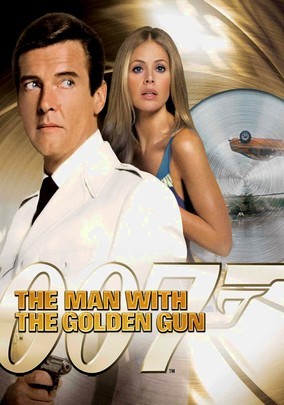
The Man with the Golden Gun-1974

Director Guy Hamilton

Starring Roger Moore, Christopher Lee, Britt Ekland

Top 250 Films #142

Scott’s Review #346

28370063

Reviewed January 9, 2016

Grade: A

Though not typically regarded as one of the more appealing of James Bond films, and the second chapter to feature Roger Moore, Sean Connery’s replacement, The Man with the Golden Gun (1974) is one of my favorites, firmly placed in my top 5 of 007 offerings.

This could be the result of the film being one of my first introductions to the world of 007 when I was a child.

Moore seems more comfortable in the role than he did in the uneven Live and Let Die, released in 1973.

Qualities that make The Man with the Golden Gun a success include the wonderful casting of Christopher Lee, a famed horror film icon, in the central role of Francisco Scaramanga, the title character and nemesis of Bond.

Who cannot think of Count Dracula while watching Lee act- his dark, swarthy looks, angular face, and his deep baritone voice make for a perfect villain.

Known in large part for participation in Hammer Horror films opposite another legend, Peter Cushing, this is casting at its finest and a true high point of the film.

To summarize the story, MI6 receives a golden bullet with “007” sketched on the side, a clear threat to James Bond’s life. It is assumed to have been sent by the famed assassin, Scaramanga, whose trademark is a deadly golden gun.

Bond is ordered to remove himself from his current mission. Still, he pays no mind and sets out to find Scaramanga on his own, leading him into a mystery involving a stolen solar energy weapon feared to destroy the world.

The adventure takes Bond to a bevy of gorgeous locales, including Hong Kong, Thailand, Macau, and the South China Sea, where our villain resides on a private island accessible only by helicopter.

I found the main locale of the sunny deserted island and Scaramanga’s dwarf sidekick, Nick Nack, to be great aspects of the film. Majestic caves, sandy beaches, and a gorgeous array of water set the tone with gorgeous fantasy elements.

Servant Nick Nack is sinister, but with a sweet smile, one almost trusts him as he serves lunch or expensive champagne to guests sure to be killed afterward.

The secret maze of mirrors that Bond finds himself in is made all the more perfect by Nick Nack’s taunting and cackling. And the flying car that Scaramanga and Nick Nack drive in, though gimmicky, is a real hoot.

A demerit to The Man with the Golden Gun that I have always been able to look past, since other factors usurp her importance, is the miscasting of Britt Eklund as Bond’s assistant, Mary Goodnight.

The writer’s pen is good, but Goodnight is simpering, silly, and a big goof. An attempt at comic relief falls flat as the character epitomizes a blonde bubblehead- constantly screwing up everything.

Scaramanga’s girlfriend and co-Bond girl, Andrea Anders, played by Maud Adams, is much better, though we do not get to know the character very well before she is offed.

Fortunately, Adams would return to star in Octopussy in 1983.

Perhaps middling at times and suffering from some negative characteristics, The Man with the Golden Gun (1974) is a love of mine, a trip down memory lane to a time as a child when I was first discovering my love and zest for James Bond films.

This offering cemented my love of Roger Moore in the central role, and I still adore watching this film.

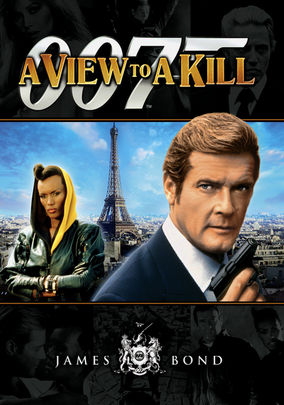
A View to a Kill-1985

A View to a Kill-1985

Director John Glen

Starring Roger Moore, Grace Jones, Tanya Roberts

Top 250 Films #151

Scott’s Review #484

60002473

Reviewed September 21, 2016

Grade: A

Not exactly deemed a masterpiece or even a treasured favorite among the masses of James Bond lovers, A View to a Kill (1985) holds a soft spot for me.

It is one of the first Bond films that I was fortunate enough to see in the movie theater, and it has continued to enchant me all these decades later.

Yes, it has flaws (to be mentioned later), but it is a classic, fun, exciting, mid-1980s Bond offering.

It contains Roger Moore- in his final Bond appearance, the exotic Grace Jones, a great villain, and on-location treats such as Paris and Iceland- who could ask for anything more?

We are reintroduced to MI-6 agent James Bond on the snowy slopes of Siberia as he discovers the body of 003, along with a Soviet microchip believed to belong to the wealthy Max Zorin (Christopher Walken).

Bond attends a horse sale hosted by Zorin and discovers he is drugging the horses to make them perform better.

It is also revealed that he intends to destroy Silicon Valley to rule the microchip industry. In Zorin’s camp is a mysterious woman named May Day and an odd Nazi scientist named Dr. Carl Mortner.

Events conclude in San Francisco as the action-packed finale takes place in a mine overlooking (via blimp) the historic Golden Gate Bridge.

I completely get the criticisms hurled at this film- both Roger Moore and, as a secondary character, Lois Maxwell as Miss Moneypenny, had gotten quite long in the tooth by this point in the franchise (1985), which is a shame because both are favorites of mine.

Most glaring in the “bad” department is Tanya Roberts as the main Bond girl, Stacy Sutten, almost rivaling Halle Berry (Die Another Day) as screamingly awful.

Not appearing as a major character until quite late in the film, Stacey is a wealthy heir to whom Zorin attempts to pay $5 million to relinquish her shares in Silicon Valley (she refuses).

Robert’s acting is quite poor- she has no chemistry with Moore, and comes across as a dimwit, despite being written as a doctor or scientist of some sort. Regardless, she does not work as a Bond girl.

Yes, the cartoon-like chase around San Francisco with the brooding police chief is unintentionally funny- another negative to the film.

But here are some strengths- Fantastic is Walken as the main villain role of Zorin. Psychotic, Looney Tunes, and such a pleasure to watch. With his bleached blonde hair and grimacing sneer, a particularly controversial, and favorite scene of mine is when Zorin, machine gun in hand, sprays bullets from left to right, undoubtedly killing dozens, as he gleefully laughs.

This was unprecedented in Bond films up to this point, as most villains contained a safer personality- Zorin is positively monstrous and to be feared.

Also worth mentioning is Jones as May Day, simply mesmerizing in the role- although sadly her character is weakened toward the end, did she believe Zorin was capable of love??

Countering the anemic chemistry between Bond and Roberts, the chemistry between Jones and Moore sizzles.

This is not the first time Bond has explored an interracial (white and black) romance- far from it. Live and Let Die- circa 1973 takes this honor. I would have enjoyed much more emotional exploration between Bond and May Day, rather than the animalistic physical attraction.

One may wonder, with all the recognizable flaws in the film, why the A rating? Because, simply put, this film is fun and contains all the elements a Bond film ought to. The action is plentiful- who can forget the nail-biting Eiffel Tower chase or the Paris car chase- sans car roof?

Not high art, but a grand favorite of mine, A View to a Kill (1985) is entertainment personified.

The pop title-theme song, performed by Duran Duran, which became a #1 hit in the summer of 1985, is a wonderful aspect of the film and immediately takes me back to a different time.

I suppose the film does as well, and that is a great part of my fondness for it.

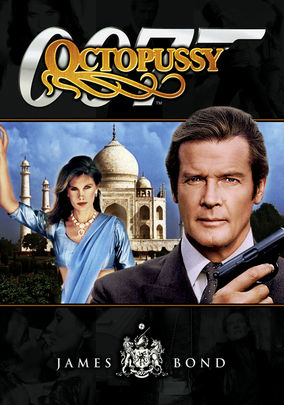
Octopussy-1983

Octopussy-1983

Director John Glen

Starring Roger Moore, Maud Adams

Scott’s Review #716

Reviewed January 17, 2018

Grade: A-

Hardly regarded as one of the most stellar of entries in the James Bond franchise, 1983’s Octopussy is nonetheless a guilty pleasure of mine.

This is undoubtedly because the film was the first installment I was allowed to see in the movie theater, and it is filled with exciting memories.

As the film stands in the current days, it is perfectly fine, containing all of the enjoyable elements necessary for a good Bond film- interesting villains, solid action, and gorgeous women.

Perhaps at times a bit silly, Octopussy is still quite the fantastic watch.

Roger Moore, admittedly looking slightly aged and sagging, returns to the fold as 007, the shaken, but not stirred action hero known as James Bond. However, he is, true to form, as witty and suave as he always is with witty one-liners and a mischievous smirk.

Moore ritualistically infuses the character with a measure of comedy- a wink of the eye or a raised eyebrow adds humor to the character so that any other actor who has portrayed Bond.

In this installment, Faberge eggs, clowns, and gorilla suits are featured.

Attempting to escape from East Berlin to West Berlin, 009- dressed as a circus clown- is murdered on the estate of a British Ambassador while attempting to deliver a fake Faberge egg.

Assuming the Soviets are involved, MI6 instructs Bond to investigate the matter, and a complex smuggling ring is uncovered- featuring a gorgeous female smuggler named Octopussy (Maud Adams), along with sinister Afghan exiled prince Kamal Kahn (Louis Jourdan), and his bodyguard, Gobinda.

Watching the film in 2018, even though it was made in 1983, Octopussy does not suffer from the dreaded “1980s look” that so many other films do; it seems surprisingly clean and fresh.

The colors are vibrant- especially in the prevalent circus and clown scenes, and the best two scenes- the airplane and train scenes- still bristle and crackle with good action.

As the climax to Octopussy culminates, the inevitable heroine and main Bond girl- Adams’s “Octopussy”- has been bound and gagged and taken hostage by the baddies in a fleeing airplane, Bond grabs hold of the fuselage, and begins a harried flight over the mountains of remote India, clinging for dear life.

The scene climaxes with an exciting fight scene atop the rooftop of the speeding plane as Bond and Gobinda fight to the death, as Kamal unsuccessfully attempts to twist and turn the plane and rid themselves of pesky Bond.

The scene is still compelling and loses none of its appeal over the years, never appearing dated.

The train sequence is still relevant but does suffer from a small dose of silliness.

The action is plentiful as Bond races against time to prevent a Russian missile from detonating and killing thousands of American citizens, and worthy of note is the timely Cold War subject matter of the Russians versus the Americans, plentiful in American cinema during this time.

As Bond dons a phony-looking gorilla outfit- embarrassing even for the comical Roger Moore- he can successfully take off the costume and sneak out of a train car, all before the three seconds that it takes for Gobinda to turn around and slice the head off of the gorilla, thinking it is Bond.

Suspension of disbelief is required.

Impressive is the female empowerment slant evident. From the strong businesswoman character that Adams portrays- she is decisive, intelligent, and savvy, she is neither cowering nor impressionable, and cannot be bullied or pushed around.

Albeit her name, “Octopussy”, does teeter on male chauvinism. Be that as it may, her gang of feminist followers, all wielding assault rifles, are quite inspiring and, at this point, unusual for a Bond film- typically masculine leaning.

Octopussy (1983) is an overlooked, under-appreciated, too easily dismissed slice of goodness served up with a bit of comedy, plenty of action, and good, solid villains- everything that makes a Bond film a Bond film.

The film is worthy of a viewing.