The Sandpiper-1965
Director Vincente Minnelli
Starring Richard Burton, Elizabeth Taylor
Scott’s Review #897
Reviewed May 12, 2019
Grade: B+
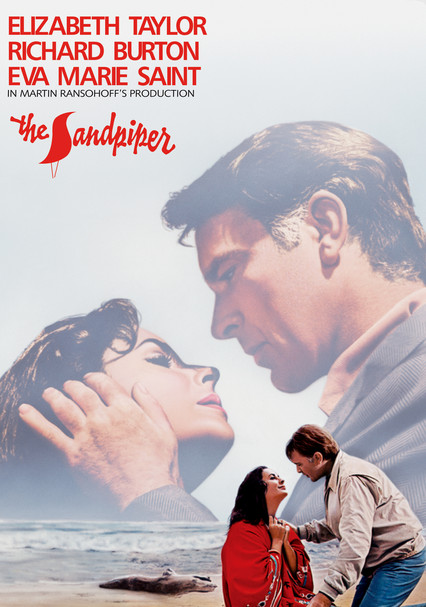
The Sandpiper (1965) is a film that stars Elizabeth Taylor and Richard Burton and was released at the height of their fame.
It capitalized on their notoriety as one of the world’s most famous couples and their well-known romantic tribulations. Although they portrayed adulterous lovers, they were married shortly before filming began.
The film’s theme of adultery closely mirrored their own lives at the time, as each very publicly conducted an affair with the other while married to spouses.
The film is a lavish and sweeping production. It is one of the few major studio pictures ever filmed in Big Sur, and the story is expressly set there.
Big Sur is a rugged, mountainous section of California’s Central Coast where the Santa Lucia Mountains rise abruptly from the Pacific Ocean.
It is often praised for its dramatic scenery and is the perfect location for a romantic film.
The Sandpiper (1965) is a romantic drama featuring the two stars’ chemistry. It is a pure case of art mimicking real life, at least in some way.
Watching the actors work off one another is fascinating and wonderful. It makes me wonder what life would have been like on set, amid the dreamlike, steamy locale and the fresh romance.
The story isn’t dynamic but quite theatrical, with the actors as the main reason to watch.
Taylor plays Laura Reynolds, a bohemian, free-spirited single mother who lives in Big Sur, California, with her young son, Danny. Laura makes a living as an artist while homeschooling her son, who has gotten into trouble with the law.
When Danny is sent to an Episcopal boarding school, Laura meets the headmaster, Dr. Edward Hewitt (Burton). The duo falls madly in love, even as Edward marries teacher Claire (Eva Marie Saint).
The melodrama only escalates as those close to the pair catch on to their infidelity.
The gorgeous locale of Big Sur is second to none and exudes romance and sexual tension, with crashing waves against the mountainous terrain symbolizing a passionate love affair.
As the characters give in to each other, the lavish weather only heightens the titillating experience.
Taylor is lovely to look at throughout the film, and the erotic nude chest of the character plays a significant role. I wondered if the inclusion had the desired effect or resulted in unintended humor, as the endowed sculpture is quite busty.
The film belongs to Taylor and Burton, but the supporting cast deserves mention for creating robust characters that add flavor.
Eva Marie Saint plays the amiable wife, distraught by her husband’s infidelity but later coming to an understanding. Charles Bronson plays Cos Erickson, Laura’s protective friend, who despises Edward’s hypocrisy.
Finally, Robert Webber is effective as Ward Hendricks, a former beau of Laura’s, eager for another chance with the violet-eyed bombshell.
The film’s title represents a sandpiper with a broken wing that Laura nurses as Edward looks on. The bird lives in her home until it heals and flies free, though it returns occasionally.
This sandpiper is a central symbol in the movie, illustrating the themes of growth and freedom. Its sweetness suits the love story between Laura and Edward.
The Sandpiper is an entertaining film but not a great one. It suffers from mediocre writing and clichéd storytelling, but it serves as a vehicle for Taylor and Burton.
The fascination is watching the actors, not for a great cinematic experience; the film is not very well remembered except by fans of the supercouple.
The film was made one year before the dreary yet brilliant Who’s Afraid of Virginia Woolf? (1966) starring the same husband-and-wife duo as does The Sandpiper (1965).
Laura and Edward are worlds apart from George and Martha, and when watched in close sequence, one can marvel at the acting chops of each star.
The film won the Academy Award for Best Original Song for the sentimental “The Shadow of Your Smile.”
Oscar Nominations: 1 win-Best Song-“The Shadow of Your Smile” (won)
Golden Globe Nominations: Best Original Score-Motion Picture, Best Original Song-Motion Picture-“The Shadow of Your Smile”